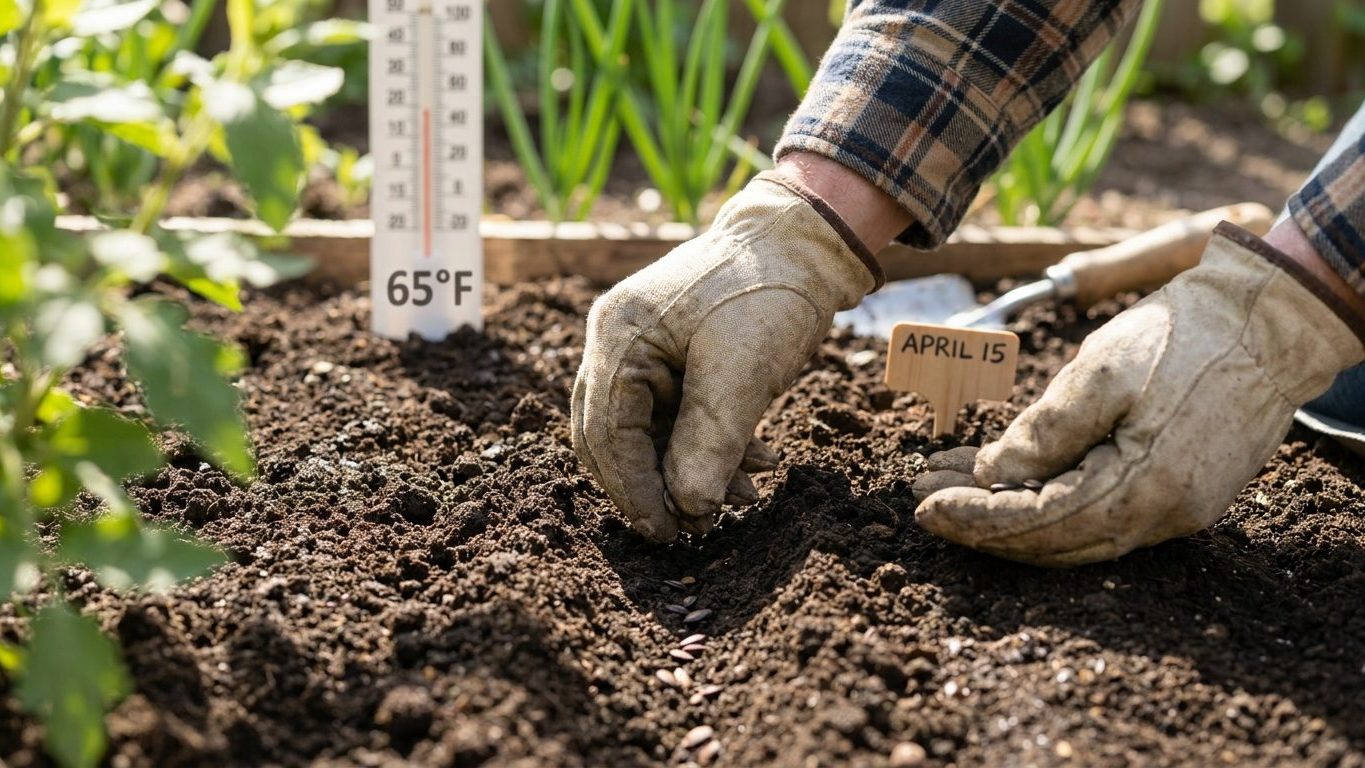

Melon seed goes in the ground in Alabama once the soil has warmed past the last frost risk, typically from mid-April into May depending on where in the state you garden. That window comes straight from NOAA’s freeze-probability data for the reference station, not a guess, and it’s worth understanding exactly what those numbers promise before you commit seed to soil.
The short answer for Alabama
NOAA’s 1991-2020 Climate Normals put the last spring frost at the reference station (Huntsville, station USW00003856) somewhere between March 19 and April 3. That’s not a single date. It’s a 30-70% probability band for a 32F freeze, meaning even at the late end of that window, there’s still roughly a 30% chance of frost occurring after it. Melons are frost-killed outright at 32F and stunted by anything below the mid-50s at the root zone, so gardeners typically wait past this window rather than push right up against it.
On the other end of the season, the first fall frost arrives between November 2 and November 16, same station, same probability method. That gives Alabama a frost-free stretch of roughly seven months in a typical year at this reference point. Most melon varieties need 70 to 100 days from transplant or direct seeding to harvest, so even planting conservatively in early-to-mid May leaves comfortable margin before the fall frost risk climbs back up.
The practical answer: direct-seed or transplant melons after the last-frost window closes for your area, generally from mid-April in the warmest pockets to mid-May further north or at higher elevation. Soil temperature matters more than the calendar date. Melon seed germinates poorly below 65F soil temperature and stalls entirely below 60F, so a warm early spring can pull the safe window earlier than these averages suggest, and a cool wet spring can push it later.
Alabama’s hardiness zone range, 7a to 9a under the USDA system, tells you about winter minimum temperatures, not spring planting dates. It’s a different measurement entirely, built on the average annual extreme low, so don’t use it to time your melon seeding. The frost-probability dates from NOAA are the correct tool for that job, and even those are a station-specific reference, not a state-wide guarantee. Suburban and rural gardens away from the reference airport tend to see later spring frosts and earlier fall frosts, sometimes by one to two weeks, so treat mid-April as an opening bid rather than a locked date.
What will not work here
Two things sink melon crops in Alabama more often than frost timing ever does, and neither shows up if you only look at the planting calendar.
The first is heat load without matching water. The reference station averages 58.5 days a year at or above 90F, concentrated in the same June-through-August stretch when melon vines are setting fruit and need steady soil moisture. Summer rainfall across those three months averages about 12.1 inches total, but it isn’t spread evenly: June brings 4.06 inches, July 4.49, and August drops to just 3.55, the driest of the three. A gardener watering once a week on the assumption that “it rains plenty here” runs into trouble in August specifically, right when fruit is sizing up and demand peaks. Melons watered on a weekly schedule through a run of 90-degree days commonly show blossom-end rot or split fruit because the soil moisture swings too wide between waterings.
The second failure mode is the flip side of the same coin: humidity. Alabama summers pair that heat with enough atmospheric moisture that fungal pressure, powdery mildew and downy mildew especially, builds fast on melon foliage. Vines planted at tight spacing, or left to sprawl into a tangled mat, trap moisture at the leaf surface and stay wet longer after rain or dew. That’s exactly the setup these diseases favor. Wider row spacing and vertical training on trellises, or at minimum keeping vines from overlapping into a solid canopy, cuts that risk substantially. A planting scheme copied from a drier, less humid state simply doesn’t hold up here.
What doesn’t fail in Alabama, is the length of the growing season. With roughly seven frost-free months at the reference station, there’s no need to chase the fastest-maturing melon variety out of fear of running out of season, the way a gardener in a shorter-season state might. The failures here are watering rhythm and airflow, not the calendar.
What changes across Alabama
Alabama sits across USDA hardiness zones 7a to 9a, a spread that covers a real climate gradient from the Tennessee Valley in the north down to the Gulf Coast counties in the south. That’s not a small range, and it means there’s no single “Alabama planting date” that applies evenly across the state. A gardener in the north is working with a meaningfully colder winter minimum, and typically a later last-frost date, than one near the coast.
Because the frost-probability figures cited here come from one reference station, a gardener further north, at higher elevation, or well inland from that station should expect the safe planting window to land later than mid-April, sometimes by a couple of weeks. Someone closer to the Gulf, in the warmer end of the zone range, may be able to plant earlier and could also push a later succession planting further into the fall before the season’s first frost risk returns.
The heat and rainfall figures shift too. A station further south typically logs more days above 90F than the Huntsville reference point, which raises watering frequency needs even higher than the state figures suggest. Summer humidity also tends to climb near the coast, which pushes the disease-pressure concerns in the previous section from “worth watching” to “manage proactively” with wider spacing and better airflow.
None of this can be resolved from a state-level page, and it shouldn’t be. If you want to know which end of that 7a-9a range your own garden sits in, the USDA’s Plant Hardiness Zone Map lets you check by ZIP code rather than guessing from a regional description. That map is built for exactly this problem: pinning a range down to one location.
Where to check this for your own county
Everything above comes from a single reference station and a statewide zone range. Neither replaces a county-level recommendation, and Alabama has an extension service built specifically to fill that gap: the Alabama Cooperative Extension System.
Two things are worth searching for once you’re there. First, a county or regional planting calendar for vegetables, which will translate the frost-probability windows discussed here into dates adjusted for local conditions rather than one airport station. County agents build these calendars from local observation over years, which catches the lag or lead that a single NOAA station can’t. Second, look for variety trial results or recommended melon cultivars for your specific region of the state. Alabama’s extension system runs variety trials across different parts of the state precisely because a melon that thrives near Mobile’s humidity and heat may underperform in the drier, cooler stretches near Huntsville, and vice versa.
A county recommendation beats a state one, plainly. Statewide frost normals and a hardiness zone range that spans two-plus zones are useful for understanding the mechanics of when and why, but not a substitute for what your county extension office has observed on the ground over multiple seasons. If your county office publishes a specific melon-planting date range or a shortlist of varieties that have performed well locally, that number should override the mid-April-to-May estimate given here.
Some gardeners also time melons by the Moon: when to plant watermelon and cantaloupe by the moon, as almanac tradition rather than fact.
Checking this against your own garden
Every date in this article is a probability drawn from one weather station. Your own garden will tell you more, and it costs nothing but attention.
Start with soil warmth, checked by feel rather than a thermometer most gardeners don’t own. Push a finger a couple of inches into the bed in the morning. If the soil still feels cool and damp-cold rather than merely cool, melon seed sitting in it will stall or rot rather than germinate, regardless of what the calendar says. Wait for that cold edge to disappear.
Second, watch for the first flush of male flowers on any melon vines already growing nearby, whether yours or a neighbor’s from an earlier planting. Male flowers appear first and in larger numbers, often a week or two before the females that actually set fruit show up. Their arrival signals the plant has settled into active growth, a decent proxy for whether conditions have turned reliably warm.
Third, look at the first true leaves on any seedlings you’ve started, not the rounded seed leaves that emerge first. True leaves, the jagged melon-shaped ones, show up once the plant is drawing real energy from photosynthesis rather than its seed reserves. Slow, pale true-leaf development even in warm-seeming weather often points to a microclimate cooler or shadier than the general forecast suggests, whether from a north-facing slope, heavy tree cover, or a low spot that collects cold air overnight. That’s a signal worth trusting over any regional date, since it comes from the exact patch of ground the melons are growing in.