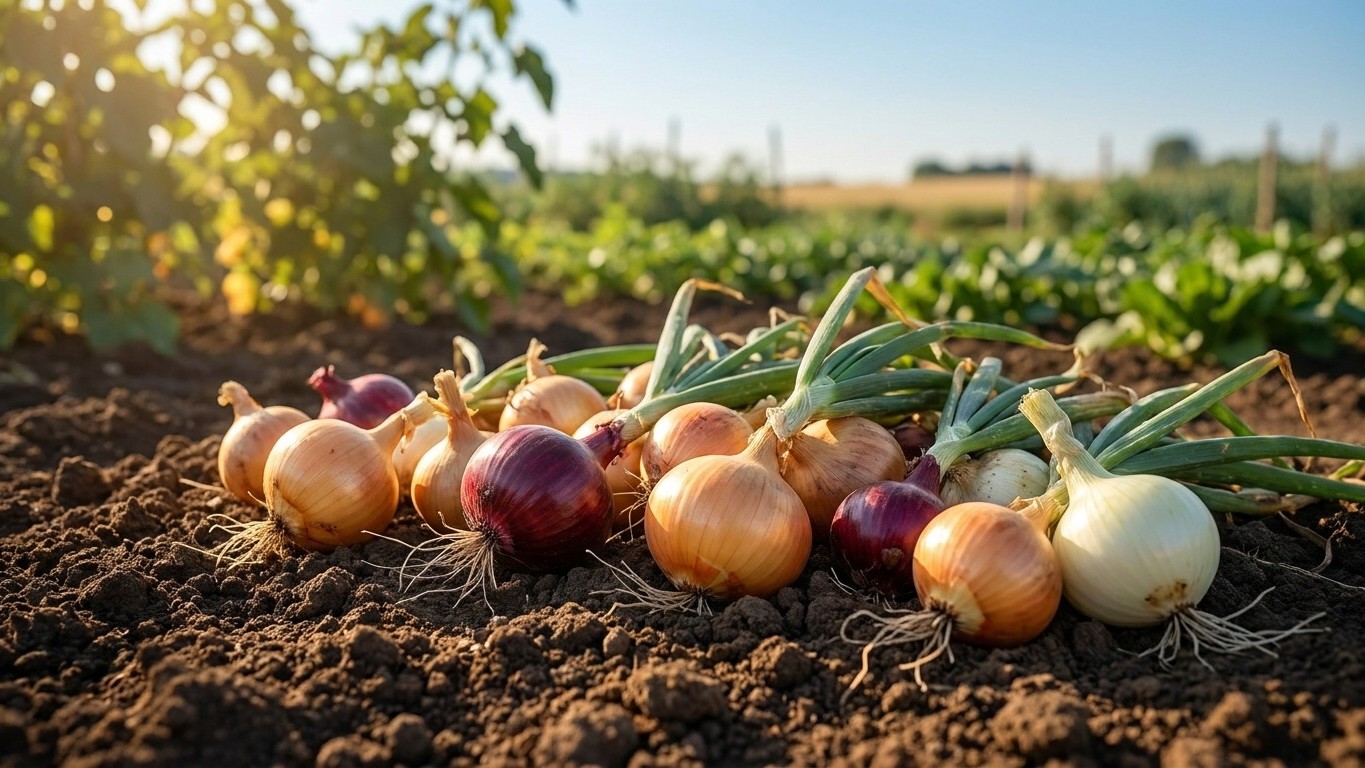

Lift onions once most of the tops have flopped over and the necks have gone soft. Then cure them in a dry, airy spot until the necks are tight and the skins rustle like paper. Only after that do they go into storage, ideally somewhere cool and dry. How long they last depends less on your care than on the variety. A sweet onion eaten by fall is a good result. A pungent one can carry you well into winter.
Keeping them, and for how long
How cold and how dry should stored onions be?
Clemson Cooperative Extension’s Home & Garden Information Center puts it plainly: “Ideal conditions are between 45 °F and 55 °F, and 50 to 60 percent humidity.” You can read the full factsheet on onions, leeks, shallots and garlic. Notice the humidity. Onions want dry air, which is the opposite of carrots, beets and potatoes, and that is why one cellar rarely suits both. Damp air lets moisture creep into the neck, and the bulb starts to rot from the top.
Treat any storage time you read as a ceiling. It describes a well-cured, undamaged bulb held in the ideal range the whole way through. A bulb nicked by the fork or still holding moisture in its neck will quit sooner, and a warm spell can wake it up and send a green shoot out of the top.
Why do some onions keep and others do not?
The bite of an onion comes from volatile sulfur compounds. Those same compounds help protect the bulb while it sits in storage. A sweet variety carries fewer of them, so it tastes gentler raw but has less defense. The University of Missouri Extension says it directly in its guide to planting, growing and harvesting onions (G6355): “As a rule, ‘sweet’ onions do not store as well as the more pungent types.” Plan on eating sweet onions first. Do not count on them to last the winter.
Day length lines up with this trade-off. Onions start forming a bulb when the days reach a certain length, and warmth has little to do with it. Clemson Extension gives about 12 hours of daylight as the trigger for short-day types. The reference station for these climate normals sits at 36.82 degrees north and gets 14 h 32 of daylight on the longest day. That is plenty for short-day onions, which bulb early and run sweeter. A long-day variety waits for 14 to 16 hours, so at this latitude it only just clears the bottom of its range, and only around the solstice. A reader well north or west of that station should check their own latitude before choosing. In the north, long-day onions are the ones that keep into March. Southern gardens usually get onions to eat soon. Our guide to the best onion varieties for Virginia sorts the choices by day length.
Where in the house that actually is
Which rooms are wrong for onions?
A kitchen refrigerator runs colder than onions like, and it is humid inside. Cold, moist air can turn the flesh soft and may push the bulb to sprout. Keep the fridge for onions you have already cut. A heated living space is the opposite mistake, since it sits above the 45 °F to 55 °F range for most of the winter. A garage is harder to judge. It can be right on a cool October morning and far too warm or too cold within a week, because it follows the weather. A basement is often cool enough, but many are damp, and 50 to 60 percent humidity is a low bar for a room below grade.
Which room comes closest, and what should you check?
The best match is usually a cool interior space with steady air: a closet against an exterior wall, an unheated back bedroom, or an enclosed porch that stays out of the freezing range. A dry, finished corner of a basement can also work. Hang the onions in mesh bags or spread them in a single layer in slatted crates so air moves around each bulb.
Before you commit, leave a thermometer and a hygrometer where the onions will sit for a full week. Read them morning and evening. Skipping this step costs you the crop, because a spot that feels cool to your hand can still warm up by afternoon or hold damp air you cannot feel. If the humidity runs high, a small fan, a bit more space between bags or a different shelf may fix it. If the temperature swings, move to a more interior wall.
Keep onions away from potatoes and root crops. Those crops want moisture, and the damp air they need will shorten the life of your onions. Check the stored bulbs every couple of weeks and use any that feel soft, smell sour or show green at the neck.
When are onions ready to lift in Virginia?
The plant tells you. As the bulb finishes swelling, the necks soften and the green tops begin to fall over. Wait until most of the tops have fallen, not just the first few. In places where summers are hot and humid, that usually happens from early to midsummer, though planting date and variety move it. Short-day types fall over first. Long-day types often hold their tops longer.
Pick a dry day. If the soil is soggy, the bulbs will carry moisture into curing. Loosen the soil with a garden fork a few inches from the row and lift gently, because a bruise is a doorway for rot. Do not bend or cut the tops. Leave them attached so they can pull the last of their energy back into the bulb.
Set aside any bulb that has a thick, stiff neck, a flower stalk or visible damage. These will not keep, so eat them first. Maggot tunnels and thrips scarring are common culprits, and you can learn more in What Eats Onion in Virginia, and When. For the full growing picture, start with the Onions in Virginia overview.
How do you cure onions before storing them?
Curing dries the outer skins and seals the neck so rot has a harder time getting in. Spread the bulbs in a single layer, tops still on, somewhere warm and well ventilated but out of direct sun and out of the rain. A covered porch, an open garage with the door raised, or a shaded spot with a fan all work. Direct sun can scald the bulbs. Humid weather slows everything, so a day of rain can add days to the process.
Judge by the neck, not the calendar. A cured onion has a neck that is tight, dry and does not squeeze. The outer skins are papery and rustle when you handle them, and the roots are shriveled and wiry. If you can still press moisture from the neck, keep curing. When it is ready, trim the tops above the bulb and brush off loose soil. Do not wash them, because water undoes the work. Then move them into the cool, dry spot you tested.
Common questions
Can I store sweet onions through winter?
Not reliably. Sweet varieties have fewer of the sulfur compounds that protect a bulb, so they soften and sprout sooner. Cure them well, keep them cool and dry, and use them first. If you want onions that last into late winter, grow a pungent variety.
What if the necks stay thick and green?
A thick neck holds moisture, and moisture invites rot. Those bulbs are best eaten soon. If only a few are affected, give them extra drying time in the airiest spot you have, and check them often. Do not mix them with the ones you plan to keep.
Should I wash onions before storing them?
No. Brush off dry soil with your hand. Water on the skins and neck works against curing and raises the chance of rot. Wash them in the kitchen, just before you use them.
Can onions share a cellar with potatoes or carrots?
It is a poor match. Onions do best at 50 to 60 percent humidity, while potatoes and roots like moist air. If you only have one space, give the onions their own shelf as far from the damp crops as you can, and check them more often.