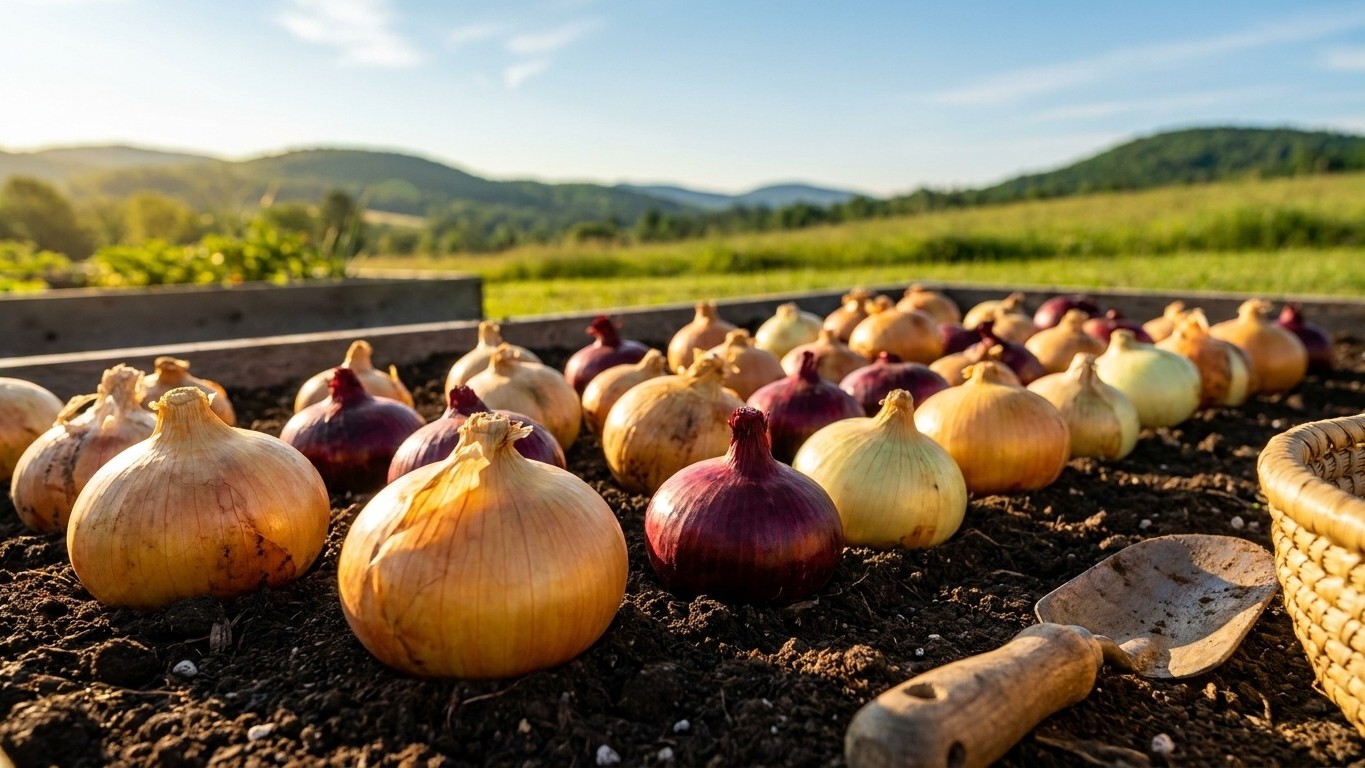

Lift onions in Alabama once about half the tops have flopped over, which for fall- and winter-planted onions usually means late spring into early summer. Then cure them for two to three weeks in shade, with air moving, before a single bulb goes into storage. The calendar matters less than the tops. Most losses happen after the harvest, when bulbs are stored with wet necks and the rot starts in the middle of the pile.
The short answer for Alabama
Huntsville sits at 34.64 degrees north, and on the longest day of the year it gets 14 h 19 of daylight. That figure is calculated for the geometric horizon, so real daylight runs about seven minutes longer. It is the number that sets the whole harvest schedule, because an onion does not bulb when the weather warms up. It bulbs when the days get long enough. Clemson Cooperative Extension puts the trigger for short-day onions at about 12 hours.
At Huntsville’s latitude, day length passes 12 hours around the spring equinox in late March. From that point a short-day onion stops building leaves and starts swelling a bulb. Every leaf it has by then becomes one ring of the finished onion, which is why a big, healthy plant in March makes a big onion in June. The stretch from the equinox to harvest is roughly two to three months of bulb fattening, and the end of it is what you are watching for.
Reading the tops
The signal is the foliage. As the bulb matures, the neck softens and the tops bend over at the point where they leave the bulb. When about half of the tops have fallen, the bulbs are ready, and the rest will follow within days. Waiting for every last top to go brown gives you onions sitting in warm, wet soil, where the outer scales split and rot organisms move in.
Pick a dry stretch if you can. Loosen the soil with a garden fork, pull the bulbs gently, and leave the tops attached. Do not wash them. If you want to know whether a plant with a stubborn upright neck is ready, squeeze the neck: a thick, green, firm one means the bulb is still working. Neck-damaged bulbs, including those chewed by thrips, will not cure well, and What Eats Onion in Alabama, and When covers which pests to look for before you pull.
Curing, in order
Spread the bulbs in a single layer on screens, racks, or hardware cloth, somewhere shaded, dry, and breezy. A covered porch or an open-sided shed works. Direct sun in an Alabama May can scald the skins, so keep them out of it. Over two to three weeks the necks shrink and tighten, and the outer skins turn papery and rustle when you handle them. Only then trim the roots, cut the tops to an inch or so, and move the bulbs to storage. Bulbs that still have a moist, open neck go in the kitchen and get eaten first.
What will not work here
A long-day onion planted in Alabama is the most common way to produce a bed full of leaves and nothing else. Long-day varieties need 14 to 16 hours of daylight to trigger bulbing. Huntsville touches 14 h 19 only for a short window around the June solstice, and by then heat, disease, and the plant’s own age are in charge. Through March, April, and May, when a bulb should be building, the days are shorter than the trigger. The plant keeps making leaves, the neck stays thick, and the result is a small or missing bulb that rots in the ground or in storage.
These are the types to leave out of an Alabama garden if the goal is a harvest:
- Walla Walla: a sweet long-day type that waits for the long northern summer days it is bred for and, planted here, makes leaves while the bulb never gets its signal.
- Yellow Sweet Spanish types: long-day onions that behave the same way, with big tops and a slow, late, poor bulb.
- Copra: a long-day storage onion, famous for keeping well in the north, that will not bulb properly before heat shuts it down in the south.
The same logic applies to planting date, and it works against the gardener who is behind. Planting late does not push the harvest later. It shrinks it. Whatever size the plant has reached when the days pass 12 hours is the size the bulb will be, because bulbing starts on the clock, not when the plant is ready. A transplant set out in mid-March has a few weeks of leaf growth before the trigger and finishes with a golf-ball onion at best. Gardeners who wait for the soil to be perfect lose the most.
Short-day varieties are the ones to build on, and The Best Onion Varieties for Alabama sorts them by type and use. Intermediate-day types can work in the northern part of the state, but they are the exception.
What changes across Alabama
All of the figures above come from one place. Huntsville, in the Tennessee Valley, is the reference city, and the latitude and day length belong to it. Alabama runs from the Tennessee line down to the Gulf coast, a span of several degrees of latitude, and day length shifts with every one of them. A gardener near Mobile Bay lives in a different onion climate from one in the Tennessee Valley, even though both are inside the same state lines.
| Where in Alabama | Latitude | Longest day | What it changes |
|---|---|---|---|
| Huntsville (reference city) | 34.64 degrees north | 14 h 19 | Short-day onions bulb from the March equinox; a long-day type still falls short for most of the season |
| Far north, near the Tennessee line | Slightly above 34.64 | A little more than 14 h 19 | Intermediate types become a real option; harvest comes a bit later than in the south |
| Gulf coast and the far south | Well below 34.64 | Shorter than 14 h 19 | Bulbing starts earlier and the bulbs finish sooner; planting can run roughly two weeks ahead of Huntsville |
The practical effect shows up at harvest more than anywhere. A gardener in the south may be pulling onions while the northern counties are still watching tops, and the heat arrives sooner on the coast, which makes drying down on schedule more important. Readers near either edge of the state should look up their own latitude rather than borrow Huntsville’s. The planting-and-growing background for the whole state sits in Onions in Alabama.
Sweet now, or onions that last
An onion’s bite comes from volatile sulfur compounds, and those same compounds protect the bulb in storage. A sweet onion has fewer of them. That makes it better raw and worse after a few weeks on the shelf. University of Missouri Extension (publication G6355) states it plainly: “As a rule, ‘sweet’ onions do not store as well as the more pungent types.”
Day length lines up with this. Short-day types, the ones Alabama is built for, run sweeter. Long-day types keep longer. A southern garden therefore gives onions to eat soon, and a northern one gives onions that feed a household into March. Alabama sits firmly on the first side of that trade. The harvest comes in late spring, the sweetest bulbs should be eaten first, and the kitchen counter, not the cellar, is where most of them belong.
Storage conditions are specific. Clemson Extension’s guidance is that ideal conditions are between 45 °F and 55 °F, and 50 to 60 percent humidity. Onions want dry air, which is the opposite of carrots and other root crops, so one cellar cannot hold both well. An Alabama garage or hall closet in July sits far above 55 °F, and humidity there is rarely low. Mesh bags hung in the coolest, driest, best-ventilated spot in the house are the realistic option.
Checking this against your own garden
The figures on this page belong to Huntsville and no other garden. A state-wide number does not describe every plot in Alabama, and the frost dates that decide planting and harvest are not published here, so they are yours to look up. These are the checks that take a week or less:
- Look up the latitude of your own town. If it is well south of 34.64 degrees north, your longest day is shorter than 14 h 19 and your season runs earlier.
- Find your average last and first frost dates for your county and write them on the calendar before you plant next fall.
- Call or visit your county office of the Alabama Cooperative Extension System and ask which onion types they recommend for your soil and your county.
- Walk the bed and count how many tops have fallen. At about half, plan a dry day to lift.
- Pick the shaded, airy curing spot now, and confirm it stays dry in a rainstorm.
- Measure the temperature and humidity where you plan to store them against Clemson’s 45 °F to 55 °F and 50 to 60 percent.
Common questions
When should I lift onions in Alabama?
When about half the tops have fallen over, which is usually late spring into early summer for onions planted in fall or winter. Your planting date and county shift the timing, so go by the tops rather than a date on the calendar.
How long do onions need to cure?
Two to three weeks in a shaded, dry, airy spot. They are done when the necks are tight and the skins are papery. A neck that is still moist or open means the bulb is not ready for storage.
Why did my onions make big tops and no bulb?
The most likely cause is a long-day variety, which needs 14 to 16 hours of daylight to bulb. Huntsville reaches only 14 h 19 on the longest day of the year, and the rest of Alabama gets less, so the plant keeps making leaves instead.
Can I store sweet onions through winter?
Not reliably. Sweet onions have fewer of the sulfur compounds that protect a bulb in storage, so they should be eaten first. Keep the more pungent types for storage, at 45 °F to 55 °F and 50 to 60 percent humidity.