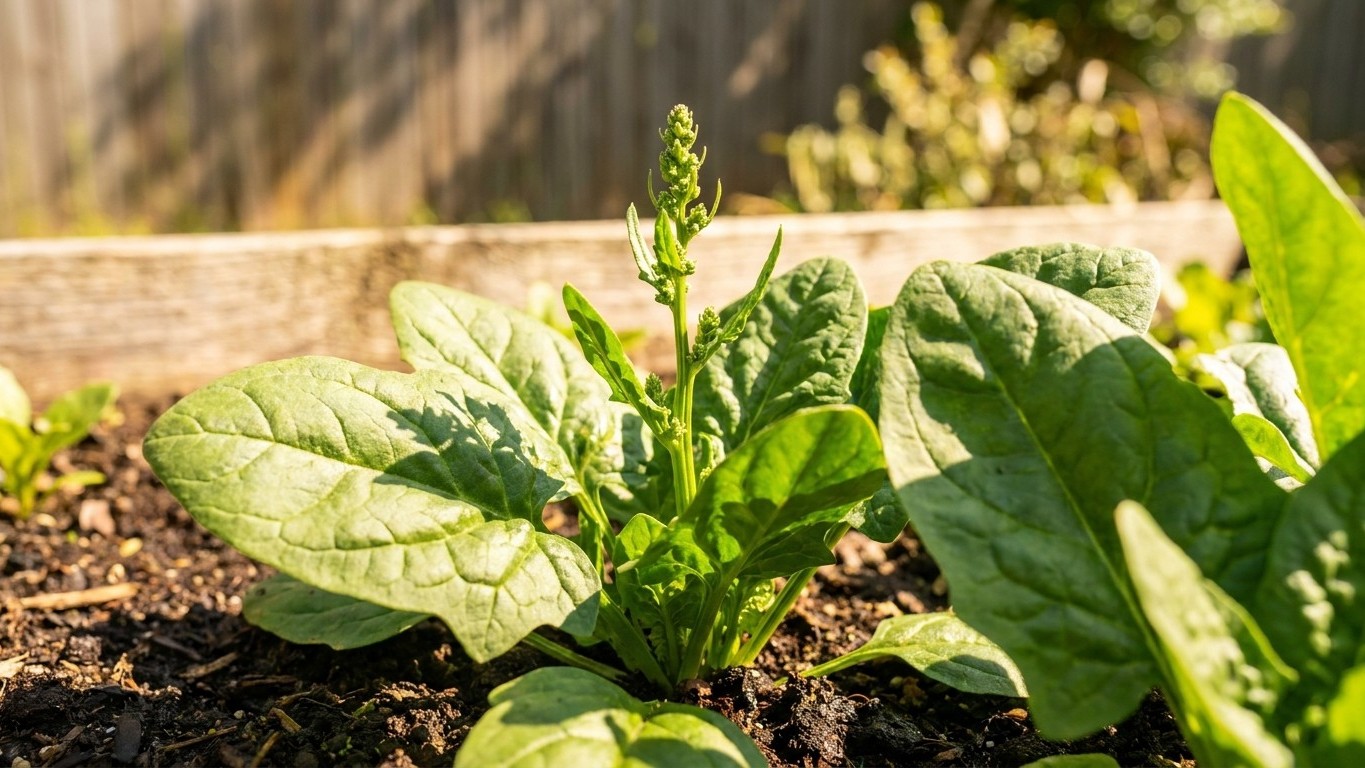

Cut spinach in Alabama in two short windows: a spring crop sown a few weeks before the last frost and harvested before the heat arrives, and a fall crop sown only once the soil cools down. After cutting, spinach keeps best at 32°F and still shouldn’t be counted on past two weeks. The refrigerator door does worse than that.
The short answer
Huntsville gets 14 h 19 of daylight on the longest day of the year. That figure is calculated from the latitude of the weather station behind the climate normals used here, and it counts the geometric horizon only (real daylight runs about seven minutes longer). It matters because spinach bolts, meaning it sends up a flower stalk and turns bitter, during long days as well as warm temperatures. Utah State University Extension is clear on this: spinach grows best where temperatures stay at or below 75 F.
Day length alone is enough to trigger flowering. A cool summer, the kind a gardener farther north might hope for, does not buy extra weeks, because the days are what they are. In Alabama the limit is both: the long days and the heat. Huntsville averages 58.5 days a year at 90 F or higher, so even the plants that dodge the daylight trigger have to survive a long run of weather far above their comfort zone.
The number 75 F does double duty. It is the point where growth stops being good, and it is also where bitterness becomes a problem. It is a temperature, not a calendar date, so it moves from year to year and from yard to yard. The practical rule is to harvest while the plants are still growing well and the leaves are big enough to use, rather than waiting for a final fat cutting. For how fast bolting arrives in a warm state, see Will Spinach Bolt Early in Alabama?
How long cut spinach keeps
UC Davis Postharvest describes spinach as highly perishable. Its optimum is 32°F at 95 to 98 percent relative humidity, and it says spinach will not maintain good quality for more than 2 weeks. That is a ceiling, not a plan. Wilting, yellowing and decay increase after 10 to 14 days of storage, and they come faster at 41 to 50°F, which is about what a home fridge actually holds, especially in the door.
The coldest spot in most refrigerators is the back of the bottom shelf, so that is where a bag or a lidded container of dry leaves belongs. Treat 10 days as a sensible planning number and anything past it as a bonus. The full details are on the UC Davis spinach fact sheet.
How long the spring window really is
Spring spinach is sown 2 to 3 weeks before the last frost. For Huntsville, NOAA NCEI climate normals put the last spring frost between March 19 and April 3. That is the reference-city range, not a statewide promise. Suburban and rural gardens often see the last frost one to two weeks later, and more at elevation, so check your own county before you trust any date here. Here is how to work out your own window:
- Find your last frost range. At the Huntsville reference station it runs from March 19 to April 3. Adjust later if you garden in the country or on higher ground.
- Subtract 2 to 3 weeks. From those dates, sowing opens around February 26 and closes around March 20. That is roughly three and a half weeks of sowing dates, and an early cold snap can shorten them.
- Watch for 75 F. Growth stops being good above that. The sources behind this page do not publish the date it arrives in Alabama, so a daytime high forecast that keeps landing in the mid-70s is your signal that the crop’s clock is running out.
- Count the weeks in between. Subtract the sowing date from the first stretch of mid-70s highs and that is your real window. Many Alabama springs warm quickly, so for most gardeners the harvest comes down to a handful of weeks, not a season.
The source publishes no days-to-maturity figure for spinach, and I won’t borrow one from another crop. What it does say is to plant on time and harvest while temperatures are still cool. A sensible approach is to start cutting as soon as leaves are big enough for a salad bowl. Pulling early beats waiting for a better harvest that the weather may not allow.
The source names four varieties: Bloomsdale, Melody, Teton and Olympia. It gives no data about any of them, so nothing here ranks them or describes how they handle heat. A short window also leaves little room for pests. If something is chewing the leaves before you can cut them, What Eats Spinach in Alabama, and When covers it. For the planting basics, start with Growing Spinach in Alabama.
The autumn crop, and when the soil lets you sow
The fall crop is the one most Alabama gardeners should plan around. Utah State University Extension says to plant 50 to 75 days before the date you want to harvest. Working back from the Huntsville first fall frost range of November 2 to November 16 (NOAA NCEI, again a reference-city figure, with rural plots often one to two weeks earlier), the arithmetic is tidy.
Obstacle one: the soil is still too warm
Counting back 50 to 75 days from November 2 gives sowing dates from about August 19 to September 13. From November 16, it gives about September 2 to September 27. Those dates sit squarely in the part of the year with the most 90 F days, and that is the catch. Seed germination is reduced when the soil is above 80 F. The barrier in autumn is warm soil, not cold.
The window opens when the soil falls, not when the calendar says so. A soil thermometer pushed an inch or two down tells you more than a date does. The sources used here do not publish the date the soil crosses 80 F in Alabama, and it varies by yard, so the thermometer is the authority. Sowing into a bed shaded by afternoon cover can help you test the edge of that rule, though the sources offer no figures for it.
Obstacle two: the frost that ends the season
The first fall frost is the other end of the clock. A sowing that goes in late, even into properly cool soil, has less time to reach a cuttable size before the frost date in your county arrives. Because rural gardens commonly see frost one to two weeks sooner than the airport, move the earlier end of your count back accordingly.
Pick a realistic harvest date first, then subtract 50 to 75 days, then check that the result falls after the soil has dropped below 80 F. If it doesn’t, wait. Sowing into soil that is too hot wastes seed and a bed’s worth of time. The same warm weather that discourages germination also lengthens the days spinach dislikes, so a late-summer sowing sits between two problems until the soil cools.
Common questions
When should I stop cutting spinach in an Alabama spring?
Stop when growth is no longer good, which is above 75 F, or when a flower stalk starts rising from the center. At that point leaves turn bitter. Cut what is usable and pull the rest.
Would a cool summer let spinach last longer in Alabama?
No. Long days trigger flowering on their own, and Huntsville reaches 14 h 19 of daylight on the longest day. A cool spell does not cancel that.
How long does cut spinach keep in the refrigerator?
UC Davis says it will not keep good quality beyond 2 weeks, and only at 32°F with 95 to 98 percent humidity. At the warmer temperatures of a typical fridge, deterioration comes faster. Store it at the back of the bottom shelf, not the door, and plan to use it within about 10 days.
Can I sow spinach in August?
You can, but the soil is the problem. Germination is reduced above 80 F soil, and August in Alabama is hot. Sow when a soil thermometer reads below that, then count 50 to 75 days to your harvest date.