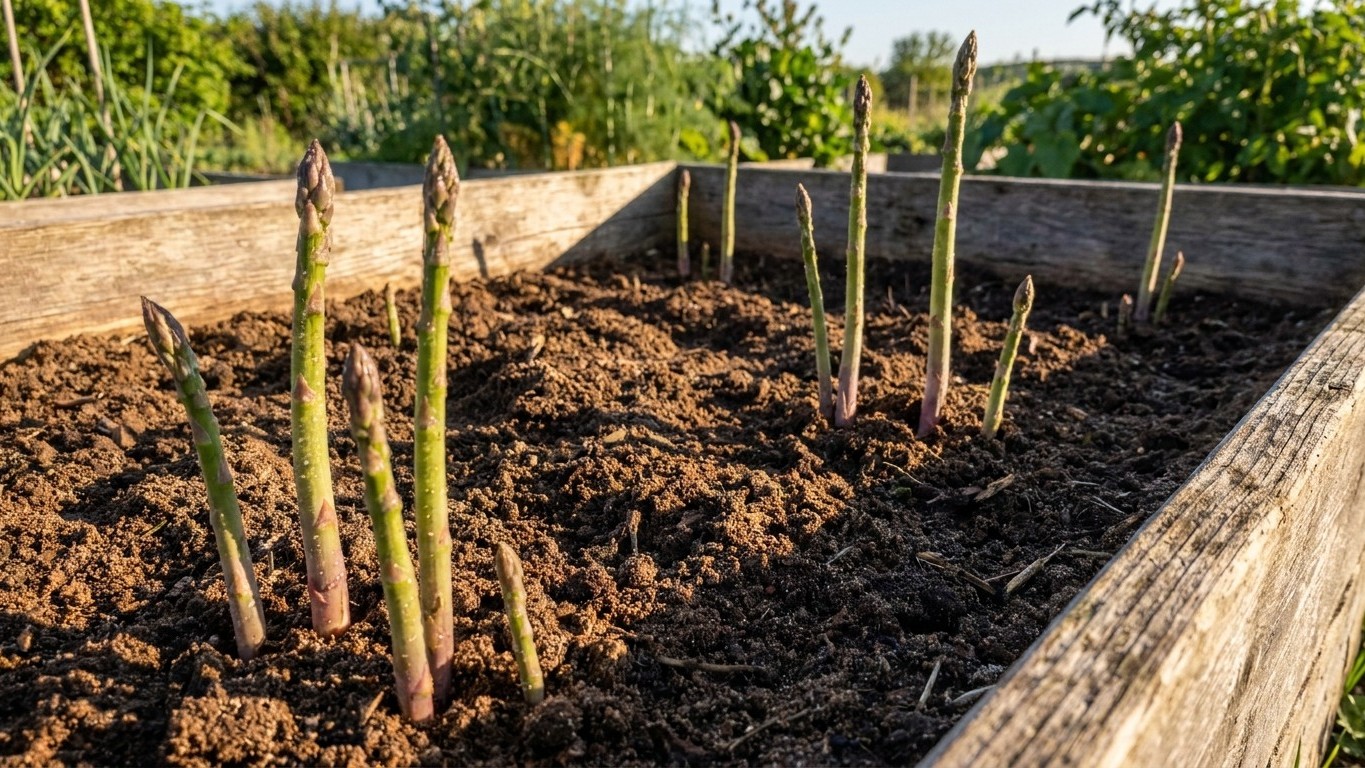

Stop cutting when most of the new spears come up thinner than a pencil. That signal matters more than any calendar week. Before you ever reach it, the bed gets no harvest at all until year 3. The first season then runs 4 weeks, the next 6, the one after that 8. Cut spears keep best at 32 to 35°F with the butts standing in water. This page is a companion to Growing Asparagus in Alabama.
The short answer
Alabama’s official state soil is the Bama series, and an asparagus bed here is a 10-to-15-year commitment. Utah State University Extension, the source behind this page, sets exactly one soil requirement: most soils will do, provided they are well drained. Bama is well drained. USDA’s representative figures for its surface layer put it at 67 percent sand, 14 percent clay and 19 percent silt, so water moves through instead of parking on top of the crowns. For a plant that stays put for a decade and a half, that is the right starting hand.
The rest of the profile is less generous. Bama is an Ultisol, an old, heavily weathered and leached soil that is naturally acid and low in nutrients. Its surface layer averages about 0.8 percent organic matter and a pH of about 5.3, which counts as strongly acid. Those are the series’ numbers, not yours. The Extension source is silent on soil pH, so no target is offered here. A soil test on your own plot is the only way to get your number.
That test matters because the state soil is a starting point, not a diagnosis. Alabama spans hundreds of soil series. River bottoms, hill country and any lot a builder has scraped or filled can behave nothing like Bama.
If your ground does not drain
With most vegetables, a heavy soil is an annual nuisance you amend each season. With asparagus it is a decision you cannot undo, because the crowns sit in one spot for up to fifteen years. After a good rain, dig a hole where the bed would go and watch how long water stands in it. If it lingers, move the bed to higher, freer-draining ground, or build a raised bed and fill it with a soil that sheds water. (The Extension source does not address raised beds. That is a practical workaround, not a published rule.) Our piece on whether Alabama soil will hold an asparagus bed for fifteen years goes deeper on the decision.
Where cutting stops and keeping starts
Crowns go into 8-inch furrows in early spring. No spears are cut in the first two years. Year 3 brings the first harvest, 4 weeks long, then 6 weeks, then 8. No source here softens that into “a few spears early,” and neither will I. Each season ends when most of the spears thin to less than a pencil’s width. That is an object you can hold up, not a week on the calendar.
After the cut, the clock runs fast. UC Davis Postharvest puts the optimum at 32 to 35.6°F with relative humidity at 95 to 100 percent. Above 50°F the spears toughen rapidly, within hours. At about 30.9°F or lower they freeze, turn water-soaked, and go soft on thawing. Both edges bite. In a home kitchen, standing the cut butts in a little water, or wrapping them in a damp towel, is the practical way to reach that humidity, since spears lose moisture through the cut end faster than anywhere else.
Will the summer here water it for you?
The bed wants 1 to 2 inches of water every other week for its first two years, then every three weeks after that. Alabama’s reference station records about 12.1 inches of rain across June, July and August, out of 54.3 inches for the whole year. June brings 4.06 inches, July 4.49 and August 3.55, making August the driest of the three. On paper, that is close to what the bed asks for. In practice, three things bend the math.
- Do the fortnight arithmetic. Twelve inches over about thirteen weeks is roughly 1.9 inches per two-week stretch. August alone works out closer to 1.6. Those averages sit inside the 1-to-2-inch range, which is why a normal summer can cover a young bed.
- Distrust the average. Normals blend soaking weeks with bone-dry ones. Rain that falls as one summer thunderstorm mostly runs off rather than soaking in, and hot days at or above 90°F pull water back out of the ground quickly. Two inches in an hour is not two inches delivered to the crowns.
- Factor in the sand. A sandy surface like Bama’s lets an inch of rain through within the day, where clay might hold it for a week. A wet summer on sand can still leave roots thirsty, so the bed may need help even when the rain total looks fine.
- Measure what you actually get. A rain gauge on your own plot settles it. If a two-week stretch delivers less than 1 inch, add the difference. If it delivers 2 inches or more, skip the hose. The station figures are normals from the most recent thirty-year record, not a forecast, and a slope, a city or a rain shadow can shift them.
- Switch gears after year two. From then on the schedule relaxes to one watering every three weeks. Keep the gauge anyway, because dry spells do not follow schedules.
The gardener’s job, then, is to top up the gap between the gauge and the target, not to water on a fixed calendar. In a typical summer that gap may be small. In a dry August on sandy ground it can be most of the supply.
When to put the crowns in
Early spring is the planting window. In Alabama, the reference city’s last spring frost falls around March 19 to April 3, going by the 30-to-70 percent probability band for a 32°F freeze in NOAA NCEI’s most recent climate normals (station USW00003856). Treat that as around those dates, since a mean frost date is an average, not a promise. Suburban and rural gardens often see the last frost one to two weeks later than the airport station, and more at higher elevation. Check your own county before you pick a planting weekend.
The crowns go into an 8-inch furrow, and that furrow is not filled in on day one. Backfill gradually across the year, adding about 2 inches every other month, so the growing shoots are never buried at once. Then comes the long wait: no cutting until year 3. A bed planted this spring waits through two full growing seasons before it gives anything back, which is why drainage and spot selection deserve more thought than the shopping list does. When the spears do start coming, what eats asparagus in Alabama, and when is worth a read.
On varieties, the Extension source names four and says only one thing about each: its sex. Jersey Giant and Jersey Knight are all-male. UC 157 F1 and Purple Passion are male and female plants. No flavor, no yield and no reason to prefer one over another is published, so any claim that one is “best” for Alabama would be invention. Pick on availability and on whether you want all-male plants. The source names no nursery, and neither does this page.
Seed is the alternative to crowns, but the facts behind this page carry no sowing dates and no timeline for it. That is not published here. If you want to start from seed, your county Extension office is the place to get a calendar that fits your ground.
Common questions
Can I cut a few spears in the first or second year?
No. Asparagus is not harvested until year 3. Every spear left standing in the early years feeds the crown for the 10 to 15 years of harvests ahead.
How do I know it is time to stop cutting for the season?
Look at the spears, not the calendar. When most of the new ones come up thinner than a pencil, stop. Harvest windows also lengthen as the bed matures: 4 weeks the first time, then 6, then 8.
How should I store the spears I cut?
Aim for 32 to 35°F with near-saturated air, 95 to 100 percent humidity, per UC Davis Postharvest. Stand the butts in water or wrap them damp. Above 50°F the spears toughen within hours, and at about 30.9°F or lower they freeze and collapse. A refrigerator thermometer will tell you which side of that window your fridge sits on.
Do I fill the planting furrow right away?
No. The furrow is 8 inches deep at planting and is backfilled gradually through the year, about 2 inches every other month, not all at once.