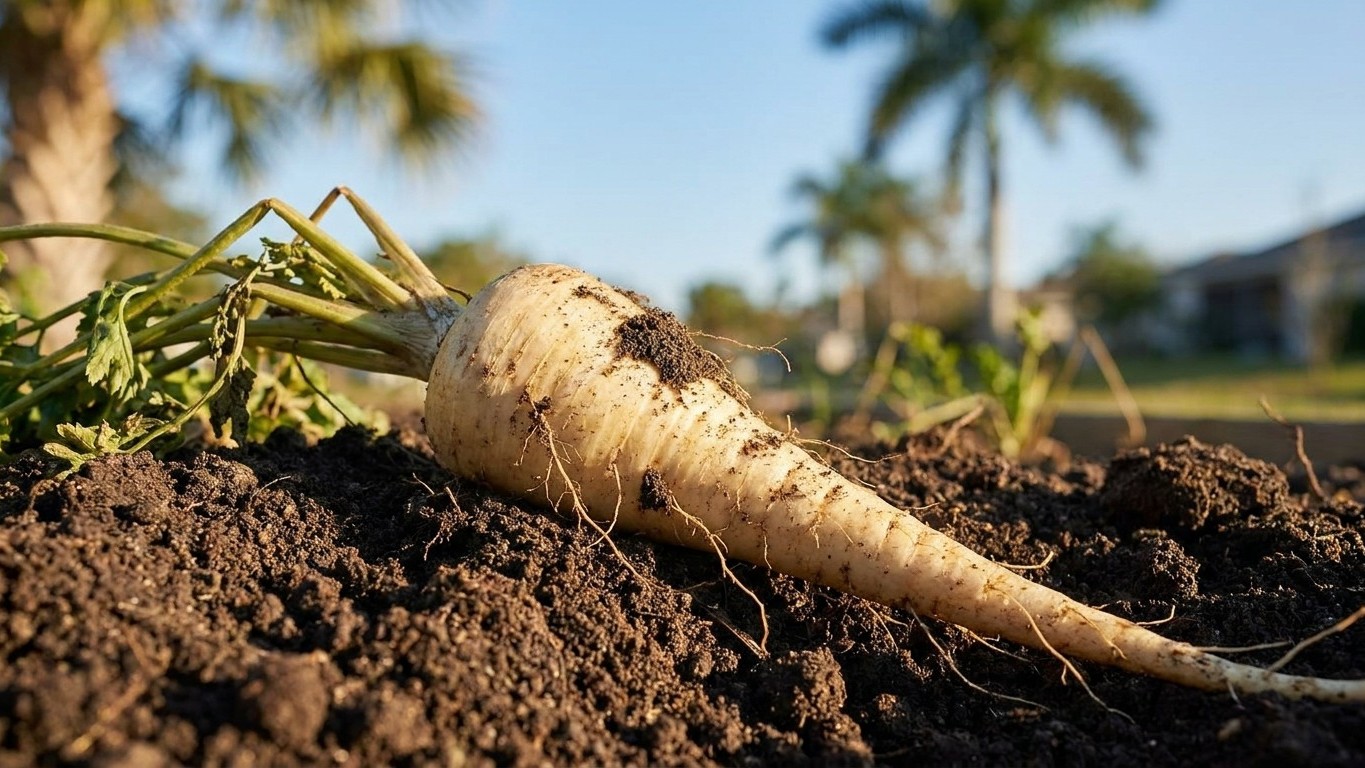

Lift parsnips in Alabama when frost has had its say, not when the calendar says so. A spring sowing makes full-size roots by early summer, but the sugar arrives only after several frosty weeks, and this state hands those out sparingly. Once the roots are out, 4 to 6 months of storage is possible, but only at 32 to 34 °F and 98% humidity, and never beside apples. The details start with how thin Alabama’s winter really is.
The short answer
Does Alabama deliver several frosty weeks? Not reliably. At the Huntsville reference station, the mean daily minimum of the coldest month is 33.1 °F (NOAA NCEI climate normals). That is one degree above freezing, and it is an average of nights, so some dip below 32 and plenty do not. Parsnips taste best after several weeks of cool, frosty weather, which converts stored starch to sugar, according to Utah State University Extension. A few frosty nights scattered between mild spells is a different thing from weeks of it.
So the plain verdict: a parsnip grown here will grow without much fuss, and in most winters it will sweeten only a little. A colder-than-usual winter can change that. Hardiness zone has no say in it. A comfortable zone tells you the plant survives the winter, not that it sees frost for weeks on end, and the sugar comes from the frost. The longer reasoning is in Will Parsnips Sweeten in Alabama?, and the general growing picture is in Growing Parsnips in Alabama.
The 33.1 figure belongs to one airport station. Your garden may run colder or milder, so check your own county’s numbers before you bank on any of this.
That shapes the lifting decision. The roots reach size at 100 to 120 days from seeding, which for a late-winter sowing means summer. Size is not the signal, though. Leave the roots in the ground through whatever cold the winter brings, then lift as you need them. In a mild year, pull one and taste it before you commit the whole row. Starchy and mild is a plausible result, so it is better to find that out on one root than on forty.
Storage after lifting is where the numbers get generous and the fine print gets ignored. USDA Agricultural Handbook 66 says parsnip roots can be stored 4 to 6 months at 32 to 34 °F with 98% relative humidity (USDA Handbook 66, commercial storage). Four to six months is a long keeper by any standard. But the figure assumes those conditions held steady, which almost no house does. Treat it as a ceiling.
Parsnips are not chilling sensitive, so cold is not what ruins them in storage. Ethylene is. Parsnips give off almost none themselves, but even low levels from nearby apples or other ripening fruit turn the roots bitter. The handbook’s guess is a buildup of a compound called xanthotoxin. Keep them away from the fruit bowl, and top them after harvest without trimming into the crown.
Does the season fit?
Parsnips are sown in place, and the clock of 100 to 120 days runs from seeding. Here is the arithmetic in order, using the Huntsville reference figures.
- Find the last spring frost. The reference-city window is March 19 to April 3. Suburban and rural gardens often see the last frost one to two weeks later, and more at elevation, so shift everything below by that much if that is you.
- Sow two to three weeks before that window. Counting back from March 19 and April 3 gives a sowing window of about February 26 to March 20.
- Allow for germination, which takes 14 to 21 days. Seedlings should show from roughly March 12 to April 10. Bare soil at day ten is normal, so do not dig it up and re-sow.
- Add 100 to 120 days from the seeding date. The earliest sowing plus 100 days lands on June 6. The latest sowing plus 120 days lands on July 18. Roots are mature from early June to mid July.
- Compare with the first fall frost, which the reference city puts between November 2 and November 16. From the latest maturity date to the earliest frost is 107 days, about 15 weeks. From the earliest maturity to the latest frost is 163 days, about 23 weeks.
The season fits comfortably. It does not run tight and it does not run out. If anything, the problem runs the other way. The crop finishes months before the cold arrives, so the real question is not whether the roots mature but how long they sit in the ground waiting for frost that may be brief.
Even a garden that sees its last frost two weeks late still matures its roots by late July at the outside, well ahead of the fall window. What the arithmetic cannot tell you is how much sweetness you will get when that window finally opens. That depends on the winter, and the 33.1 figure says to expect a modest one.
What goes wrong here
Four things tend to go wrong, plus one that happens after the harvest. Each has a remedy that costs more effort than money.
- Forked roots from heavy or stony ground. A root that meets clay or a stone splits around it. Utah State University Extension asks for deep sandy soil and says heavy soil must be double dug. A state soil map is a starting point, not a diagnosis, so dig a test hole in your own bed and see what you hit. Double dig, pull out the stones, and break up the lumps before you sow.
- Forked roots from overwatering. This is a separate cause and needs a separate fix. Soil kept constantly wet can fork roots even in good ground. Water deeply and less often, and skip a day when the soil is already damp. If you have fixed the soil and still see forking, look at your watering next.
- A winter too mild to sweeten. With a coldest-month minimum of 33.1 °F, you may grow a perfectly good parsnip that never gets sweet. Leave the roots in through the coldest stretch you get and taste one before pulling the rest. Do not lean on your hardiness zone for reassurance, because it measures survival, not frost exposure.
- A season that slips away. It will not run out in a spring sowing, but a late one slides the maturity date later by the same number of days. A sowing in the middle of April would mature in late July or August, not early June. Sow inside the window, and count the 14 to 21 days of germination before you decide a row has failed.
- Roots that survive the winter and then get eaten. Plenty of things go after a root that sits in the ground for months. What Eats Parsnip in Alabama, and When covers who, and when.
- Bitter roots after harvest. The cause is ethylene, not cold. Roots stored near apples or any ripening fruit turn bitter even at the right temperature. Keep them apart, and top them without cutting into the crown. If a stored batch tastes bitter, check what was sitting next to it.
Common questions
What is the earliest I can lift parsnips in Alabama?
Roots are full size 100 to 120 days after seeding, so from early June for the earliest sowings. You can eat them then. They will taste starchier, because sweetness comes from several frosty weeks, and those do not arrive in June.
My seed was sown two weeks ago and nothing has come up. Should I re-sow?
Wait. Germination takes 14 to 21 days, so a bare row at day 14 is still on schedule. Re-sow only if the row is still empty after the third week.
How long will lifted parsnips actually keep?
The USDA figure is 4 to 6 months at 32 to 34 °F and 98% humidity. A home refrigerator or garage rarely holds those conditions steadily, so plan on less. Keep them well away from apples and other ripening fruit.
Do I trim the tops before storing?
Yes, top them, but do not cut into the crown, the shoulder where the leaves joined. The handbook is specific on this, and a cut crown is an open wound on a root you wanted to keep for months.