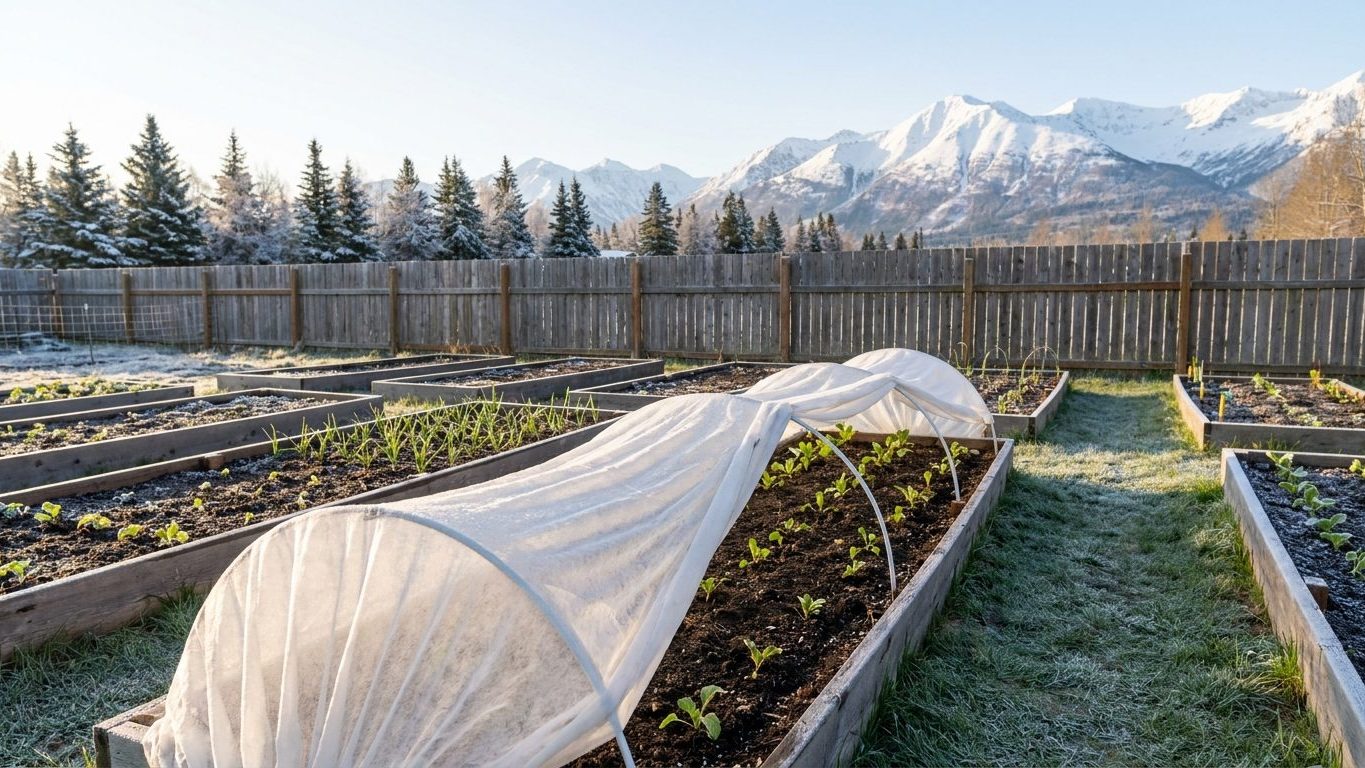

Cover your Alabama garden on any night the forecast calls for 32°F or lower. Keep cloth within reach from mid-March through early April in spring, and from early November in fall. Those windows come from Huntsville-area climate normals, so rural and higher-elevation gardens should add a week or two of caution. The calendar tells you when to be ready. The forecast tells you when to act.
The short answer for Alabama
For the reference station in Huntsville, NOAA’s 1991-2020 Climate Normals put the last spring frost between March 19 and April 3. The first fall frost falls between November 2 and November 16. Both ranges describe the 30-70% band of 32°F freeze probability. A date in that band is not a promise that frost has ended or begun. It marks the stretch where a freeze is still a real possibility, somewhere between a bad bet and a good one.
| Season | Reference window (Huntsville station) | What it means for covers |
|---|---|---|
| Last spring frost | March 19 to April 3 | Keep covers ready until you are past the late end of the window |
| First fall frost | November 2 to November 16 | Have covers out by late October for tender crops |
Those are airport-station figures, not a statewide guarantee. Suburban and rural gardens usually see the last spring frost later and the first fall frost earlier, often by one to two weeks, and more at elevation. A gardener outside town should read the spring window as running toward mid-April and the fall window as starting in mid-to-late October.
The reason a cover works at all is simple. On clear, still nights the ground gives up its stored daytime heat to the sky, and the air near the soil drops fastest. Cloth over the bed slows that loss and keeps a pocket of warmer air around the plants. It doesn’t make heat, which is why a windy, cloudy night rarely brings frost and why a calm, clear one does.
The practical rule follows from that. Tender plants such as tomatoes, peppers, squash and basil need covering whenever a freeze is forecast, spring or fall. Cool-season crops such as collards, kale and spinach shrug off light frost and need cloth only for harder cold. For the full range of materials, see Extending the Growing Season in Alabama, and for what suits each job, Which Season Extenders Work in Alabama.
What will not work here
Planting on the first warm weekend and trusting luck is the classic failure. Alabama springs swing hard. A run of balmy days in early March tempts people to set out tomato transplants, yet the Huntsville reference window for the last freeze doesn’t open until March 19 and doesn’t close until April 3. A garden outside town can carry that risk later still. Transplants that go out early and get no cover on the one cold night are the most common loss.
Using one date for the whole state fails too. The figures on this page belong to one station at 34.64 degrees north. They say little about a hollow at the edge of a field, where cold air pools on still nights, or about a ridge that stays a few degrees warmer. Frost lands on the low spot first, even when the hilltop two hundred yards away stays clear.
Sealed plastic is the next trap. Alabama sunshine can turn a closed plastic tunnel into an oven by midmorning, even in winter, and cooked seedlings look a lot like frozen ones. Plastic needs venting on any sunny day. Fabric row cover is more forgiving because it breathes and lets some moisture escape.
Humidity punishes the opposite mistake, leaving covers on for days. The state’s damp air and frequent rain mean trapped moisture, crowded foliage and slow-drying leaves, which invite fungal problems. Cover at dusk ahead of a freeze, then take it off the next morning once temperatures climb. Close spacing, which sounds efficient under a low tunnel, compounds the problem by cutting airflow.
Finally, expect little from covers in a true deep freeze with tender crops. The coldest month at the Huntsville station averages a daily minimum of 33.1°F. That is barely above freezing, so plenty of winter nights cross the line, and a hard freeze can overwhelm a single layer of thin cloth. Summer crops left in the ground into December are the wrong place to spend effort. Cool-season crops are the better use of a cover, and a second layer on the worst nights is usually the better bet.
What changes across Alabama
There is no single Alabama answer. The USDA Plant Hardiness Zone Map (2023, built on 1991-2020 data) puts the state at zones 7a through 9a. That spread covers a cooler north and a Gulf end where freezes are far less common. The map rates one thing only, the average annual extreme minimum temperature, so it says how cold a plant must endure, not when your last frost will fall.
A gardener in the northern counties or at elevation should shift the cautious end of the spring window later and the fall start earlier. Planning from the Huntsville range already includes a lot of north Alabama, but ridges, valleys and the Tennessee state line all pull the real dates around. Near the Gulf, the reverse applies. Frost comes later in fall and ends earlier in spring, so covers get used for fewer nights, though a single surprise freeze can still catch tender plantings.
Latitude matters in one specific case. Huntsville sits at 34.64 degrees north, and day length, not warmth, tells an onion when to stop growing leaves and start forming a bulb. A reader farther south sees shorter winter days, so the same variety may behave differently there. Check varieties against your own part of the state.
For your own zone, use the USDA map and type in your ZIP code. This page can’t tell you which zone you’re in, and guessing from a county name is unreliable in a state this varied.
Where to check this for your own county
Your state extension service is the next stop. The Alabama Cooperative Extension System is the land-grant university program that serves every county, and its local offices answer gardening questions for free. A county recommendation beats a state one, and this page is the state one.
When you’re there, look for two things. First, a planting calendar written for your part of Alabama, which will usually give dates for spring and fall crops that account for local frost patterns. Second, the varieties that have been trialled in your county, meaning grown side by side and compared for yield, disease resistance and tolerance of heat or cold. A tomato that thrives in a trial near you is a safer bet than one praised on a seed packet.
This page does not have county-level frost dates or a published Alabama planting calendar, so it points you to the extension office rather than filling in numbers it cannot support. County extension agents and Master Gardener volunteers can also tell you how far your area typically runs from the airport-station dates above. That difference, often a week or two, is the most useful number you can bring back to your garden.
Checking this against your own garden
Your own observations outrank every date on this page. Three are worth watching, and none need equipment.
Start with soil warmth by feel. Push your hand a few inches into a bed in the morning. If it feels cold and clammy, seeds will sit and rot instead of sprouting, whatever the calendar says. Compare two beds. The one that warms first is your early spot, and the one that stays cold is where frost will linger.
Next, watch for the first flush of male flowers on squash and cucumbers. Plants send up male blooms before female ones, so their arrival tells you the plant is established and the weather is steady enough for it. If male flowers open on plants in one corner weeks ahead of the rest, that corner is your warm microclimate.
Finally, look at the first true leaves on seedlings. The first pair that unfolds are seed leaves, and the true leaves that follow show real growth. Seedlings that stall at that stage in one bed while others move on point to a cold pocket, shade or wet soil. Note where frost shows up first on grass or car windshields in the morning, and cover that bed earliest.
Common questions
Should I cover plants the night before a frost or the same day?
Put cover on in late afternoon or at dusk, while the soil still holds the day’s warmth. Covering earlier traps heat nicely, but covering after the temperature has already dropped traps cold air instead.
Do I need to cover cool-season crops like collards and kale?
Usually not for light frost. They tolerate it well. A hard freeze is a different matter, and a layer of cloth is cheap insurance for them on the coldest nights.
Is the last frost date a safe planting date?
No. The Huntsville range of March 19 to April 3 marks the band where a freeze is still possible, not past. Rural gardens often run a week or two later.
Can I leave row cover on all night and all day?
Fabric row cover can stay in place for days, but plastic must be vented on sunny days. In Alabama’s humid air, leaving any cover on through warm, damp weather invites disease.