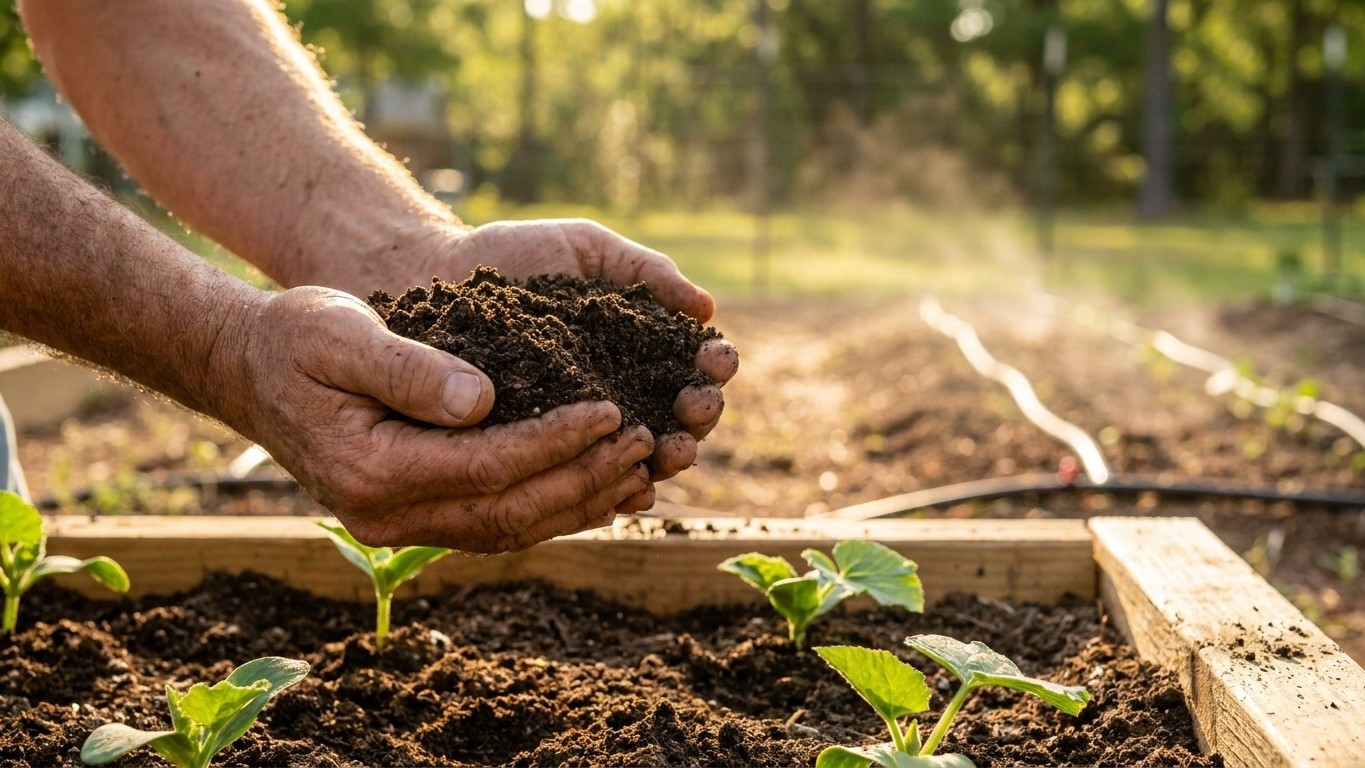

Summer squash goes in the ground once soil, not air, has warmed past the mid-60s, which in Alabama usually lands a couple of weeks after the last frost risk clears. The state’s frost-free window runs roughly seven months, but 58.5 days a year above 90°F and a dry August mean irrigation, not the calendar, often decides whether the crop makes it to fall.
When the soil is warm enough in Alabama
Gardeners fixate on frost dates because they’re the number everyone quotes, but frost is really a stand-in for something else: soil temperature. Summer squash seed rots in cold, wet ground long before frost is a threat, and the plant’s roots stall out below about 60°F even if the air feels pleasant. At the reference station used for Alabama climate normals (USW00003856), NOAA’s 1991-2020 data puts the last spring frost in the window of March 19 to April 3. That’s a 30-70% probability band, not a guarantee, and it comes from an airport weather station. Suburban yards and rural gardens away from that pavement and jet exhaust typically see their last frost run later, sometimes by a week or two, and low-lying or elevated ground shifts it further.
So the honest planting rule isn’t “count to zero after the frost date.” It’s wait until the soil itself has caught up, which for most of Alabama means late March in the warmest pockets and well into April elsewhere. Squash seed sown into soil still in the low 50s just sits there, vulnerable to rot, while seed sown two or three weeks later in warmed soil often catches up and passes it. If you want a number to work from, a soil thermometer pushed 4 inches down and read in the morning is worth more than any frost table.
The state’s hardiness zone spans 7a to 9a under the USDA Plant Hardiness Zone Map, built from 1991-2020 average extreme minimum winter temperatures. That range matters for what survives a hard winter, but it says almost nothing about spring soil warming or summer heat, which is a separate set of numbers entirely. Treat the frost dates above as the reference-city figure for the station named, not a statewide promise, and check your own county’s extension data before committing trays of transplants to the ground. Alabama’s extension service, reachable through the Alabama Cooperative Extension System, keeps localized planting calendars that adjust for exactly this kind of regional lag.
One practical habit: hold direct-seeded squash back until nighttime lows are reliably above 55°F for several consecutive nights, not just the daytime high. Squash germinates unevenly in a cold snap even after a warm afternoon, and a stand with gaps is harder to manage than one sown a week later but all at once.
How long the season lasts here
Put the two frost dates together and Alabama’s frost-free stretch runs from the last spring frost (March 19 to April 3) to the first fall frost (November 2 to November 16), both from the same NOAA 1991-2020 normals at station USW00003856. Taking the more conservative ends of each range, the latest likely spring frost (April 3) to the earliest likely fall frost (November 2), the window comes out to roughly 213 days, about seven months. That’s a wide margin by national standards, and it changes how you plan the crop, not just when you start it.
A season that long doesn’t just fit one planting of summer squash. It fits two, sometimes three, because the plant itself is fast from seed to first harvest and tends to decline in productivity and vigor after eight to ten weeks of bearing, especially once squash vine borer or powdery mildew catches up with it in midsummer. Gardeners working a shorter window, say five months or less, are usually locked into a single sowing and have to make it count, which is where transplants and careful root handling earn their keep. In a seven-month window, that pressure eases. A first sowing in April can be followed by a second in June or even July, timed to mature before the fall frost risk climbs back into that 30-70% band in early November.
This is also where transplanting versus direct seeding becomes a real decision rather than a formality. Squash resents root disturbance, so transplants need cell trays or biodegradable pots that go into the ground root-ball intact. In a long season, the extra week or two you might gain from a transplant matters less, because there’s time to recover from a slow direct-seeded start. In a compressed one, that head start can decide whether a planting beats the heat.
Anyone stacking a second or third planting into that window should work from a proper succession sowing plan rather than guessing at intervals, since timing the next sowing against the current crop’s decline, not the calendar, is what keeps squash coming without a gap. The site’s succession sowing guide covers how to stagger those windows crop by crop.
Heat and water in Alabama
Alabama averages 58.5 days a year at or above 90°F, based on the Huntsville reference station in NOAA’s 1991-2020 Climate Normals. That’s not a description of every backyard in the state, since coastal counties and shaded lots run cooler and the Black Belt clay country runs hotter, but it’s a solid proxy for the heat load a squash plant has to deal with over a typical summer. Above the low 90s, squash pollen starts losing viability fast, sometimes within hours of opening, which is why plants can flower heavily in late July and still set almost no fruit. It isn’t disease or a missing pollinator causing that gap. It’s heat doing exactly what heat does to pollen.
Water compounds the problem. Squash carries some of the largest leaves of any common vegetable relative to its root system, and those leaves transpire hard on a 95°F afternoon while the roots sit in a shallow plate that dries out fast. Alabama’s summer rainfall runs light against that demand:
| Month | Average rainfall (inches) |
|---|---|
| June | 4.06 |
| July | 4.49 |
| August | 3.55 |
That’s about 12.1 inches across the three summer months, out of 54.3 inches for the year, according to NOAA’s Monthly Climate Normals at station USW00003856. August, the driest of the three, is also usually the hottest stretch of the season, which is the worst combination for a shallow-rooted crop already fighting pollen loss. Rain that does fall in Alabama summers often arrives as a single thunderstorm rather than steady soaking, which means more of it runs off than infiltrates, especially on compacted or clay soil.
None of this is a case for giving up on July and August plantings, but it is a case for treating irrigation as the deciding factor rather than an afterthought. A rain gauge on the actual plot tells you more than any regional average, since a sandy raised bed and a heavy clay row in the same county can need watering on completely different schedules. Afternoon shade cloth over the hottest week or two, and deep, infrequent watering that reaches past the top few inches of soil, do more for fruit set in an Alabama summer than almost any other single adjustment.
Which summer squash suit Alabama
Reasoning from the three sets of numbers above points toward a type of squash, not a specific one. A seven-month frost-free window means the earliest-maturing types aren’t a necessity the way they would be in a shorter northern season, so there’s room to choose based on heat and humidity tolerance instead of speed alone. With 58.5 days a year above 90°F, types bred or selected for continued fruit set under heat stress, and grown with airflow around the base and some root-zone shade from surrounding foliage, tend to outperform ones chosen purely for early yield. And with summer humidity running high on top of that heat, disease resistance, particularly to powdery mildew and the viruses that move through aphid populations in a warm, damp canopy, becomes the first filter to apply before yield or shape even enter the decision.
This page won’t name a variety, and that’s a deliberate choice rather than a gap. Cultivar performance shifts year to year and county to county based on which diseases are active locally, what the soil is doing, and which seed lots a given supplier is carrying that season. A name that performed well in a trial two states over, or even in north Alabama versus the Gulf Coast, isn’t a reliable recommendation here. The Alabama Cooperative Extension System runs its own variety trials and publishes results calibrated to the state’s actual growing conditions, and that’s the source worth checking before buying seed, not a generic list.
What’s worth carrying forward from this page is the reasoning, not a shopping list: pick for heat tolerance and disease resistance first in Alabama’s climate, treat frost dates as a starting proxy rather than a rulebook, and let the length of the season decide whether one planting or two makes sense on your own ground.