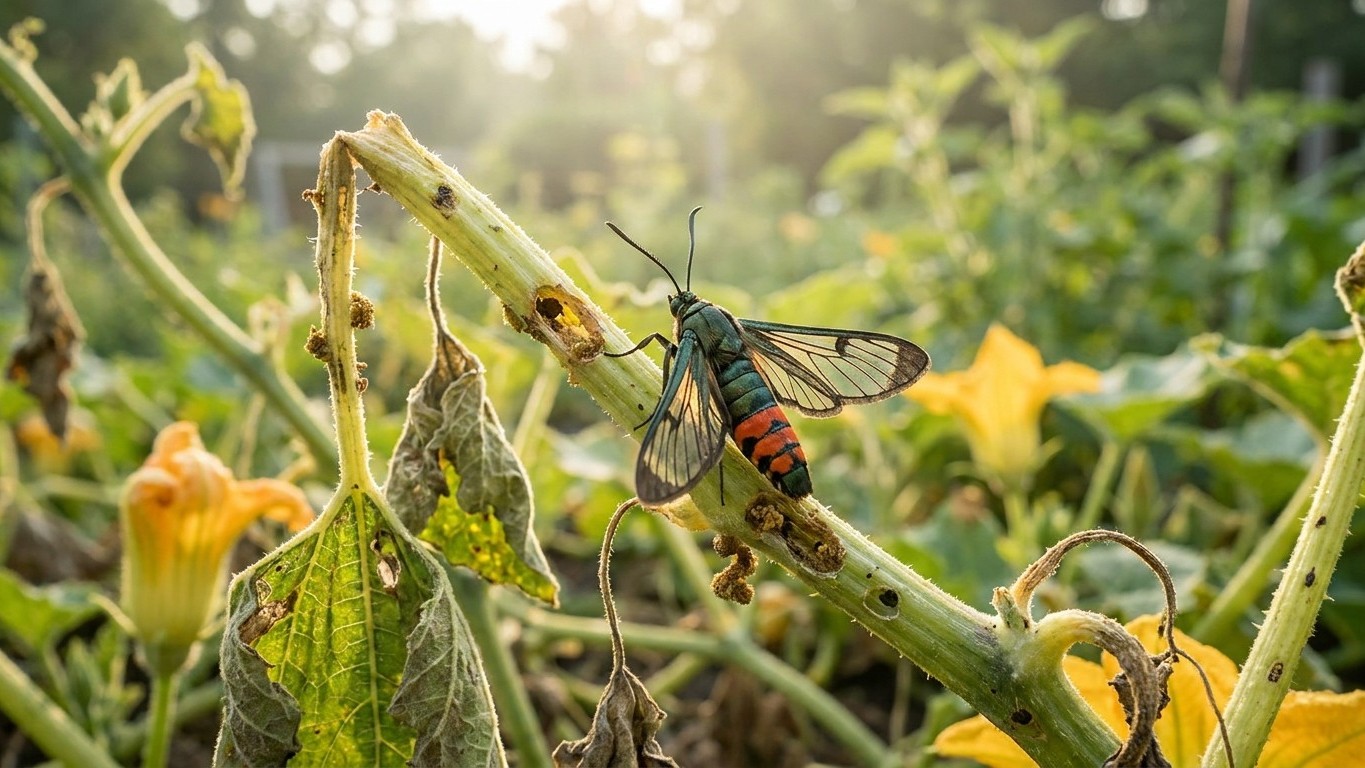

Squash vine borer moths start flying in Alabama earlier than almost anywhere else in the country, and thanks to the state’s long growing season, many gardeners deal with two separate waves of attack instead of just one. The first generation typically emerges in late April through May in south Alabama and mid-May into June farther north, with a second flight often showing up in late July or August. Stopping this pest means combining physical barriers, timely monitoring, and stem-level intervention rather than relying on a single spray or trick.
Two Generations, Not One: Alabama’s Extended Threat Window

In colder states, squash vine borer (Melittia cucurbitae) manages one generation per year. Alabama’s mild winters and long warm season change that math. The insect overwinters as a mature larva or pupa tucked one to two inches into the soil, often right where last year’s squash plants stood. Once soil temperatures hold steady in the 60s, adults chew their way out and start looking for host plants.
That means a south Alabama grower planting an early spring crop of yellow squash can see moths active by late April, while someone in the Tennessee Valley might not spot the first one until late May. The second generation compounds the problem: eggs laid by early-summer survivors hatch new larvae in July and August, right as many gardeners are trying to squeeze out a fall planting of zucchini or pumpkins. Two overlapping generations across a five-month window is longer exposure than gardeners in Ohio or Minnesota ever have to manage.
The adult itself throws people off because it doesn’t look like a typical garden moth. It flies during the day, has a wingspan close to an inch and a half, and sports an orange abdomen with black dots that makes it resemble a wasp more than a moth. Gardeners who see it hovering near squash blossoms often assume it’s a beneficial pollinator and let it go, which is exactly the mistake that lets egg-laying continue unchecked.
How to Spot the Damage Before It’s Too Late
By the time a squash plant collapses, the borer has already been feeding inside the stem for one to two weeks. Catching the problem earlier means checking the base of plants regularly rather than waiting for wilting leaves.
Look for these signs starting a few weeks after transplanting or direct seeding:
- Small, dry, sawdust-like frass piling up near the base of the stem, often the first visible clue
- Tiny entry holes at or just above the soil line, sometimes oozing a sticky, yellowish residue
- Sudden wilting of individual leaves or entire vines even though the soil is moist
- Soft, hollow-feeling stems when gently squeezed near the crown of the plant
- Reddish-brown, oval eggs laid singly on stems near the soil surface, visible with close inspection in the weeks before larvae hatch
Butternut squash and other Cucurbita moschata varieties tend to shrug off borer damage better than yellow summer squash, zucchini, or pumpkins because their stems are more solid and less hollow. That’s not immunity, though, and moschata types still get attacked, especially in a bad year with heavy moth pressure.
Why Alabama’s Humidity Makes Detection Harder
Frass can wash away or dissolve quickly during Alabama’s frequent summer downpours, which means a gardener checking plants only once a week might miss the early warning signs entirely. Checking stems every two to three days during peak flight periods catches problems while the larva is still small enough to remove without killing the vine.
What Actually Works Against Squash Vine Borer
No single tactic handles this pest reliably on its own. Effective control in Alabama gardens usually stacks several methods across the season.
Row covers timed to moth flight. Floating row covers or fine mesh over young plants block egg-laying adults from ever reaching the stems. The catch is that squash needs pollinators, so covers have to come off once flowers open, right around the time moths are most active. Some growers hand-pollinate covered plants in the morning and keep covers on longer, delaying exposure until the first flight wanes.
Stem wraps at the soil line. Wrapping the lower four to six inches of stem in aluminum foil, nylon stocking material, or even a strip of pantyhose creates a physical barrier where females most often lay eggs. This is one of the more practical tricks for home gardens since it doesn’t interfere with pollination and lasts the whole season once installed.
Surgical removal of larvae. If a stem already shows frass, a thin knife blade slit lengthwise along the damaged section (not cutting all the way through) lets a gardener dig out the larva by hand. Mounding moist soil over the wounded section afterward encourages the plant to root along the buried stem and often saves the vine.
Targeted insecticide applications. Products containing spinosad or Bacillus thuringiensis subspecies kurstaki work against young larvae before they tunnel in, but timing matters more than the product itself. Applications need to hit the stem base every five to seven days starting when moths are first spotted, not after wilting appears. Once a larva is inside the stem, sprays on the surface no longer reach it.
Trap crops and yellow bucket traps. Some Alabama growers plant a sacrificial row of Blue Hubbard squash, which borers strongly prefer, along the edge of the main squash bed to lure moths away from the crop meant for harvest. Yellow pan traps filled with soapy water, similar to those used for squash bug monitoring, also help track when adults become active so sprays and covers can be timed accurately instead of guessed.
Timing Your Defense: A Season-by-Season Approach
For south Alabama gardeners planting squash in March or early April, row covers should go on at transplant and stay until the first blooms open, usually four to six weeks later. That window generally lines up with the tail end of overwintering moth emergence, so covers block the earliest and often most damaging wave. Stem wraps and daily frass checks should start the moment covers come off.
North Alabama gardens planting a bit later, into May, face a shorter gap between planting and first-generation moth flight, so covers and stem protection need to be ready sooner relative to transplant date. Either way, the second generation in late July and August tends to hit fall plantings of squash and pumpkins hardest, since those young, tender plants are exactly what a fresh batch of egg-laying females is looking for.
End-of-season cleanup matters as much as anything done during the growing months. Pulling and destroying squash vines immediately after the last harvest, rather than leaving them to decompose in place, removes the overwintering site larvae rely on. Tilling the bed in fall exposes buried pupae to birds and winter weather, cutting down on the population that emerges the following spring. Rotating squash plantings to a different part of the yard each year, at least 50 to 100 feet from the previous bed if space allows, also reduces how easily emerging moths find a new host without much searching.
Related guides
- Squash vine borer in Tennessee: When It Shows Up and What Stops It
- Squash vine borer in Georgia: When It Shows Up and What Stops It
- Squash vine borer in Arkansas: When It Shows Up and What Stops It
- Squash vine borer in Connecticut: When It Shows Up and What Stops It
- Imported cabbageworm in Alabama
- Mexican bean beetle in Alabama
- Corn earworm in Alabama
- Squash vine borer in Missouri: When It Shows Up and What Stops It