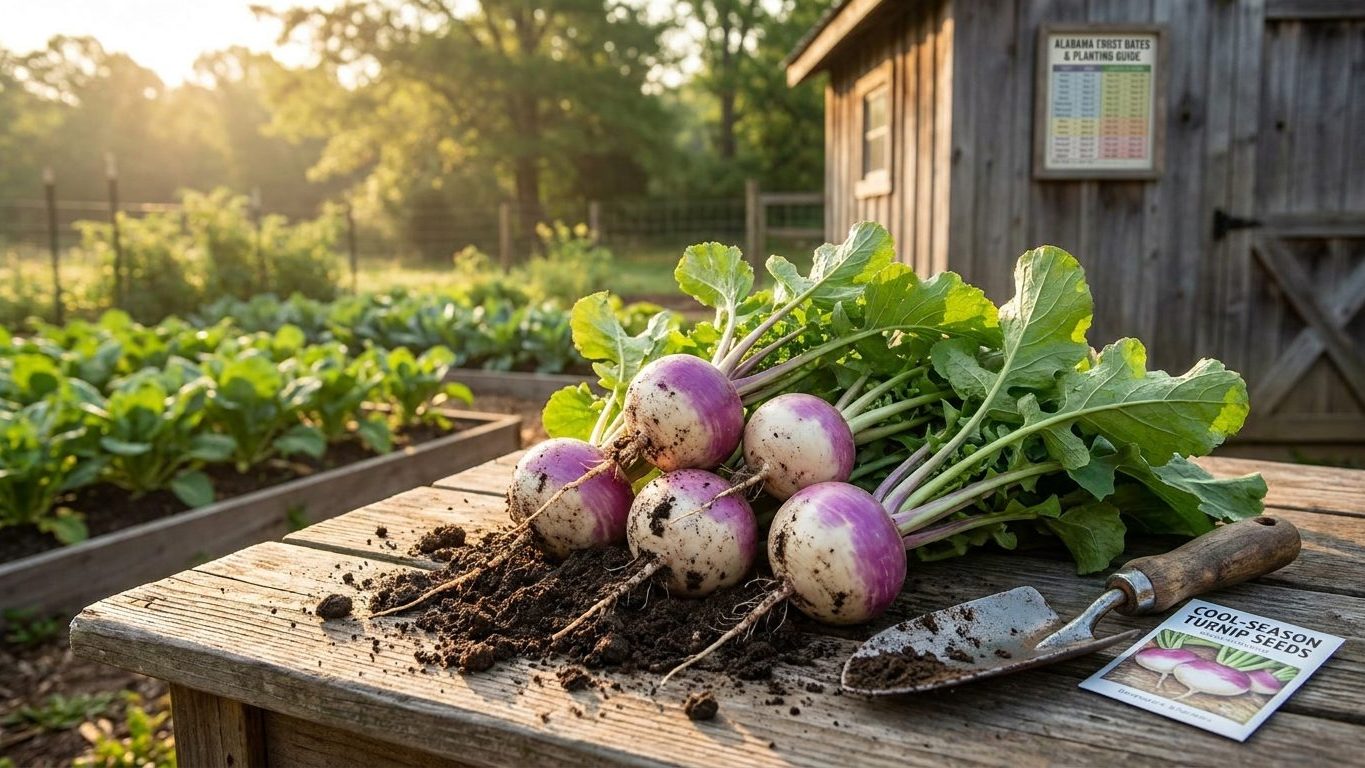

In Alabama, turnips go in the ground twice a year: a fall crop sown from late July through September, and a smaller spring crop sown from mid-February through March. Fall is the safer bet, because turnip roots turn woody and bitter once summer heat settles in. The spring window works only if you get the seed in early enough to beat the heat that follows the state’s frost-free stretch.
The short answer for Alabama
Turnips are a cool-season root crop, and their calendar in Alabama is built around avoiding heat more than avoiding cold. The state’s last spring frost falls between March 19 and April 3, and the first fall frost arrives between November 2 and November 16, according to NOAA’s 1991-2020 Climate Normals for station USW00003856. Those dates are not fixed events. They’re a 30-70% probability band for a 32°F freeze at one airport weather station, which means your own yard could see frost a week or two earlier or later, especially if you garden outside city limits.
For the fall crop, count backward from the first frost date. Turnip roots mature in 40 to 60 days depending on variety, and the greens are edible in as little as 30. Sowing from late July through early September gives most varieties enough runway to size up before that November frost window closes in. Seed sown this late actually benefits from the frost: a light freeze sweetens turnip roots rather than damaging them, so you’re not racing the calendar so much as using it.
The spring crop is the trickier one. Turnips can go in the ground two to three weeks before the last frost date, meaning late February into early March across most of the state. But the growing window from there to reliable 80°F+ days is short, and turnips bolt or turn pithy once soil and air temperatures climb. Spring sowing works best as a quick greens crop rather than a full root harvest, unless you’re in one of the state’s cooler pockets where the heat arrives later.
The coldest month’s average daily minimum in Alabama runs 33.1°F, per NOAA Climate Normals referenced to Huntsville. That number matters more than the record low for turnip growers, because it tells you the crop rarely faces a hard, sustained freeze during a normal winter. Established turnip plants tolerate temperatures well below that mean minimum for short stretches, which is part of why the fall-into-winter window is the one most Alabama gardeners actually rely on.
What will not work here
Sowing turnips in April or May is the most common mistake in Alabama gardens, and the state’s own frost calendar explains why. The last spring frost clears by early April at the latest, but Alabama summers arrive fast behind it. A turnip sown in late April has maybe six to eight weeks before soil temperatures start pushing 80°F, and that’s not enough time for most varieties to size up a root before the plant bolts to seed or turns woody and sharp-tasting. If you want a spring harvest, the seed needs to be in the ground while frost is still a live possibility, not after it’s passed.
Rutabaga is the crop that fails hardest on this calendar, and it’s worth naming separately from turnips because gardeners often lump the two together. Rutabaga needs 80 to 100 days to mature, nearly double a typical turnip. Sown in early September to dodge summer heat, a rutabaga crop is still growing when the first fall frost arrives between November 2 and 16, and a hard freeze on an immature root is a different story than a light frost on a mature one. In Alabama, rutabaga has to go in by mid-to-late July at the latest, while soil is still summer-hot, which is its own separate problem.
Summer-sown turnip seed also struggles with germination in dry, baked soil. Alabama’s late-summer stretches can go weeks without meaningful rain, and turnip seed sown a quarter-inch deep dries out fast in that kind of heat. A once-weekly watering schedule, which works fine for an established fall garden, is not enough to keep shallow-sown seed viable through a hot, dry August. Germination needs consistent moisture for the first week to ten days, which in practice means watering more like every other day until seedlings are up.
Tight spacing is the third failure point, and it’s a humidity problem more than a heat problem. Alabama’s combination of warm nights and high humidity, especially close to the Gulf, favors foliar diseases like white rust and downy mildew on turnip greens planted too close together. Crowded rows trap moisture on the leaves overnight, and that’s exactly the environment those pathogens need.
What changes across Alabama
Alabama spans USDA hardiness zones 7a to 9a, based on the 2023 Plant Hardiness Zone Map, and that two-zone spread is wide enough that no single sowing date works for the whole state. Zone 7a sits in the state’s northern counties, where winter cold arrives sooner and more sharply. Zone 9a runs along the Gulf coast, where frost is rare and mild enough that a turnip crop planted in fall can often keep producing greens through most of the winter.
That spread matters most at the edges of the fall sowing window. A gardener near the northern border is working against an earlier frost and a shorter autumn, so getting seed in by early August, rather than waiting until September, buys more margin. Along the coast, the fall window stretches later into September and the crop can sit in the ground longer without frost forcing an early harvest. The spring window shifts the same way in reverse: northern counties see their last frost later, pushing spring sowing back toward mid-March, while Gulf-coast counties can often start a few weeks earlier.
Elevation adds another layer that the state-level numbers can’t capture. Higher ground in the northeastern part of the state tends to run cooler than the valley floors and coastal plain, which can mean an earlier fall frost and a later spring one than the statewide range suggests. None of this is something to guess at from a zip code. The USDA’s hardiness zone map lets you look up the specific zone for your county, and that’s the tool to check before you lock in a date, rather than assuming your garden matches the state’s midpoint.
Where to check this for your own county
Everything above is a state-level picture, built from one weather station’s climate normals and a statewide hardiness zone range. It’s a reasonable starting point, but it’s not a substitute for what your county extension office knows about your specific soil, microclimate, and the varieties that have actually performed well nearby. The Alabama Cooperative Extension System, at https://www.aces.edu/, is the place to find that finer-grained information.
Two things are worth looking for once you’re there. First, a county-level or regional planting calendar, if one exists for your area, which will typically break the state’s broad fall and spring windows down into narrower dates based on local frost records rather than a single airport station. Second, look for variety trial results or extension publications naming turnip and rutabaga cultivars that have done well in Alabama conditions specifically, since heat tolerance and disease resistance vary a lot between varieties, and a variety that thrives in a humid Gulf-coast garden may struggle in the drier upland part of the state.
A county recommendation will always beat a state one, because it accounts for local frost timing, local soil types, and local disease pressure in a way a statewide page like this one can’t. This page gives you the mechanism, the frost probabilities, and the reasoning behind the calendar. Your county extension office, or a local Master Gardener program working through it, gives you the specific dates and varieties tuned to where you actually garden.
Checking this against your own garden
Once you’ve narrowed down a target window, your own garden will tell you more than any calendar date. Three signs are worth watching, and none of them require anything beyond your hands and your eyes.
Soil warmth by feel is the first and most useful check before sowing. Turnip seed germinates reliably once soil has warmed past roughly 50°F, which for a fall crop means checking that the punishing peak of summer heat has started to ease, and for a spring crop means confirming the ground has actually thawed and warmed rather than just going by the calendar date. Dig down two inches; if the soil feels cool and slightly damp rather than cold and wet or bone-dry and hot, you’re in range.
The first flush of true leaves, the second set that appears after the initial rounded seedling leaves, tells you the plant has moved past its most vulnerable stage and is established enough to handle a light frost or a dry spell without much drama. Seeing them appear on schedule, roughly 10 to 14 days after sowing, is a good sign your local conditions matched what the seed needed.
Watch for early flower stalks, especially on a spring-sown crop. If a turnip starts sending up a central stalk with buds before the root has bulked up, that’s the plant telling you the heat arrived faster than expected in your specific spot, a clearer and more immediate signal than any frost-date table, and worth remembering for how much earlier you sow next spring.
The Moon calendar is a separate, older custom: see when to plant turnips by the moon, written as tradition rather than fact.