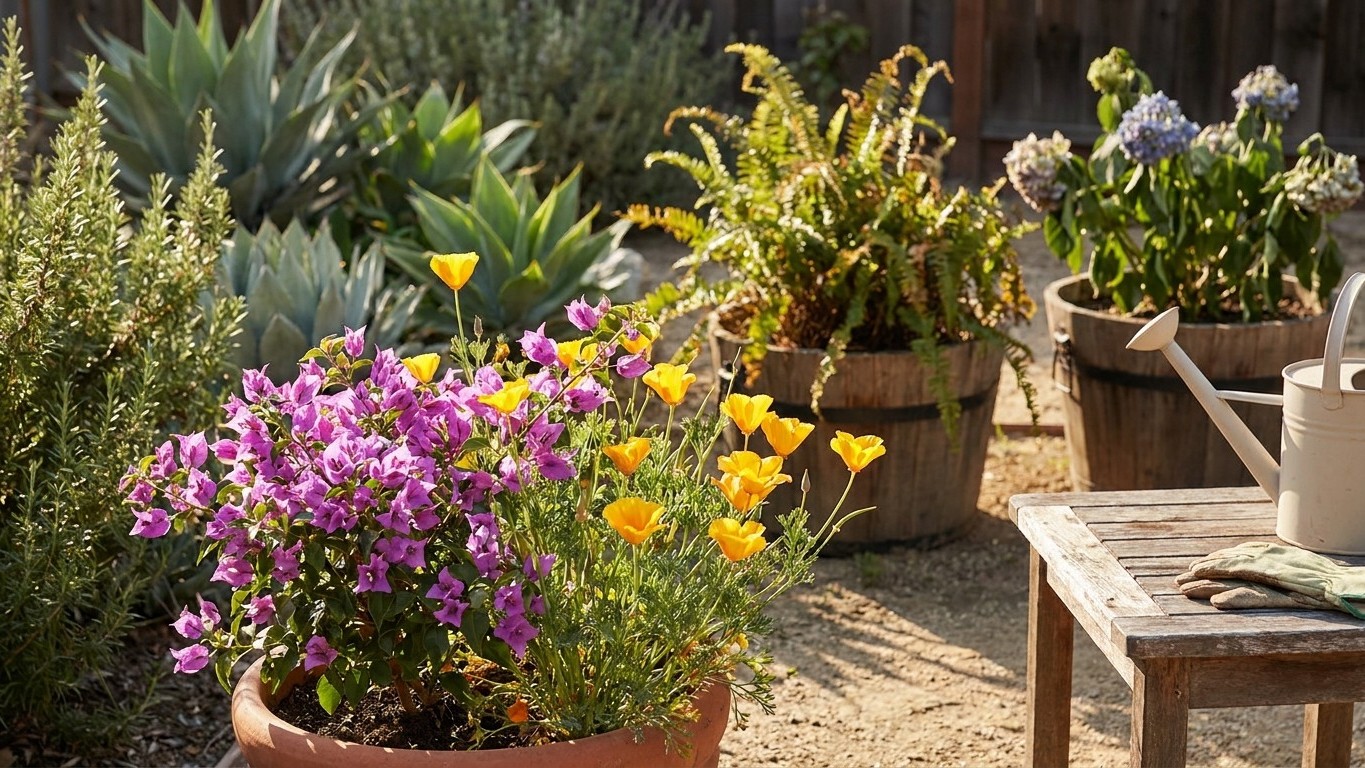

Flowers that thrive in California are the ones built for heat and drought rather than cold. Bougainvillea, lavender, salvia and California poppy do well because the state’s real challenge is dryness and summer sun, not frost. USDA’s 2023 hardiness map puts California anywhere from zone 5a in the high Sierra to zone 11a along the coast, and at the Los Angeles reference station, NOAA’s 1991-2020 climate normals show no freeze occurring in an average year. Check your own zone on the USDA map before ordering anything, because a plant that sails through a Los Angeles winter can die in one Sierra frost.
What thrives in California

2.4 days a year at or above 90F — that’s the coastal average around Los Angeles, and it’s the number every generic “California garden” list quietly assumes applies to the whole state. It doesn’t. Forty miles inland, summer stops being polite, and a flower that sulks in coastal fog can suddenly thrive, while one that loves the coast will scorch by July in Fresno or Redding. The state isn’t one climate wearing a single name.
Heat is the other side of the equation. Los Angeles averages just 2.4 days a year at or above 90F under NOAA’s 1991-2020 normals, but that figure belongs to the coast alone. Inland valleys and the Central Valley run considerably hotter through summer, and a flower that struggles in coastal fog can perform completely differently forty miles inland. This is the single biggest reason plant advice for “California” falls apart: a plant tag written for the coast does not automatically apply to Fresno or Redding.
Traits worth screening for
Before buying anything, check a plant against these:
- Drought tolerance once established, since summer irrigation is expensive and, in many districts, restricted
- Heat tolerance through long dry stretches without wilting or dropping buds
- Sun tolerance, since much of the state gets strong, direct light with little cloud cover in summer
- Cold hardiness matched to your actual zone, not the state average
Plant families that consistently carry these traits include the mint family (Lamiaceae), which gives us lavender, salvia and rosemary, all of which handle dry soil and reflected heat well. The daisy family (Asteraceae) contributes yarrow and coreopsis, both of which shrug off poor soil. Mediterranean shrubs and bulbs, adapted over centuries to a wet-winter, dry-summer rhythm nearly identical to California’s, tend to transplant into the state’s gardens with little fuss. Gardeners coming from a harsher climate, the kind covered in Flowers That Actually Thrive in Colorado, and the Ones That Struggle, often over-water California natives out of habit built somewhere frost and snowmelt did the watering for them.
Native plants worth the space
Native and regionally adapted plants earn their space because they need less water and less fuss once their root systems are established, usually after one full year in the ground. They also do more for the local food web: native bees, butterflies and hummingbirds evolved alongside these species, and many pollinators are far more selective about which plants they can actually use than a general “pollinator-friendly” label suggests.
Reliable choices for California and the wider West
California poppy (Eschscholzia californica) is the most obvious starting point, a low, silvery-leaved annual or short-lived perennial with cup-shaped orange flowers that self-sows readily and asks for almost nothing once seedlings are established. Cleveland sage (Salvia clevelandii) is a rounded, gray-green shrub with whorls of lavender-blue flowers that draws bees and hummingbirds through a long summer bloom. California lilac (Ceanothus species) ranges from low groundcovers to large shrubs, most covered in clusters of blue or white flowers in spring, and it is one of the few widely available natives that tolerates both drought and part shade.
Manzanita (Arctostaphylos species) brings smooth, reddish bark and small urn-shaped white or pink flowers in late winter, useful because it blooms before most of the garden wakes up and feeds early-emerging bees. Yarrow (Achillea millefolium) and native penstemon species fill in as reliable mid-height perennials with flat flower clusters or tubular blooms respectively, both drought-tolerant once past their first season. Sticky monkeyflower (Diplacus aurantiacus) contributes a long bloom season of orange, apricot or cream trumpet-shaped flowers on a low, sprawling shrub.
The tradeoff with natives is patience, not effort. Most need regular water for the first year while roots establish, then very little after that, which is the opposite pattern from a bedding annual that needs steady water its entire short life. Plant them in fall if your area has any rain to rely on, so roots get a head start before the dry season arrives.
Perennials that come back

Whether a flower comes back next year in California depends entirely on matching its published hardiness rating to your actual zone, and that match changes dramatically across a state running from USDA zone 5a to 11a. A plant that returns reliably every year in Los Angeles or San Diego may need replanting annually, or protection through winter, in the Central Valley or the Sierra foothills.
Reading a plant tag against your zone
Lavender, salvia and penstemon are genuinely perennial across most of the state’s milder zones and will come back season after season with only a hard pruning in late winter. Other popular garden flowers are perennial by nature but get treated as annuals here simply because their published cold tolerance does not reach the colder inland and mountain zones. The table below shows a few common examples, using the hardiness ranges commonly printed on nursery tags and seed packets.
| Flower | Typically perennial in | Grown as an annual in |
|---|---|---|
| Bougainvillea | Zones 9-11 (coastal and southern CA) | Zones below 9 (Central Valley, Sierra) |
| Lantana (Lantana camara) | Zones 8-11 | Colder mountain zones |
| Garden geranium (Pelargonium) | Zones 10-11 | Most of inland and northern CA |
| Snapdragon (Antirrhinum majus) | Zones 9-11 as a short-lived perennial | Widely grown as a cool-season annual statewide |
Catalogue figures like these are published nationally and hold everywhere, but they only tell you whether a plant can survive your winter, not whether it thrives there. Always cross the tag’s zone range against your own local zone before assuming a “perennial” will actually return. A gardener working a much shorter, harder season, the kind described in Flowers That Actually Thrive in Alberta, and the Ones That Struggle, treats nearly everything as an annual by necessity. California gardeners, by contrast, have the opposite problem: figuring out which of the “perennials” sold at the local nursery actually qualify as such in their specific zone.
Putting a border together
A border that looks full and deliberate, rather than like a scattering of individual plants, comes down to a handful of practical decisions made before anything goes in the ground.
Height, bloom timing and spacing
Layer by height with the tallest plants at the back of a bed viewed from one side, or in the center of an island bed viewed from all sides. Shrubby natives like Cleveland sage or California lilac work well as the backbone, mid-height perennials like penstemon and yarrow fill the middle, and low groundcovers or reseeding annuals like California poppy edge the front.
Stagger bloom times so something is always flowering. Manzanita opens in late winter, California poppy and penstemon carry spring into early summer, Cleveland sage and lantana take over through the hot months, and yarrow often rebloomsthrough fall if deadheaded. Without deliberate succession planning, most borders peak once in spring and then look tired for the rest of the year.
Repeat two or three colors through the length of the border rather than using one of everything. A bed that repeats the same blue-purple of salvia and Ceanothus every few feet, breaking it up with the orange of poppy or monkeyflower, reads as designed. A bed with one each of ten different colors reads as chaotic, however nice each individual plant looks up close.
Leave real space at planting time. Shrubby perennials and natives especially are sold small in a one-gallon or five-gallon pot and look sparse the first season, but most will double or triple in spread within two to three years. Planting at mature spacing from day one, even though it looks empty at first, saves the work of digging out and dividing an overcrowded bed later.
Local help
The University of California’s cooperative extension service runs Master Gardener programs across the state’s counties, and they are the most reliable source for plant lists tailored to your specific microclimate rather than the state as a whole. You can find your county’s office and current plant recommendations through the UC ANR extension directory. For broader planning across the state’s varied regions, our California guides cover topics beyond flowers, from vegetable timing to soil management.
Common questions
Why do my flowers stop blooming in the middle of summer?
Most likely heat stress rather than a watering problem. Many cool-season bloomers slow down or shut off flower production once temperatures climb, even if the soil is moist, and they typically resume once temperatures ease in fall.
Can I plant flowers year-round in California?
In the coastal and southern parts of the state, yes, since there is no freeze in an average year according to NOAA’s 1991-2020 climate normals for the Los Angeles reference station. Northern California, the Central Valley and the Sierra do freeze, so treat any statewide “plant anytime” advice with caution and check local frost history for your specific area.
Do I need to amend my soil before planting natives?
Usually less than you’d think. Many California natives evolved in lean, fast-draining soil and actually perform worse in rich, heavily amended beds, which can encourage root rot. A light topdressing of compost is usually enough.
Why did the “perennial” I bought die over winter?
It was likely rated for a warmer zone than yours. Nursery tags list a hardiness range based on national ratings, and a plant tagged for zones 9-11 will act as an annual, or die outright, anywhere colder, including much of inland and northern California.
Related guides
- Flowers That Actually Thrive in Oregon, and the Ones That Struggle
- Flowers That Actually Thrive in Nevada, and the Ones That Struggle
- Flowers That Actually Thrive in Colorado, and the Ones That Struggle