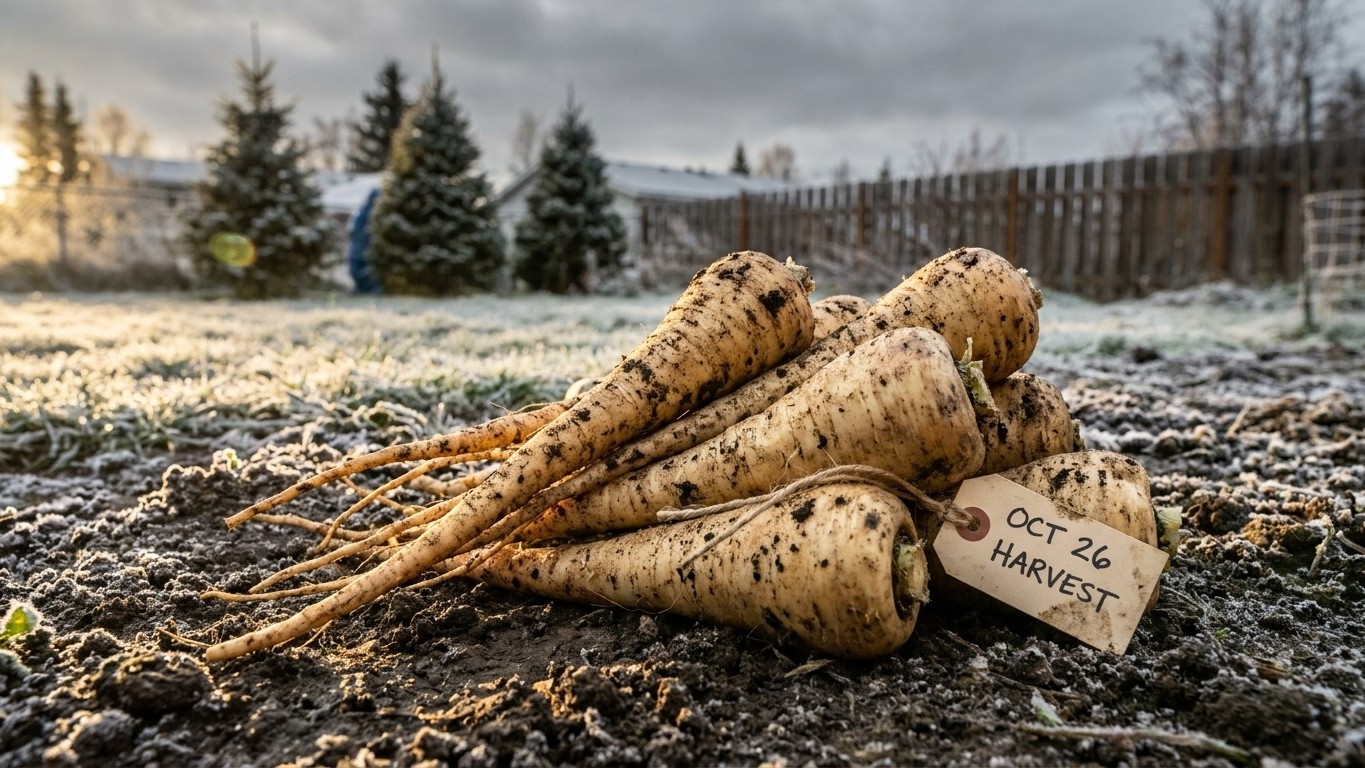

Yes, parsnips grown in the Anchorage area of Alaska will sweeten, and sweeten well. The region banks enough sharp, sub-freezing nights each fall to convert stored root starch into sugar, the shift that turns a bland parsnip into a genuinely sweet one. What limits Alaska growers isn’t cold; it’s daylight and calendar math. The frost that sweetens a root and the frost that kills a plant are two different thresholds, and mixing them up is the most common mistake gardeners make when reading a planting guide written for a warmer state.
The short answer

Start with the number that actually decides this, not the hardiness zone printed on a seed packet. At the Anchorage reference station, the mean daily minimum temperature during the coldest month sits at 11.0°F, according to NOAA NCEI Climate Normals covering 1991-2020. That’s not a record low from some unusual cold snap. It’s the average low across the coldest stretch of an ordinary winter, which tells you this isn’t a marginal or occasional freeze. It’s routine, repeated, and deep.
That figure matters because parsnip sweetness has nothing to do with whether the plant can survive a zone rating. Hardiness zones describe the coldest a perennial can endure and still come back next year. Parsnip sweetening is a different mechanism entirely: the plant stores energy as starch in its taproot, and repeated exposure to cold, frosty weather triggers an enzymatic conversion of that starch into sugars, according to Utah State University Extension. A parsnip can grow in a place with a comfortable, mild zone rating and still taste flat, because comfortable isn’t the same as frosty. Alaska has the opposite problem in the best possible way: nobody is worried this climate is too mild.
With a coldest-month average low of 11°F, and a first fall frost that typically lands between September 22 and October 1 near Anchorage, the roots left in the ground through several weeks of autumn cold get exactly the sustained chill USU Extension describes as necessary. This is not a place where a gardener has to wonder if winter arrived hard enough. It arrives hard, and it arrives on a predictable schedule that lines up with when parsnips are usually ready to be sweetened rather than simply grown.
So the flavor question resolves itself early. The harder question, and the one that actually decides whether a gardener in this region gets a full-sized root at all, is whether the growing season leaves enough daylight-to-maturity time before that first hard frost shows up. That’s a matter of counting days, not degrees.
Does the season fit?
- Sowing date: Parsnips are sown directly in place, not started indoors and transplanted, and Utah State University Extension recommends sowing 2-3 weeks before the last spring frost. Near Anchorage, the last spring frost falls between May 3 and May 12, which puts a realistic sowing window in mid-to-late April.
- Germination: Parsnip seed is slow. Count on 14 to 21 days before seedlings break the surface, dig up nothing and re-sow nothing if the bed looks bare after a week, because that’s normal, not failure.
- Days to maturity: USU Extension puts full maturity at 100 to 120 days from seeding. Counting from a mid-to-late April sowing, that lands the roots at harvestable size somewhere in the second half of August, well ahead of anything approaching a hard freeze.
- First fall frost: Between September 22 and October 1, roughly four to five weeks after the roots reach maturity size. That gap is the window where the roots sit in the ground, exposed to the first cold nights, doing exactly the starch-to-sugar conversion the crop needs.
- The verdict: With roughly 143 frost-free days available near Anchorage and only 100 to 120 needed for the crop to mature, this season fits comfortably rather than tightly. There’s slack on both ends, enough to allow for a slow germination stretch and still leave weeks of frosty ground time before the roots need to come up.
That comfortable margin is specific to the Anchorage area, which NOAA classifies among the mildest inhabited parts of the state. Long summer daylight helps compensate for the shortened season, but the Interior and points further north run a much shorter frost-free window, and the arithmetic above doesn’t transfer automatically.
What goes wrong here
- Forked roots from heavy or stony ground. Much of Alaska’s soil sits over glacial till, dense and full of rock. A taproot meeting a stone or a compacted layer splits rather than growing straight down. USU Extension’s fix is deep sandy loam where it exists, and double-digging the bed 12 to 18 inches where the soil is heavy, clearing stones as you go.
- Forked roots from overwatering. This is a separate cause from soil texture, not a variation on it. Roots sitting in consistently saturated ground branch and split even in a well-worked bed. The fix is steady, moderate moisture and a bed that drains rather than pools.
- A season that runs out before maturity. Not a risk in the Anchorage area given the margin above, but a real one further into the Interior or the north, where the frost-free window shrinks sharply. Gardeners there gain little by sowing earlier into cold soil; row covers and raised beds that warm faster in spring do more to close the gap.
- Sweetness that never develops. This isn’t an Alaska problem given how cold the coldest month runs here, but it’s worth naming because it’s the flip side of the same mechanism: a winter too mild simply never delivers the several frosty weeks the starch conversion needs, no matter how well the roots grew.
Before harvest day, one warning has nothing to do with soil or season. North Carolina Extension Gardener Plant Toolbox states plainly: “All parts of this plant contain furocoumarins which can make skin sensitive to light causing burns so be sure to wear gloves, long sleeves and long pants when dealing with it.” Not the foliage alone, all parts, including the roots and stems.
The mechanism is what makes this catch people off guard. The burn doesn’t come from the sap by itself. It takes sap on the skin and sunlight together, a reaction called phytophotodermatitis. That’s why it shows up after a bright afternoon spent pulling tops or digging roots, and why the reaction often doesn’t appear until hours later, when the skin that touched broken stems or handled the crop in direct sun starts to redden or blister. Washing up afterward doesn’t undo the exposure once sunlight has already reacted with the sap on the skin. The protection has to happen before the sun does, which means gloves, long sleeves, and long pants on the day you handle this crop, not a trip to the sink once the work is done.
Checking this against your own county
Every figure above is anchored to a single reference station near Anchorage. Alaska is enormous, and the Interior, the Southcentral coast, and the far north each run on frost calendars that don’t resemble each other, let alone the numbers used here. Before committing a season’s worth of bed space to a crop with a 100-to-120-day clock, check the local frost-free window and soil conditions against your own area.
The University of Alaska Fairbanks Cooperative Extension Service is the right place to start. It’s the land-grant extension office for the state, and it can confirm local frost dates, recommend soil amendments suited to your specific ground, and flag anything about your microclimate that the statewide picture misses.
Common questions
Do parsnips need to be left in the ground after the first frost?
Utah State University Extension’s guidance is that the sweetening happens after several weeks of cool, frosty weather, so leaving roots in place through the early frosts rather than pulling them at the first cold night gives the starch-to-sugar conversion time to happen.
Can parsnip seed be started indoors and transplanted in Alaska to save time?
The crop is grown by direct sowing in place; nothing in the guidance covers a transplant method, and a taproot crop generally doesn’t take well to having its root disturbed early.
Is a mild coastal spot in Alaska different from the Anchorage figures used here?
Very possibly. These numbers come from one reference station, and coastal microclimates elsewhere in the state can run milder or wetter; check locally rather than assuming the same window applies.
Does wearing gloves only matter when pulling parsnip tops?
No, the warning from NC State Extension covers all parts of the plant, not just the foliage, so the same precaution applies when handling the roots too.