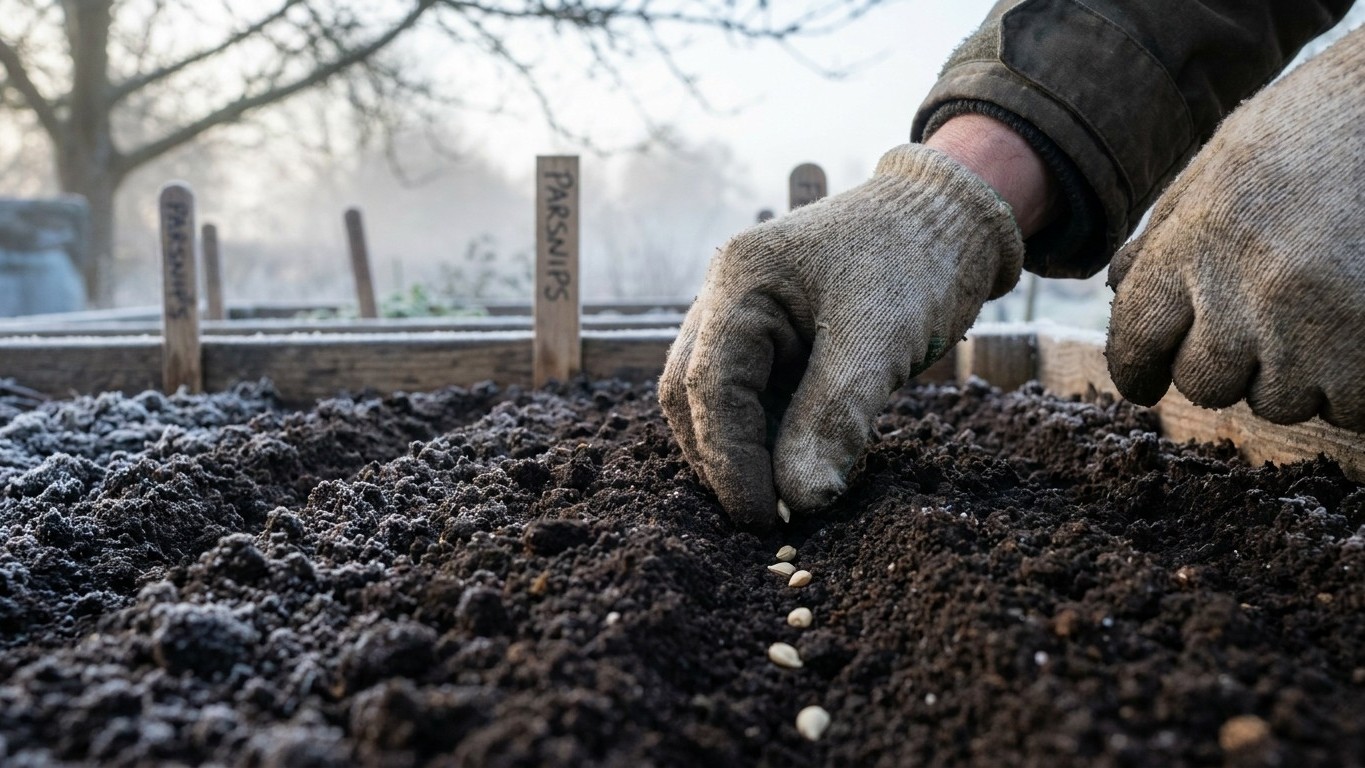

In the Anchorage area, sow parsnip seed directly into the garden bed from mid-April to late April, roughly two to three weeks before the average last spring frost (May 3 to May 12). Seeds germinate slowly in cool soil, taking 14 to 21 days to show green, so patience matters more than replanting. The 100 to 120 day season then stretches into September and October, when repeated frosts convert the root’s stored starch into sugar.
The short answer
Ask whether a place delivers several frosty weeks, and Anchorage answers clearly: yes. The mean minimum temperature of the coldest month here sits at 11.0°F, according to NOAA’s 1991-2020 Climate Normals for the Anchorage station. That figure isn’t a record low, and it isn’t a hardiness zone rating. It measures the average nightly low across the coldest month of the year, and at 11 degrees, it tells you this ground spends weeks locked well below freezing every winter.
That distinction matters for parsnips because the crop’s flavor depends on cold exposure, not on which USDA zone a map assigns to a town. A hardiness zone predicts whether perennial roots survive winter underground; it says nothing about whether the air around a parsnip top gets cold enough, for long enough, to trigger the starch-to-sugar conversion that gives the vegetable its reputation. Two towns can share the same zone number yet deliver very different frost seasons, because zone ratings track absolute minimum extremes, not the weekly rhythm of cold that ripens flavor.
Anchorage’s numbers settle the question directly. A mean minimum of 11.0°F in the coldest month, paired with a first fall frost that typically lands between September 22 and October 1, means the crop experiences not one light frost but a sustained run of cold weeks before the ground locks up for winter. That’s the exposure parsnips need. Utah State University Extension notes the roots taste best after several weeks of cool, frosty weather, since that cold converts stored starch into sugar. Anchorage’s climate delivers exactly that kind of sustained cold, not just a token overnight dip.
So a parsnip sown here won’t just survive to harvest, it will sweeten the way growers hope for, provided the roots stay in the ground long enough to catch those weeks of frost before digging. Skip that frost period, pull the crop the day after the first light freeze, and the sugar conversion barely starts. The climate does the work; the gardener’s patience decides whether the crop actually collects on it.
Does the season fit?
Anchorage’s frost calendar and the parsnip’s own timeline line up more comfortably than most Alaska gardeners expect. Here’s the arithmetic, step by step.
- Start from the last frost. The average last spring frost falls between May 3 and May 12. Sowing 2 to 3 weeks ahead of that date places the seeding window between April 12 and April 28.
- Account for slow germination. Parsnip seed takes 14 to 21 days to sprout in cool soil. A seed sown April 12 might not show green until early May, right around the last-frost window itself, but buried seed isn’t harmed by a light frost overhead.
- Measure the frost-free stretch. Anchorage averages about 143 frost-free days, running from the May 3-12 last frost to the September 22-October 1 first fall frost.
- Add the early buffer. Because sowing happens 2 to 3 weeks before that frost-free window even opens, the usable growing period, measured from seeding to first fall frost, actually runs closer to 157 to 164 days.
- Compare against the crop’s needs. Parsnips need 100 to 120 days from seeding to maturity. Even sowing at the earlier end of the window and using the longer end of the maturity range, the roots reach full size with roughly a month to spare before the first fall frost typically arrives.
- Count the sweetening days. That surplus doesn’t go to waste. Since parsnips tolerate light ground freezing and actually improve with it, the extra days double as the frost-sweetening period, letting roots sit in cooling soil through the season’s first frosts before harvest.
The upshot: for the Anchorage area, the season fits comfortably rather than tightly, as long as sowing happens promptly within the mid-to-late April window rather than drifting into May.
What goes wrong here
Soil, water, and timing
Three separate problems trip up parsnip crops in this climate, and they don’t share one cause.
- Forked roots in heavy or stony native soil. Anchorage-area yards often sit on compacted or rocky ground, and a parsnip root splits into forks the moment it hits an obstruction. Utah State University Extension recommends deep, sandy soil for straight roots; where the native ground is heavy, double dig the bed to at least a foot deep before sowing, working in enough sand or fine compost to let the taproot drive straight down.
- Forked or hairy roots from overwatering. This is a separate cause from soil texture, and it’s an easy one to trigger with a hose. Excess moisture, especially uneven watering that swings from soggy to dry, encourages side roots and hair-like growth along the taproot. Water evenly and moderately through the season rather than flooding the bed after a dry stretch.
- A season that runs out on late sowings. The arithmetic above works only if seed goes into the ground within the mid-to-late April window. Delay sowing into late May, and the 100 to 120 day maturity period pushes the harvest dangerously close to, or past, the September 22-October 1 first frost, with no buffer left for the sweetening period.
- Harvesting before the frost has done its work. Eager gardeners often pull parsnips at the first sign of a light freeze, assuming the crop is done. That’s premature. The starch-to-sugar conversion needs several frosty weeks, not one overnight dip. Leave roots in the ground through repeated fall frosts, mulching heavily once nights turn consistently cold, and harvest later rather than sooner.
Common questions
When exactly should I sow parsnip seeds in Anchorage?
Aim for mid-April to late April, timed to land 2 to 3 weeks before the average last spring frost, which falls between May 3 and May 12 at the Anchorage station.
How long do parsnip seeds take to germinate in Alaska’s cool soil?
Expect 14 to 21 days. Don’t dig up the bed or re-sow if nothing shows after a week; that’s normal for parsnip in cool spring soil.
Can parsnip seedlings handle a light frost after sowing?
Buried seed and early germination are unharmed by the light frosts still possible in early May, since the last-frost date itself falls in that early-to-mid May range.
Do I need special soil for growing parsnips in Alaska?
Utah State University Extension calls for deep, sandy soil for straight roots. Where the native ground is heavy or stony, as it often is around Anchorage, double dig the bed before sowing rather than planting directly into compacted soil.