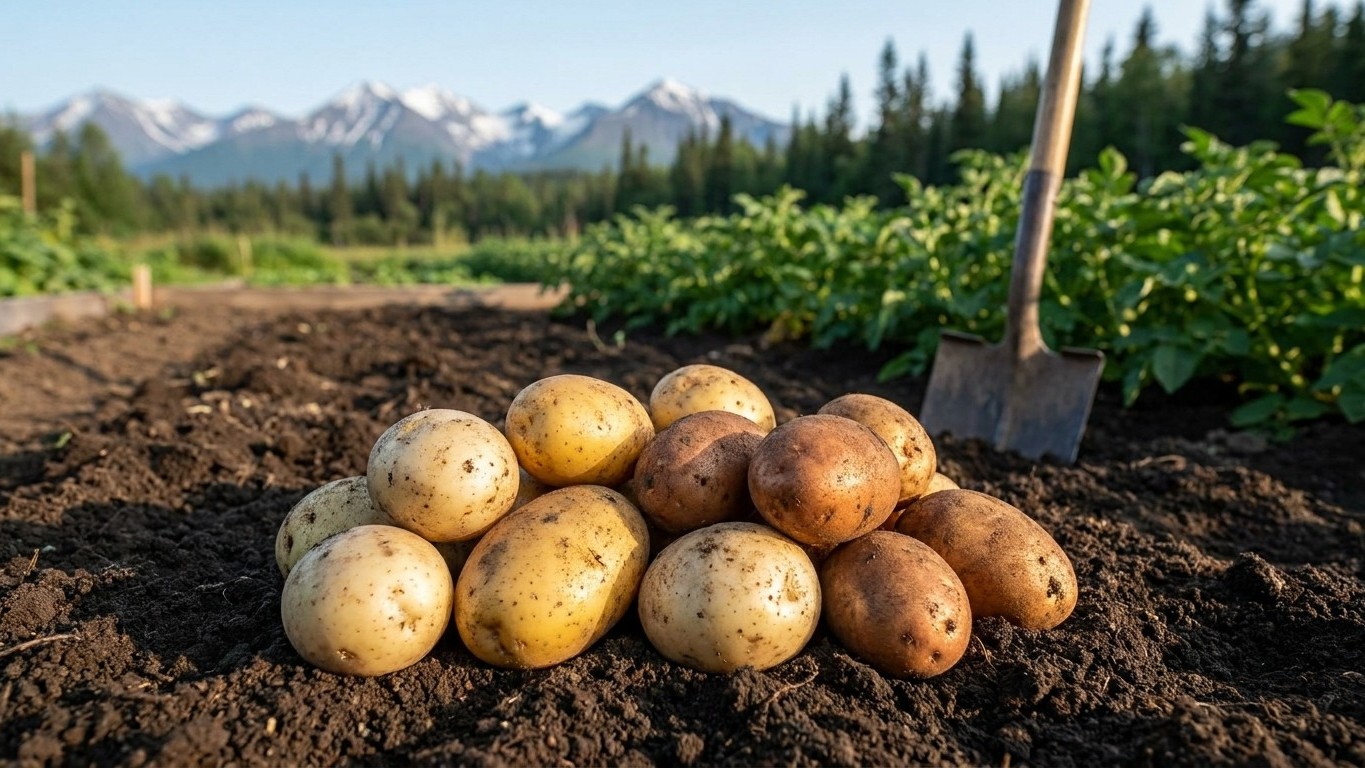

Alaska’s short growing season favors early and mid-season potato varieties bred for cool soil and quick tuber set, not the long-season types grown in warmer states. In Anchorage, the reference city for South-central Alaska, the last spring frost falls between May 3 and May 12, according to NOAA NCEI’s 1991-2020 Climate Normals for station USW00026451. That window, combined with roughly 143 frost-free days, shapes which varieties actually finish a crop before the ground cools again.
The short answer
Early and mid-season potatoes are the ones that suit Alaska, and the reasoning starts with that May 3 to May 12 frost window from NOAA NCEI. A gardener working from an Anchorage-area calendar has roughly 143 frost-free days to work with, and that count drops fast the farther north or inland you go. The Interior around Fairbanks and the northern regions run a much shorter window than Anchorage, which sits among the mildest inhabited parts of the state. Long summer daylight helps offset the short calendar, pushing plant growth hard once the soil warms, but daylight does not create more frost-free days on its own.
Neither Utah State University Extension nor the University of Maine Cooperative Extension publishes a days-to-maturity figure for individual potato varieties, so this page will not invent one. What both sources do publish is season class: early, mid-season, or late. That distinction matters more in Alaska than almost anywhere else in the country, because a late-season variety simply may not have enough frost-free days to size up before the ground freezes again in fall. An early or mid-season variety, planted at the right soil temperature, has a realistic shot at reaching harvest within an Anchorage-length season.
The other half of the answer is what the plant does underground once the season is running. Utah State University Extension and the University of Maine Cooperative Extension both note that tuber set and fill shut down when soil temperatures climb above 90 F, and that potatoes should go into the ground as soon as soil reaches 50 F, which works out to 14 to 21 days before the last frost date. That’s a narrower planting window than most vegetables get, and it’s the reason experienced Alaska gardeners talk about planting “early and cool” rather than waiting for guaranteed frost-free air.
So the short answer isn’t really about picking a brand name off a seed rack. It’s about matching season class to the frost-free count for your specific location, and getting the crop into cool soil early enough that it can finish before either a fall frost or a hot-soil stretch cuts tuber growth short. Reference-city numbers like Anchorage’s do not carry over to Fairbanks, Delta Junction, or the Kenai Peninsula without adjustment, and this page won’t pretend otherwise.
What actually decides it
The frost-free window sets the ceiling
Anchorage’s roughly 143 frost-free days, bracketed by that May 3 to May 12 last-frost window from NOAA NCEI, function as a hard ceiling on what a potato crop can accomplish in a single season. A mid-season variety planted on schedule has room to finish; a late-season variety is racing a clock it may not win. This is exactly why the sources point gardeners toward season class instead of variety marketing names: season class tells you whether the plant’s genetics are built to size tubers quickly or to take its time doing it.
Soil temperature, not air temperature, triggers planting
The 50 F soil-temperature threshold from Utah State University Extension and the University of Maine Cooperative Extension is the real trigger, and it typically arrives 14 to 21 days before the last frost date. That means an Anchorage-area gardener isn’t waiting until mid-May air feels safe. They’re checking soil, not sky, and getting seed potatoes into the ground while a light frost is still a real possibility above ground. The plant tolerates cool soil at planting far better than it tolerates a compressed season later.
Heat above 90 F stops the clock from the other end
The mechanism that decides the whole crop, per Utah State University Extension and the University of Maine Cooperative Extension, is what happens when soil crosses 90 F: tuber set and fill are inhibited, and watering does not reverse it. This is less of a concern in much of Alaska than in warmer states, but it’s the reasoning tool that transfers to any other territory this page doesn’t name. Wherever a location logs a high count of 90 F soil days, the answer shifts from nursing a full summer crop to digging a spring crop early, before heat shuts tuber growth down. Reading a location’s heat pattern against that 90 F ceiling, alongside its frost-free day count, is what lets a gardener reason about a spot in the Mat-Su Valley or the Kenai Peninsula without needing a separate fact sheet for each one.
How to do it
- Check your soil temperature directly with a soil thermometer rather than guessing from air temperature or the calendar date.
- Plant certified seed potatoes as soon as soil reaches 50 F, which typically falls 14 to 21 days before your area’s last frost date.
- Choose early or mid-season varieties over late-season ones, since neither Utah State University Extension nor the University of Maine Cooperative Extension publishes a maturity-day figure but both confirm season class as the meaningful distinction for a short-season location.
- Select varieties by intended use, since baking and boiling performance is published by these sources, while texture terms like waxy or floury are not used here.
- Track your local frost-free day count against the reference-city figure for your region, since a statewide number is never accurate for every location in Alaska.
- Watch soil temperature again in mid-summer, and if your area regularly crosses 90 F in the root zone, plan to dig earlier rather than extending the crop into hot soil.
- Harvest once foliage dies back or once the season’s frost-free window is closing, whichever comes first for your specific reference city.
What goes wrong
- Planting by air temperature instead of soil temperature. Waiting for warm, frost-free air often means missing the 50 F soil window entirely. Check soil directly with a thermometer and plant 14 to 21 days ahead of Your Last Frost date, as Utah State University Extension and the University of Maine Cooperative Extension both describe.
- Choosing a late-season variety for a short-season location. A late-season potato may not size up before Anchorage-area frost returns in fall. Favor early or mid-season season class, which both extension sources publish, over an unpublished maturity-day guess.
- Assuming watering fixes heat stress. Once soil crosses 90 F, tuber set and fill are inhibited and irrigation does not reverse that, per the same two sources. The remedy is timing the crop earlier in the season, not adding water later.
- Using saved or uncertified seed potatoes. Uncertified seed carries virus forward into the crop, reducing yield and vigor. Starting with certified seed potatoes each season avoids importing a problem you can’t see at planting time.
- Applying an Anchorage frost date to a different part of the state. The May 3 to May 12 window and the roughly 143 frost-free days come from a single reference city; the Interior and northern Alaska run a much shorter season, and a gardener there needs to shift the whole planting plan earlier and choose the shortest-season class available.
- Ignoring texture claims not published by the sources. Marketing language that calls a variety “waxy” or “floury” isn’t part of what Utah State University Extension or the University of Maine Cooperative Extension publish. Choose based on stated use, baking or boiling, instead.
Common questions
Do potatoes need full sun in Alaska’s long summer days?
The sources used on this page address soil temperature and season class, not sunlight requirements specifically, so that figure isn’t published here.
Can I plant potatoes before the last frost date in Anchorage?
Yes. Utah State University Extension and the University of Maine Cooperative Extension both note that potatoes go in once soil reaches 50 F, which lands 14 to 21 days before the last frost date, meaning planting typically happens while frost is still possible above ground.
Is a late-season potato ever worth trying in Anchorage’s roughly 143-day season?
Neither extension source publishes a maturity-day count, so this page can’t confirm whether a specific late-season variety would finish. The safer approach, based on season class alone, is choosing early or mid-season potatoes for a season this short.
Does the 90 F soil heat ceiling matter much in Alaska?
It matters less than in hotter states, but the mechanism still applies wherever soil temperature climbs that high. Checking soil temperature through the season, rather than assuming Alaska’s climate rules it out entirely, is the more reliable approach.