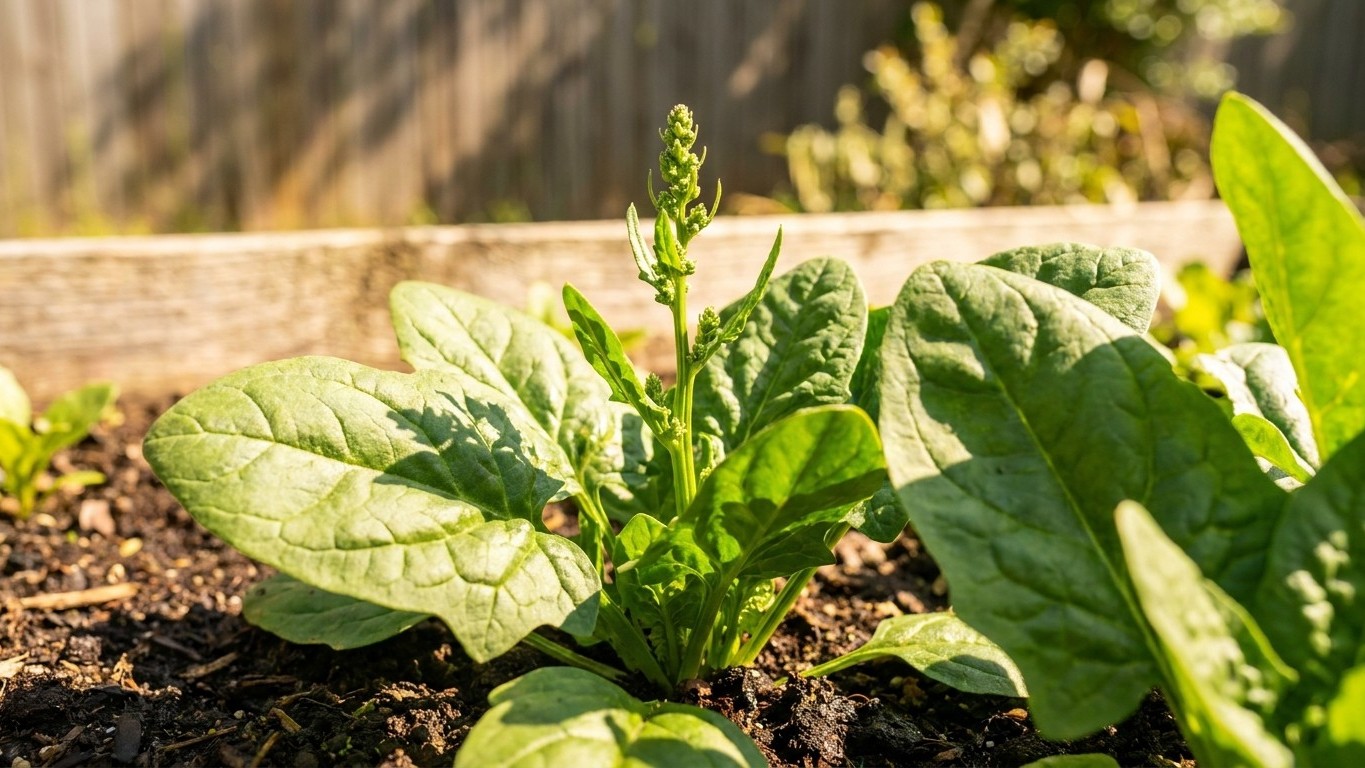

Cut spinach young, before the long days push it to flower, and treat the refrigerator as a holding pen for 10 to 14 days at most. For Anchorage, the reference point for the numbers here, that means a spring sowing in mid-to-late April and a second sowing between early July and mid-August. Daylight, not heat, is what ends spinach in Alaska. The sections below give the dates and the arithmetic behind them.
The short answer
Daylight sets the deadline
The longest day of the year in Anchorage delivers 18 h 56 of daylight. That figure comes from the city’s latitude and a geometric horizon, so real daylight runs about seven minutes longer. Either way, the sun is up for most of the clock. For spinach, that is the problem. Utah State University Extension is blunt about it: spinach bolts, meaning it sends up a flower stalk, during long days and warm temperatures. Long days alone are enough to trigger it.
A cool summer therefore does not buy extra weeks. Many northern gardeners hope the cold will stretch a cool-weather crop, but cold only covers the temperature half of the trigger. Anchorage averages 0.0 days a year at 90 F or hotter, so heat is almost never what finishes a spinach bed here. Day length is the limit. Heat is a smaller second factor, since Extension puts the ceiling for good growth at 75 F, and a greenhouse, cold frame or sunny south wall can pass that on a clear afternoon even when the weather outside is mild.
The practical rule follows from that. Cut early, cut often, and don’t wait for big leaves. The same 75 F figure is where growth stalls and where leaves turn bitter, so a bed that has already tipped toward flowering gives you tough, sharp-tasting leaves. For what a bolting plant looks like and which sowing dates to avoid, see Will Spinach Bolt Early in Alaska?
How long it keeps once it’s cut
Spinach is a two-week crop at best. The UC Davis Postharvest Technology Center lists the optimum storage at 32°F and 95 to 98 percent relative humidity, and says spinach “will not maintain good quality for more than 2 weeks.” Wilting, yellowing and decay are likely to increase once storage runs past 10 to 14 days. That is a ceiling, not a plan, and it only applies at 32°F.
A home refrigerator rarely holds that. At 41 to 50°F, the range typical of ordinary distribution conditions and of a fridge door, the same source says spoilage comes faster, and yellowing can show up within days. The coldest, steadiest spot is the back of the bottom shelf, away from the door and the cooling vent. A closed container keeps humid air around the leaves, which matches the high humidity UC Davis specifies. Plan to eat what you cut within the first week or so, and treat anything past day ten as a gamble.
How long the spring window really is
The frost-free season in Anchorage runs about 143 days, which sounds generous until you remember that spinach cannot use all of it. It gets a slice at each end. The spring slice breaks down like this.
- Sowing opens two to three weeks before the last frost. NOAA’s 1991-2020 climate normals for the Anchorage station put the last spring frost between May 3 and May 12 (NOAA NCEI normals). Three weeks before May 3 is April 12. Two weeks before May 12 is April 28. So the opening is a band about 16 days wide, from roughly April 12 to April 28, depending on the year and on whether the ground is workable.
- The heat ceiling rarely closes the window. Growth stops being good above 75 F, but with zero 90 F days in a typical year, open ground in Anchorage seldom runs hot enough to force the issue. Under glass or plastic it can. The 75 F figure is a temperature, not a calendar date, and no date for it is published here.
- Daylight is the clock that runs out. Days keep lengthening through spring toward that 18 h 56 peak. The source publishes no day-length threshold for bolting and no days-to-maturity for spinach, so there is no honest way to name the week the window shuts. What the numbers do say is that every week you delay sowing starts the count later and moves it closer to the long days.
- Count usable spring from sowing day to the first flower stalk. Anchorage has roughly two weeks of sowing opportunity at the front end, and the cutting window that follows is set by daylight, not by the thermometer. Treat the 143 frost-free days as the outer fence, and plan to be done with the spring crop well inside it.
- Harvest as you go. Young leaves are the point. A bed you thin and cut early is a bed you have already harvested if the stalks start rising.
Which variety to sow
Utah State University Extension names four varieties: Bloomsdale, Melody, Teton and Olympia. It publishes no data on any of them, not days to maturity, not bolt resistance, not leaf type. I won’t pretend otherwise. If a seed packet claims slow bolting, that is the seller’s claim, not something the sources here back up. In Alaska, sowing date will do more for you than variety.
The autumn crop, and when the soil lets you sow
Autumn spinach is the cleaner bet in many gardens, because the days are shortening instead of lengthening. The planning rule from Extension is to plant 50 to 75 days before the date you want to harvest. The source gives no days-to-maturity for spinach, so that range is a planning rule, not a prediction.
A realistic harvest target in Anchorage is the first fall frost, which NOAA’s normals place between September 22 and October 1. Count back from September 22: 50 days is August 3, and 75 days is July 9. Count back from October 1: 50 days is August 12, and 75 days is July 18. Put together, the sowing window runs from about July 9 to August 12. The early end of that range is the risky one, since early July seedlings still sit under nearly the longest days of the year. My read is that the second half of the window is the safer half.
Obstacle one: soil that is too warm to germinate
Germination drops when the soil is above 80 F, per Utah State University Extension. In much of the country, that is what blocks an August sowing: the seed sits in hot dirt and fails. Alaska is not that story. With zero 90 F days in a typical year, open ground in Anchorage is unlikely to reach that mark. A bed under black plastic, inside a high tunnel or against a sun-baked wall is another matter, and a soil thermometer settles it faster than guessing. If seeds sown in July come up patchy, warm soil is the first thing to rule out, and you can fix it by shading the bed or watering it to cool it before sowing.
Obstacle two: the frost that ends the season
The other deadline is the first fall frost, September 22 to October 1 in Anchorage. Anchorage is one of the mildest inhabited parts of Alaska. The Interior and the north have much shorter frost-free seasons, and this page holds no frost dates for them. If you garden outside Anchorage, find your own date and count back from it using the same 50-to-75-day rule. Long summer daylight partly compensates for the short season, which is why a sowing made in early August can still produce, but only if the count back from your own frost date works.
Late sowings also face pests that spring sowings miss, and some arrive just as the leaves reach cutting size. What Eats Spinach in Alaska, and When covers the timing.
Common questions
How do I know when to cut spinach?
Cut while the leaves are young and before a flower stalk rises from the center. The sources here publish no leaf size or days-to-maturity, so the plant itself is the signal. If the center is lengthening or the leaves taste bitter, the plant is bolting and the harvest is over. The full growing picture is in Growing Spinach in Alaska.
Does Alaska’s cool summer let spinach grow all season?
No. Long days alone trigger flowering, and Anchorage gets 18 h 56 of daylight on the longest day. Cool air does not cancel that. Heat is the lesser problem here, since Anchorage averages no days at 90 F or above, but daylight is the limit.
How long does cut spinach last in the fridge?
At best about two weeks, and only at 32°F with 95 to 98 percent humidity. UC Davis says it will not keep good quality beyond two weeks, and wilting, yellowing and decay increase after 10 to 14 days. In a fridge door at 41 to 50°F, it goes faster. Store it at the back of the bottom shelf, in a closed container.
When should I sow spinach for a fall harvest in Alaska?
Plant 50 to 75 days before the harvest date you want. For Anchorage, counting back from a first frost between September 22 and October 1 gives a sowing window from about July 9 to August 12, with the later half the safer one. Outside Anchorage, the frost date arrives sooner, so the window shifts earlier on the calendar, and this page does not hold the frost dates for those places.