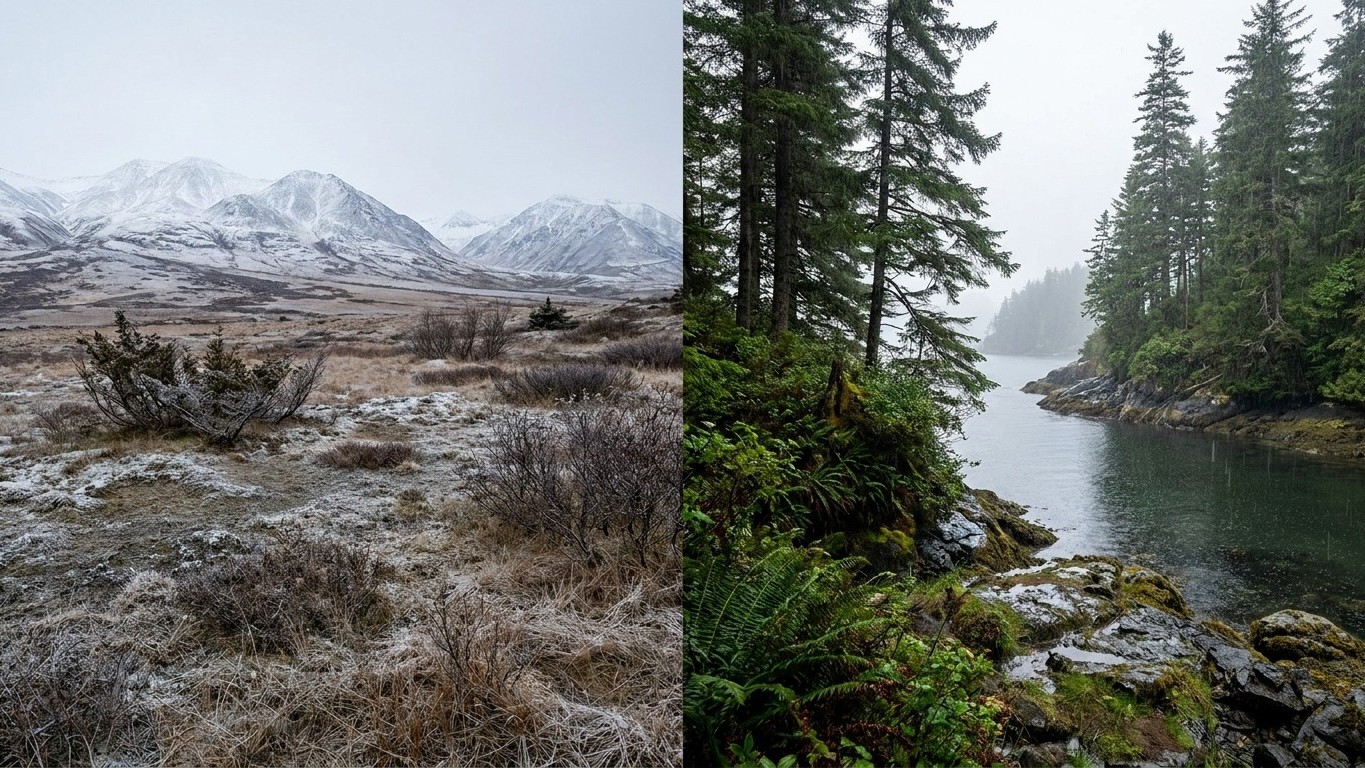

Alaska’s USDA hardiness range runs from 1a to 8a, the widest spread most territory pages on this site deal with. Cross that against the 65 Trees, Shrubs and Perennials tracked here, and none survive across the whole state, but none fail everywhere either. All 65 are hardy somewhere in Alaska and shut out somewhere else. The real question isn’t whether a plant works in Alaska. It’s which zone of Alaska.
What will not survive a winter in Alaska

That eight-step spread, 1a to 8a, explains most of what follows. It stretches from ground so cold that only a handful of native shrubs manage it, to a narrow coastal pocket mild enough to carry plants more at home in the Pacific Northwest. Few states on this site come close to that range.
Cross it against the 65 species documented here, and the result is plain: none fail across the entire state. Every one is hardy somewhere within 1a-8a, usually near the mild 8a end, where a maritime pocket pushes winter minimums high enough for plants that would never make it through an Interior winter.
That isn’t the same as saying anything grows anywhere in the state. “Hardy” on these lists means the plant survives a zone’s average extreme minimum winter temperature, nothing more. A plant rated hardy to zone 8a can be listed as fine for Alaska’s mildest corner and still sit there unhappy through a cool, short summer that never warms enough to ripen its wood. The upper end of a hardiness range is often a heat limit rather than a cold one, and Alaska’s brief summers can leave a technically hardy plant stalled instead of thriving.
So the bucket most guides lead with, the plants that fail everywhere, is empty here. That deserves stating plainly rather than manufacturing a failure the data doesn’t support. What the crossing does turn up, in detail, is a long middle bucket: species hardy in part of the state and excluded from the rest, sometimes by a wide margin, sometimes by just two zones. That’s where the planning actually happens, and it’s the next section.
The plants that work in part of the state and not the rest
This is the section that matters for an Alaska reader, because the state’s 1a-8a range means a plant list built for “Alaska” without zone detail is really two or three different lists stapled together. Crossing the site’s 65 documented Trees, Shrubs and Perennials against that range, all 65 land in the same bucket: hardy in part of the state, excluded from the rest.
Most fail only at the cold end, the same handful of zones near 1a and 1b, and are hardy from there up through the mild 8a edge. A smaller group fails at both ends at once, shut out of the coldest zones and also out of the very mildest pocket, meaning it needs a true middle zone to work at all. A few fail across nearly the whole range, holding on only in the narrow 7a-8a sliver.
| Plant | Type | Excluded from | Hardy within Alaska’s range |
|---|---|---|---|
| Physocarpus opulifolius | Shrub | 1a, 1b | 2a-8a |
| Viburnum dentatum | Shrub | 1a, 1b | 2a-8a |
| Acer rubrum | Tree | 1a, 1b | 2a-8a |
| Cornus florida | Tree | 1a-4b | 5a-8a |
| Magnolia grandiflora | Tree | 1a-5b | 6a-8a |
| Hydrangea macrophylla | Shrub | 1a-5b | 6a-8a |
| Ficus carica | Fruit | 1a-6b | 7a-8a |
| Syringa vulgaris | Shrub | 1a, 1b, 2a, 2b, 7b, 8a | 3a-7a |
| Weigela florida | Shrub | 1a-3b, 7a, 7b | 4a-6b |
| Thuja occidentalis | Tree | 1a, 1b, 2a, 2b, 8a | 3a-7b |
Finding which of those zones covers a given address starts with a county-level map, not a state average. This site’s Alaska insulation page carries the county-by-county zone picture for the state, the tool for placing a specific spot before checking any plant against the tables above.
The soil and the summer they will be planted into
The soil USDA lists as representative of Alaska is the Tanana series, a Gelisol, meaning permafrost sits within reach of the profile. The surface is poorly drained, runs strongly acid at a pH near 4.7, and leans silt loam: 30 percent sand, 7 percent clay, 63 percent silt. Organic matter averages about 90 percent at the surface, a figure high enough to signal a natural peat, muck or forest-litter layer rather than a worked garden bed.
For a woody plant, drainage matters more than raw cold most winters, since roots sitting in water above frozen ground rot faster than they freeze. A poorly drained, silt-heavy surface holds water rather than shedding it, and permafrost beneath gives that water nowhere to go. None of this describes any specific backyard, though. The Tanana series is what USDA maps as representative of the state, not a measurement of one cultivated bed, and a raised or amended planting site can behave completely differently. A soil test on the actual spot is the only way to know its real pH and drainage rather than borrowing the state figure.
Summer rainfall at the reference station averages about 5.8 inches across June, July and August, out of 16.4 inches for the year, with June the driest at 1.02 inches and August the wettest of the three at 2.93 inches. That’s a moderate summer total, but it never reads alone. The same 2.93 inches of August rain soaks into a sandy, well-drained bed within a day and moves on. On a poorly drained silt loam sitting over permafrost, that same rain can pool for a week. Cross the number with the ground it’s falling on rather than converting it into a fixed schedule; a rain gauge on the actual planting site settles the question better than any state average can.
When to plant, here
At the reference station, the last spring frost falls between May 3 and May 12, and the first fall frost arrives between September 22 and October 1, leaving roughly 143 frost-free days. Both dates are averages built from 1991-2020 climate normals at one station, not a guarantee for any single year or any other part of the state.
A newly planted tree or shrub needs time to grow roots before it’s asked to carry a full set of leaves through summer or face a hard freeze with nothing to draw on. That reasoning shapes both planting windows more than any fixed calendar date.
| Window | Best suited to | Main risk |
|---|---|---|
| Spring, after last frost (roughly May 3-12) | Most Trees, Shrubs and Perennials, giving a full season of long summer daylight to build roots before winter | A late frost can still damage tender new growth planted too early |
| Autumn, before first frost (roughly Sept 22-Oct 1) | Hardy, dormant or balled-and-burlapped stock able to settle in quickly | Little time left before the ground locks up, especially toward the cold end of the state’s range |
In the coldest part of Alaska’s 1a-8a range, the autumn window is shorter still than those dates suggest, since the growing season closes earlier the farther a site sits from the milder coastal edge. Spring planting carries less risk there, simply because it hands the plant the whole frost-free stretch to establish before winter returns.
Whatever a plant’s published drought tolerance says, treat it as irrelevant for the first season. Those ratings describe plants with an established root system, not one still settling into new ground, so regular watering through that first summer matters regardless of how drought-tolerant the label claims the plant will eventually be.
Where to read about each one
Among the trees on the 65-plant list, Alaska’s warmer zones can carry species like Acer rubrum, Acer saccharum, Betula nigra, Quercus alba, Quercus rubra, Thuja occidentalis and Picea abies, along with fruiting trees such as Prunus domestica and Pyrus communis, though each is shut out of the coldest end of the range as the earlier table shows.
Among shrubs, the list includes Physocarpus opulifolius and Viburnum dentatum at the hardier end, Hydrangea paniculata and Ilex verticillata in the middle, and Hydrangea macrophylla, Kalmia latifolia and Syringa vulgaris needing more of the range’s milder zones, alongside fruiting shrubs like Vaccinium corymbosum and Rubus idaeus.
Among perennials, Achillea millefolium, Iris sibirica, Rudbeckia fulgida and Baptisia australis sit toward the hardier end of the list, while Lavandula angustifolia and Monarda didyma need more of the range’s milder zones, alongside perennial fruit like Fragaria virginiana.
Every name above, and every range cited earlier on this page, comes from the North Carolina Extension Gardener Plant Toolbox, a university extension plant database, crossed against the local USDA hardiness range this site holds for Alaska. That crossing is what sorts each species into hardy-in-part-of-the-state rather than a single yes-or-no verdict for the whole territory.
One distinction worth keeping straight: these are hardiness ranges, built around surviving winter cold. They aren’t the same as the adaptation ranges this site holds for apple varieties elsewhere, which measure a different trait entirely and shouldn’t be read against the zone numbers above.