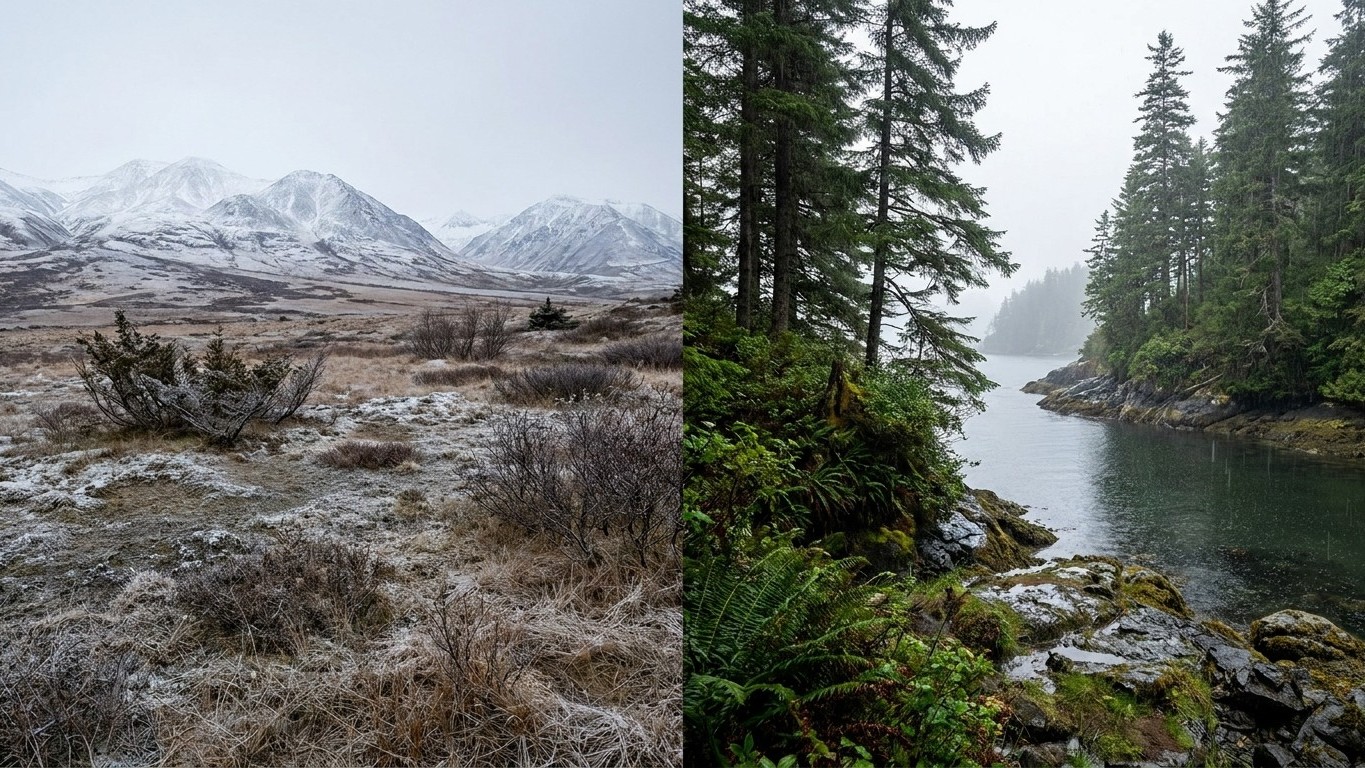

Washington’s hardiness range runs from 4a to 9a, one of the widest spreads on this site’s list of territories, and that spread is the whole story here. Among the 65 landscape trees, shrubs, fruiting plants and perennials this site tracks, 25 are hardy across the entire state and 40 are hardy in only part of it. None fail everywhere. The real work for a Washington gardener isn’t finding a plant that survives, it’s finding out which zone of the state they’re actually standing in.
What will not survive a winter in Washington

Here’s the flat answer: of the 65 plants documented on this site, zero are unable to survive winter anywhere in Washington’s 4a-9a range. That’s worth sitting with for a second, because most territorial pages in this series lead with a list of plants a reader should cross off entirely. Washington doesn’t give you that list. Its zone range is wide enough, from the cold mountain valleys of the eastern interior at 4a up through the mild Puget Sound corridor near 9a, that every documented species clears at least one part of the state.
That doesn’t mean every plant is a safe bet everywhere in the state, and it doesn’t mean “hardy” equals “happy.” Hardiness ratings measure whether a plant survives a cold extreme, nothing more. The warm end of a plant’s range, the 8a-9a territory, is frequently a heat and humidity ceiling rather than a frost limit, so a plant rated hardy through 9a can still sulk through a warm Washington summer even though it technically survives the winter. Survival and vigor are different questions, and this section only answers the first one.
The 25 that clear the whole state
These are the plants rated hardy from 4a through 9a without exception, meaning a gardener in Spokane and a gardener in Olympia are both working with a plant that will not be killed outright by a typical winter low. They include familiar shade trees like Acer rubrum and Quercus alba, understory trees such as Cercis canadensis and Ginkgo biloba, shrubs including Ilex glabra, Ilex verticillata, Clethra alnifolia and Kalmia latifolia, and a long run of perennials from Achillea millefolium to Rudbeckia fulgida.
| Category | Result for Washington | Where the mismatch lies |
|---|---|---|
| All 65 documented plants | None fail outright anywhere in the state’s 4a-9a range | No mismatch to report |
The absence of a failure list is itself the finding for this section. The next section is where a Washington reader actually needs to slow down.
The plants that work in part of the state and not the rest
Forty of the documented plants are hardy somewhere in Washington and not somewhere else, and lumping them into a single yes-or-no verdict would mislead half the state’s readers. The facts don’t say why a plant fails where it fails, only which zones it drops out of, so the useful move is grouping them by where the gap sits: the cold end of the range, the warm end, or both.
Fails at the cold end (zone 4a-4b, some further into 5a-6b)
Twelve of the forty drop out of the coldest zones only, meaning they’re fine through the milder parts of the state but risky in the coldest interior valleys: Asimina triloba, Ficus carica, Fragaria virginiana, Fragaria x ananassa, Prunus persica, Lavandula angustifolia, Itea virginica, Cornus florida, Lagerstroemia indica, Liquidambar styraciflua, Magnolia grandiflora and Hydrangea macrophylla. Some of these, like the fig and crape myrtle, lose out through 5a and 6a as well, not just 4a-4b.
Fails at the warm end (zone 9a, some further back into 7b-8b)
Twenty-five drop out at the warm end instead, meaning they’re solid through the cold and middle of the state but unreliable in the mildest 9a pocket: fruiting plants like Rubus idaeus, Rubus occidentalis, Vaccinium angustifolium and Vaccinium corymbosum; perennials including Echinacea purpurea, Iris sibirica and Salvia nemorosa; shrubs such as Syringa vulgaris, Viburnum dentatum, Physocarpus opulifolius and Weigela florida; and trees including Acer saccharum, Quercus rubra, Thuja occidentalis, Picea abies and Tilia americana.
Fails at both ends
Only three plants lose out at both extremes: Amsonia hubrichtii, Buxus sempervirens and Fothergilla gardenii. These want the middle of the state’s range and skip both the coldest interior and the mildest coastal pocket.
Finding out which of these three categories applies to a specific yard starts with knowing the local zone, not the statewide range. This site’s insulation page for Washington carries the county-level hardiness zone picture, which is the resource to check before planting anything from the lists above.
The soil and the summer they will be planted into
Washington’s representative soil, the Tokul series, is an Andisol, meaning it formed from volcanic ash. That gives it two traits that matter more than most soil facts on this site: it’s unusually light and porous, and it holds both water and phosphorus better than an ordinary mineral soil. The surface runs 45 percent sand, 10 percent clay and 45 percent silt, drains moderately well, and comes in strongly acid at a pH near 4.5. For a woody plant, drainage matters more than almost anything else, because wet feet in winter kill more shrubs and young trees than a cold snap does. A moderately well-drained, ash-derived soil is a reasonable starting point for most of the plants on the lists above, though the strongly acid pH favors acid-tolerant species like the hollies and Kalmia latifolia already on the everywhere-hardy list, and pushes back against anything that wants neutral or alkaline ground.
One number on this soil deserves a caution rather than a headline: the organic matter figure sits near 75 percent at the surface. That’s not a typo, but it’s also not what a dug garden bed will show. A figure that high describes a natural organic surface layer, forest litter or a similar buildup, as mapped in an undisturbed profile. A cultivated bed that’s been dug, amended and planted for years will read nothing like it. The pH figure carries the same caveat: it’s the mapped value for this series, not a promise about the reader’s own dirt. A soil test is what settles that question for an actual yard.
Summer rainfall statewide averages about 3.0 inches across June, July and August, out of 39.3 inches for the year, with July running driest at just 0.6 inches against June’s 1.45 and August’s 0.97. That’s a real summer dry stretch, and it doesn’t read the same on every soil. An inch of July rain on the light, porous Tokul-type ground moves through fast, since ash-derived soils drain freely even while holding a surprising amount of moisture in reserve. The same inch on a denser clay elsewhere in the state would sit longer at the surface and drain slower. Neither number tells a gardener how often to water; both together tell them what to expect from the ground they’re standing on, and a rain gauge on the actual property is what turns that expectation into a plan.
When to plant, here
At the reference station used for these normals, the last spring frost falls somewhere between February 27 and March 18, and the first fall frost arrives between November 13 and November 30. That’s a mild, maritime window, and it belongs to western Washington specifically. Eastern Washington, on the far side of the Cascades, runs as high desert with a shorter, harsher season, so a gardener out there should treat these dates as a starting reference rather than a local promise.
The reasoning behind planting timing matters more than either date on its own. A newly planted tree or shrub needs time to grow roots before it’s asked to support leaves in spring heat or withstand a hard freeze in early winter. Spring planting gives roots a full growing season to establish before the plant faces its first real winter, but it also means competing with the plant’s own push into leaf. Fall planting skips that competition, since the plant is heading toward dormancy rather than away from it, but it leaves less time for root growth before cold arrives, especially in the coldest end of the state’s 4a-9a range where the growing season is already short.
| Window | What it suits | Main risk |
|---|---|---|
| Spring (after last frost, roughly late Feb. into March) | Most trees, shrubs and perennials; safest default for the whole state | Cold, wet soil can stall root growth even after the air has warmed |
| Fall (before first frost, roughly Nov. 13-30) | Established nursery stock in the milder parts of the state | Less time to root before winter, especially toward the 4a end of the range |
Both dates are averages built from a single reference station over 1991-2020, not a guarantee for any given year. And regardless of which window a plant lands in, first-season watering follows the calendar, not the plant’s drought rating. A species listed as drought-tolerant earned that rating once established; a plant in its first year still has a small root system and needs consistent moisture through that first summer no matter what its long-term reputation says.
Where to read about each one
The 25 plants hardy across all of Washington’s range split cleanly by type. Among the trees: Acer rubrum, Betula nigra, Carpinus caroliniana, Cercis canadensis, Ginkgo biloba, Juniperus virginiana, Nyssa sylvatica, Platanus occidentalis and Quercus alba. Among the shrubs: Aronia arbutifolia, Clethra alnifolia, Ilex glabra, Ilex verticillata and Kalmia latifolia. Among the perennials: Achillea millefolium, Asclepias tuberosa, Baptisia australis, Anacis verticillata, Heuchera americana, Monarda didyma, Rudbeckia fulgida and Hylotelephium spectabile. Three fruiting trees round out the everywhere-hardy list: Diospyros virginiana, Morus rubra and Prunus domestica.
For the 40 plants that work in only part of the state, the section above sorted them by where they fail, cold end, warm end, or both, which is the detail a reader needs before choosing anything from that group for a specific address.
Every hardiness figure used across this page comes from the North Carolina Extension Gardener Plant Toolbox, a university extension plant database, crossed against Washington’s own USDA hardiness range as tracked on this site. These are hardiness ranges built for survival, not the adaptation ranges used for apple varieties elsewhere on this site, which measure something different and shouldn’t be read against the numbers above.