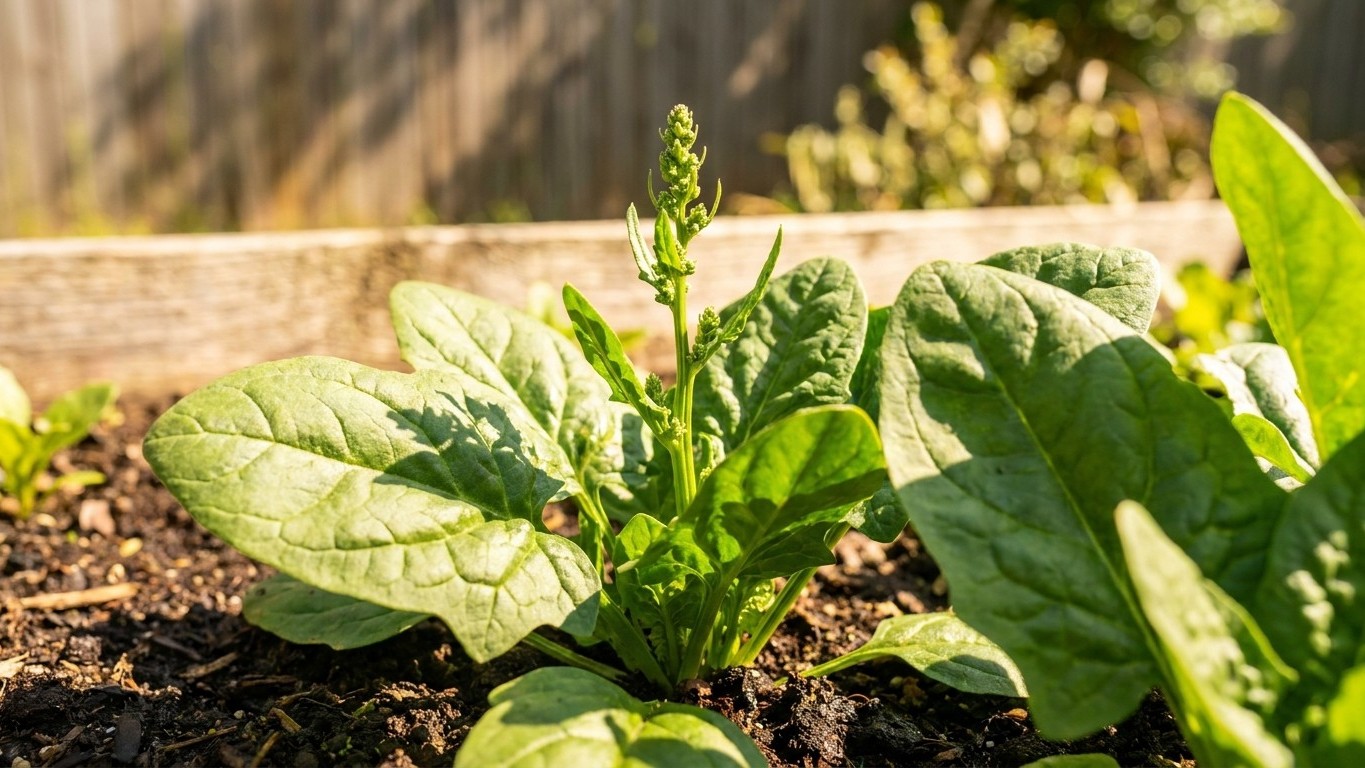

Yes, spinach bolts early almost everywhere in Alberta, and the reason has little to do with how hot the summer gets. At the reference station near Calgary, the longest day of the year holds 16 hours and 20 minutes of daylight, well past the point that pushes spinach toward flowering regardless of temperature. Cool nights and a summer with essentially no days above 90°F don’t cancel that signal. The real question isn’t whether spinach will bolt, but how many usable weeks a gardener gets before it does.
The short answer
Sixteen hours and twenty minutes of daylight on the solstice is a lot of light for a cool-season leaf crop. Spinach flowers in response to two triggers working together: long days and warm temperatures. In much of the U.S. Corn Belt or the mid-Atlantic, gardeners fight the heat side of that equation first, because summer days there rarely stretch past 15 hours even at the peak. Around Calgary, the day-length trigger arrives on its own, independent of how warm the air gets.
That distinction matters because this region’s summers are genuinely mild by continental standards. The reference station records zero days a year, on average, reaching 90°F. A gardener moving here from a hotter state might expect that mild heat load to buy extra weeks of spinach before it bolts. It doesn’t, not fully. Spinach doesn’t need heat to flower if the days are already long enough, and 16 hours 20 minutes is well past whatever threshold pushes most cultivated spinach lines toward a seed stalk.
So which is it, day length or heat? Here, day length does most of the forcing. The mild summer keeps individual leaves from going bitter as fast and slows the pace of bolting once it starts, since the 75°F ceiling for good growth is rarely breached for long stretches. But it does not stop the plant from initiating flower stalks as the calendar pushes toward the June solstice. A crop sown too late in spring will send up a seed stalk in early or mid-June even during a cool, cloudy stretch, simply because the days are long enough on their own.
Heat still plays a supporting role. When the odd warm afternoon does arrive, even without hitting 90°F, it speeds up a bolting process that day length has already started. Day length sets the clock, heat can push the hands forward, and a mild summer only slows the second half of that process, not the first.
None of this means spinach can’t be grown well here. It means the growing calendar has to work around a fixed, non-negotiable light schedule rather than around temperature forecasts. Two shorter windows, one in spring before the solstice and one in late summer as days shorten again, are the practical way through it.
How long the spring window really is
Working backward from frost dates and forward from the solstice shows just how narrow that spring opportunity actually is.
- Start counting from the last frost. The mean last spring frost at the Calgary Int’l A station is May 21. That’s a midpoint, not a guarantee: in roughly half of past years frost has struck later, so late May still carries risk.
- Sow 2 to 3 weeks ahead of that date. Spinach seed tolerates cold soil well, so gardeners typically put it in the ground before the last frost rather than after. Counted back from May 21, that lands a realistic sowing window around late April into the first days of May, soil conditions permitting.
- Measure how many weeks stand between sowing and the solstice. From early May to June 21 is roughly seven weeks. That’s the outer limit of spring growing time before day length alone starts pushing plants toward flowering.
- Expect bolting pressure to build before the solstice itself. Day length climbs toward its peak through May and the first three weeks of June, so the trigger doesn’t wait for June 21 to show up; plants sown late in the window can bolt in the first half of June.
- Heat plays a smaller role here than it would elsewhere. With zero days a year averaging 90°F or higher at the reference station, the classic heat-driven bolting that hits warmer states is rarely the deciding factor in spring here; day length carries nearly the whole effect on its own.
- The realistic usable window comes out to about five to six weeks. Sowing in late April to early May and harvesting through late May into the first half of June is the practical target before day length forces the issue regardless of how the weather behaves.
The autumn crop, and when the soil lets you sow
Fall spinach faces a different problem than spring spinach. Day length is shrinking again by late summer, which removes one trigger from the equation, but two other obstacles take its place: soil that’s still too warm for the seed to germinate well, and a frost date that eventually closes the season.
Soil still too warm to germinate
Utah State University Extension notes that spinach seed germination drops once soil temperatures climb above 80°F. That threshold isn’t tied to air temperature reaching 90°F. Bare soil sitting under full summer sun regularly runs well hotter than the air above it, so a soil surface can bake past 80°F even in a summer that never records a 90°F afternoon at the weather station. In practice, that means waiting for soil to begin cooling as days shorten in later summer, rather than sowing the moment spring heat fades.
The frost that ends the season
The mean first fall frost at the Calgary Int’l A station is September 16, and like the spring date, it’s a midpoint rather than a promise: roughly half of past years have seen frost arrive later than that. Counting back 50 to 75 days from a harvest targeted around that mean frost date, as Utah State’s guidance for a fall crop suggests, puts sowing somewhere between July 3 and July 28. That window overlaps with when soil in this region typically starts losing its peak summer heat, which helps explain why it’s the sensible target rather than an earlier or later date. Row cover can push the effective harvest window a bit past the mean frost date for gardeners willing to watch the forecast closely.
Common questions
Does a cool Alberta summer delay spinach bolting?
Not on its own. Spinach flowers in response to long days as well as heat, and Calgary’s 16 hours 20 minutes of daylight at the solstice is enough to trigger flowering even in a summer that never reaches 90°F. A mild summer slows the process once it starts more than it prevents it from starting.
What’s the best time to plant spinach in Alberta for a spring harvest?
Late April into the first days of May, roughly 2 to 3 weeks ahead of the May 21 mean last frost, gives the longest realistic run before day length near the June solstice pushes plants toward bolting.
Can a fall spinach crop work in this region, and when should it go in?
Yes. Counting back 50 to 75 days from a harvest timed near the September 16 mean first frost points to sowing between roughly July 3 and July 28, once soil has started cooling from its midsummer peak above the 80°F germination threshold.
Which spinach varieties are worth trying here?
Utah State University Extension names Bloomsdale, Melody, Teton, and Olympia as spinach varieties, but the source doesn’t publish specific days-to-maturity or bolt-resistance data for any of them. Treat the list as a starting point for local trial rather than a ranked recommendation.