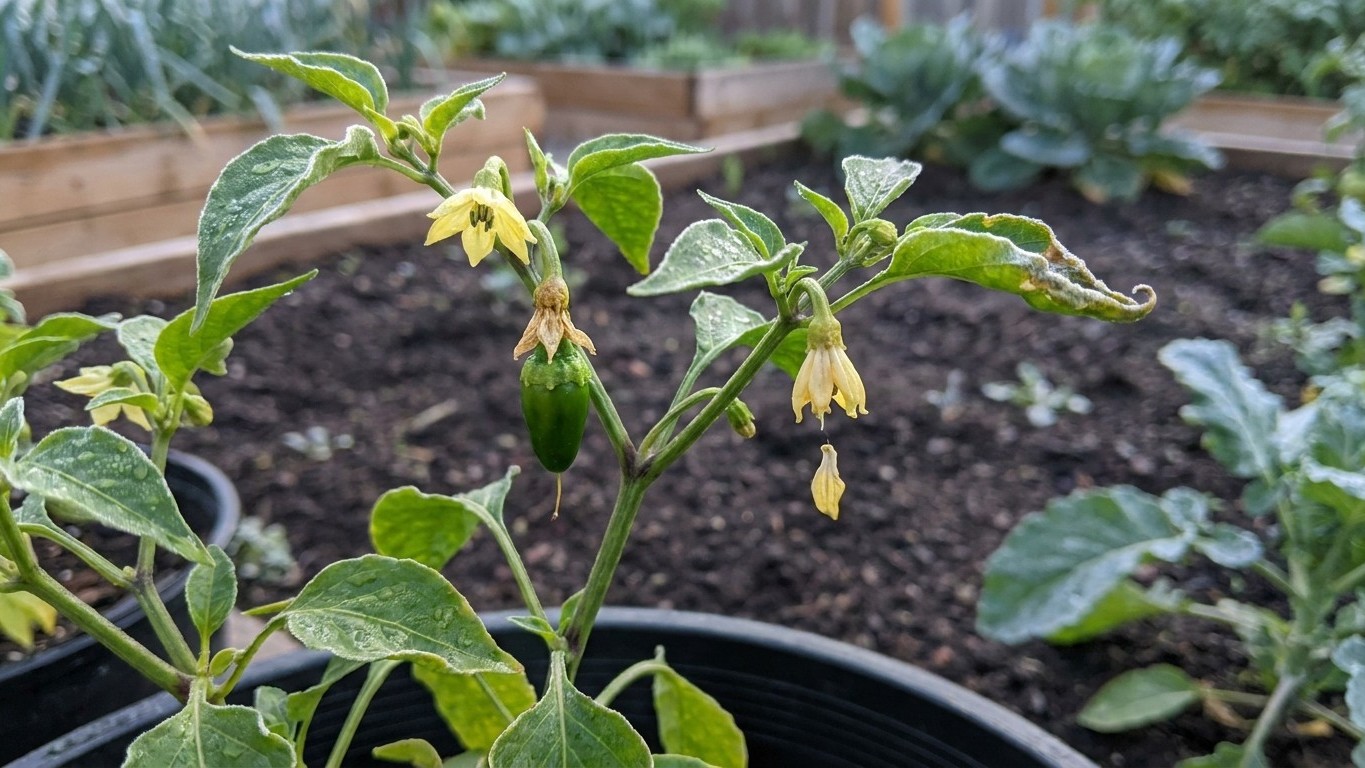

Peppers stop setting fruit in Alberta mostly because of cold, not heat. Nights that drop below 55°F stall pollen and cause blossoms to drop, and that happens here more often than a hot afternoon ever will. Alberta almost never sees the 90°F days that shut down fruit set in hotter states, so the real limiting factor is a short, cool-edged season where timing indoors and outdoors has to be right.
The short answer
Start with the heat side, because for Alberta it’s almost a non-issue. Environment and Climate Change Canada’s climate normals for the reference station at Calgary put the average number of days a year reaching 90°F or hotter at 0.0. That’s not a rounding error, it’s the long-term average: heat load strong enough to force blossom drop in pepper plants is essentially absent from this record. Growers in places with dozens of 90°F days spend July worrying about scorched flowers and stalled pollen. That’s not the fight most Alberta gardeners are having.
The other end of the threshold is where the real trouble sits. Pepper fruit set fails on both sides: heat above 90°F on one end, and nights below 55°F on the other. Alberta’s climate record here doesn’t carry summer night minimums, so there’s no station figure to point to for how cold your particular nights get in July or August. That gap matters, because a cool night is exactly the kind of thing that varies block by block, let alone county by county, depending on elevation, wind exposure, and whether cold air pools in a low spot in the yard.
This is worth being blunt about: don’t guess at night temperatures based on how far north you are, or based on how cold January gets. Those numbers tell you nothing reliable about a June or July night. The only way to know if your peppers are losing blossoms to cold is to put a min-max thermometer in the garden bed itself and read it over a few weeks. If you’re seeing repeated mornings where that thermometer shows anything close to 55°F, that’s very likely where your fruit set problem is coming from, not the heat, and not something a soil amendment or a different watering schedule will fix.
So the short version: Alberta’s climate record shows essentially zero risk of heat-driven blossom drop, and no record at all of the cold threshold that actually matters here. The practical move is to treat the cold end as the one to monitor yourself, season after season, rather than assume it away.
When to start seed here
Utah State University Extension lays out the basic pepper timeline plainly: transplants need 8 to 10 weeks indoors before they go in the ground, and they shouldn’t go outside until after frost, once the soil itself has reached 60°F. Working that arithmetic backward for an Alberta calendar looks like this:
- Find your frost reference point. Environment and Climate Change Canada’s Canadian Climate Normals (1981-2010) list the average last spring frost at the Calgary Int’l A station as May 21. That’s a mean date, not a guarantee. In one year out of every two, frost actually arrives later than that. Treat May 21 as the midpoint of a window, not a green light.
- Check soil, not just the calendar. Even after the frost risk passes, pepper transplants need soil at 60°F. Cold, wet spring soil can sit well below that mark even into late May in parts of Alberta, especially in low-lying or heavy-clay ground, so a soil thermometer is a better guide than the date alone.
- Count back 8 to 10 weeks from your realistic transplant date. If you’re aiming for a transplant window built around that May 21 average, but padding it later to account for the “one year in two” risk, an indoor start in mid-to-late March is the arithmetic that follows. Gardeners in districts that historically run behind the Calgary station, which includes many northern and upland parts of the province, should push both the transplant date and the seed-start date back accordingly.
- Rebuild the math for your own county. The Calgary station is one point on a large map. If your local frost history runs one, two, or three weeks behind or ahead of that average, shift the whole 8-to-10-week countdown by the same amount rather than anchoring to a single province-wide date.
What goes wrong here
- Blossom drop from a cool night. This is the dominant failure mode in Alberta, given how rare true heat stress is here. Flowers open, but pollen doesn’t set when nights fall below 55°F, and the plant simply sheds the bloom. The fix isn’t fertilizer or extra water, it’s protection: row cover pulled over the plants on nights when your garden thermometer signals a cold snap, or holding peppers in containers you can move closer to a warm wall overnight.
- Blossom drop from a heat spell. Rare given Alberta’s near-zero count of 90°F days, but not impossible in an unusually hot stretch. If daytime highs climb into that range for a run of days, expect the same blossom-drop response as the cold version, just from the opposite direction. Light afternoon shade cloth during the hottest hours of an exceptional heat spell is the practical response, though most Alberta seasons won’t call for it.
- Sunscald on exposed fruit. Once fruit does set, direct sun on thin-skinned peppers can bleach or blister the exposed side, particularly on plants that have lost leaf cover to pruning, wind, or disease. Leaving the plant’s natural foliage intact to shade the fruit, rather than stripping leaves for “better airflow,” is the simplest prevention.
- Blossom-end rot. This shows up as a sunken, leathery patch on the fruit’s bottom end and traces back to inconsistent watering rather than a missing nutrient in most home gardens. Uneven soil moisture, wet one week and bone-dry the next, interrupts how the plant moves calcium into developing fruit. A steady watering schedule, especially through any dry stretch, does more to prevent it than adding a calcium product to the soil.
Common questions
Do Alberta summers ever get hot enough to stop pepper fruit set?
Almost never, based on the long-term record. The Calgary reference station averages 0.0 days a year at 90°F or above, which is the threshold tied to heat-driven blossom drop. An unusual heat spell could still push temperatures that high for a day or two in a given year, but it isn’t the pattern the climate record shows.
What if my nights stay above 55°F all summer?
Then the cold-end failure mode described here likely isn’t your issue, and other causes, like uneven watering, poor pollination activity, or nitrogen-heavy fertilizer pushing leaf growth over flowering, are worth checking instead. Since this site doesn’t track night minimums, a garden thermometer is the only way to confirm where your nights actually sit.
How late can I still transplant peppers in Alberta?
There’s no fixed cutoff published here, but working backward from the season’s likely first fall frost and the plant’s own maturity timeline is the right approach. Since the average last spring frost at the Calgary station is May 21, and that date runs later in roughly half of all years, pushing transplant into early June is a reasonable hedge rather than a risk in most seasons.
Why do my pepper plants flower but not set fruit even when temps look fine?
Temperature is the leading cause covered here, but it isn’t the only one. Poor pollinator activity, excess nitrogen fertilizer, or water stress right at flowering can all cause the same blossom-drop symptom even when nighttime and daytime readings sit inside the safe range. Ruling out a night reading below 55°F with your own thermometer is still the first step before looking elsewhere.