
The frost-free window around Calgary runs to a mean last-frost date of May 21, and that single fact does more to pick a potato variety than any label on a seed bag. Early and mid-season types get tubers sized before the ground turns hostile; late types are a gamble against a season that may already be closing.
The short answer
Environment and Climate Change Canada’s Canadian Climate Normals, 1981-2010, put the average last spring frost at Calgary Int’l A at May 21. That is the number Alberta gardeners lean on, and it is also the number most likely to mislead them if they treat it as a guarantee rather than a midpoint. A mean date means exactly what it says: in one year out of two, frost arrives later than May 21. Half the seasons on record ran later than this. So the “safe” planting date isn’t a date at all, it’s a moving target that a gardener has to watch through the actual soil, not the calendar.
That single climate fact pushes the variety decision toward season class rather than brand name. Utah State University Extension and the University of Maine Cooperative Extension, the two sources this page relies on, both frame potato choice around three season classes: early, mid-season, and late. Neither publishes a specific days-to-maturity count for any variety, because maturity swings too much with soil temperature, moisture, and daylight to print as a fixed number. What they do publish is the planting rule: potatoes go into the ground once soil hits 50 F, which lands 14 to 21 days before the last frost date. Applied to Calgary’s May 21 mean, that puts a typical planting window in late April to the first days of May, with the caveat that a later frost year pushes it back.
For most Alberta yards, early and mid-season classes are the better fit. They ask for less total warm-soil time to bulk up tubers, so they finish before the crop runs into the second half of the heat mechanism this page covers next: soil temperatures climbing past 90 F, which stalls tuber set and fill outright. Late-season classes aren’t off the table everywhere in the province, but they need a longer stretch of moderate soil temperature than the Calgary-area mean frost date reliably offers, and a gardener choosing one should plan to watch the soil, not the seed packet, for the finish line.
What actually decides it
The mean frost date is a coin flip, not a fence
A climate normal is an average built from three decades of data, and averages hide their own spread. Reading May 21 off the Calgary Int’l A record means half the years in that 1981-2010 span saw frost land after that date, sometimes well after. A gardener transplanting Alberta’s climate onto a single line on a calendar is building a plan on the midpoint of a range they never see. The workaround isn’t a better date, it’s tracking actual overnight lows in the two weeks around the mean date and treating any forecast frost as real regardless of what the normal says.
Soil temperature, not air temperature, starts the clock
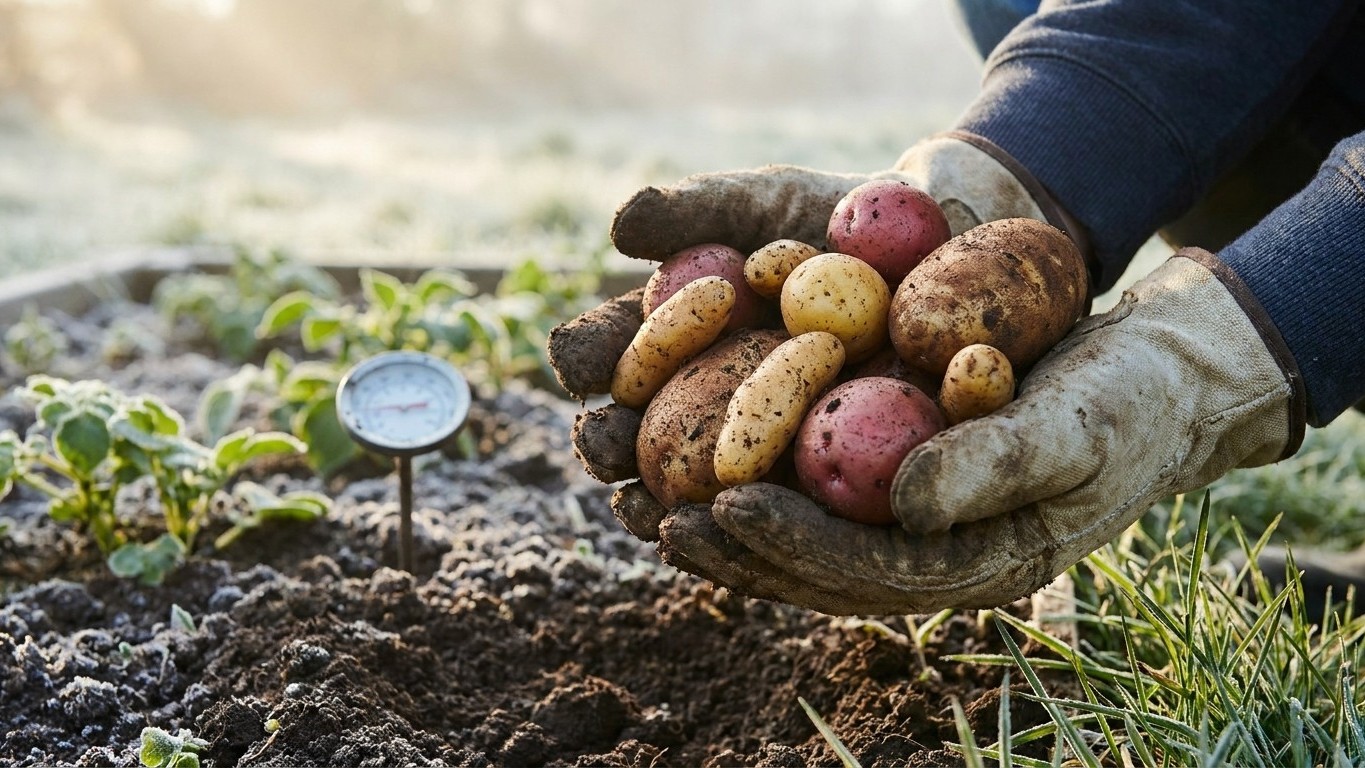
Utah State University Extension and the University of Maine Cooperative Extension both set the planting trigger at soil reaching 50 F, independent of the air. That’s why the guidance lands 14 to 21 days ahead of the last frost date rather than on it: soil warms slower than air, and a potato seed piece sitting in cold, wet ground before it hits 50 F is more likely to rot than to sprout. A thermometer pushed a few inches into the bed tells a gardener more than any frost-date chart.
The 90 F ceiling ends the season from the other direction
The same two extension sources identify the opposite failure point: soil above 90 F inhibits tuber set and fill, and watering doesn’t reverse it once it’s happening. This is the mechanism that should drive variety choice in any district where summer soil regularly climbs that high. It rewards classes that finish their bulking before peak heat arrives, which in practice means favoring early and mid-season potatoes and treating them as a spring-timed crop rather than a summer-long one. A late-season variety planted with the same spring start simply runs later into the heat window, with no mechanism to protect it once soil crosses that line.
How to do it
- Check soil temperature directly with a probe thermometer a few inches deep, rather than relying on the calendar or air temperature.
- Once soil reaches 50 F, plant seed potatoes, understanding this typically falls 14 to 21 days before the local mean last-frost date.
- Choose certified seed potatoes rather than grocery-store or saved tubers; uncertified seed carries virus that no amount of good soil management fixes later.
- Select an early or mid-season class for most Alberta locations, since these finish tuber bulking before soil is likely to climb past the 90 F ceiling.
- Track soil temperature again through the growing season, and if it approaches 90 F, recognize that irrigation will not restore tuber set once it stalls.
- Harvest early and mid-season crops as a spring-timed crop, digging before the hottest stretch of local summer soil temperatures sets in.
- If attempting a late-season class, confirm the local frost-free window runs long enough to finish before fall frost risk returns, using the same soil-based tracking rather than the calendar date alone.
What goes wrong
- Planting by the calendar instead of the soil. A gardener sets seed potatoes in on or before May 21 because that’s the “average” frost date, then loses the crop to a later frost that the same average predicted half the time. The remedy is a soil thermometer and a willingness to wait past the mean date in a cold spring.
- Choosing a late-season class in a district with a short, hot window. The variety needs more warm-soil time than the season reliably supplies, and it runs straight into the 90 F ceiling before tubers finish sizing. Switching to an early or mid-season class solves this without changing anything else about the garden.
- Assuming irrigation fixes stalled tubers. Once soil crosses above 90 F and tuber set stops, watering more doesn’t restart it, per Utah State University Extension and University of Maine Cooperative Extension guidance. The only real remedy is timing: plant early enough that bulking finishes before the soil gets there.
- Planting saved or grocery-store tubers instead of certified seed. Uncertified seed potatoes carry virus that can quietly cut yield and vigor for the whole season, with no visible warning at planting time. Buying certified seed potatoes each season removes this risk at the source.
- Treating “days to maturity” as a fixed number. Neither Utah State nor the University of Maine publishes a days-to-maturity figure for any variety, because it shifts with soil temperature and moisture. Planning a harvest date off a number found elsewhere, rather than off the season class and actual soil conditions, sets up a mistimed dig.
Common questions
Is May 21 a safe date to Plant Potatoes in Alberta?
No. It’s the mean last-frost date at Calgary Int’l A from Environment and Climate Change Canada’s Canadian Climate Normals, 1981-2010, which means frost falls later than that in roughly half of all years on record. Treat it as the midpoint of a window, and check soil temperature directly rather than planting on the date itself.
Should Alberta gardeners choose early, mid-season, or late potato varieties?
Early and mid-season classes generally fit better, since they finish bulking tubers before soil is likely to climb past the 90 F point where, per Utah State University Extension and University of Maine Cooperative Extension, tuber set and fill stall out. Late-season classes need a longer warm-soil stretch than most Alberta locations reliably provide.
Why does the guide avoid giving days-to-maturity numbers?
Because neither Utah State University Extension nor University of Maine Cooperative Extension publishes one. Maturity shifts too much with soil temperature and moisture to print as a fixed count, so both sources classify varieties by season class instead.
Does watering help once potato plants are struggling in hot soil?
No. Once soil temperature climbs above 90 F, tuber set and fill are inhibited by the heat itself, and irrigation does not reverse that mechanism. The only effective response is planting early enough that the crop finishes before soil reaches that point.