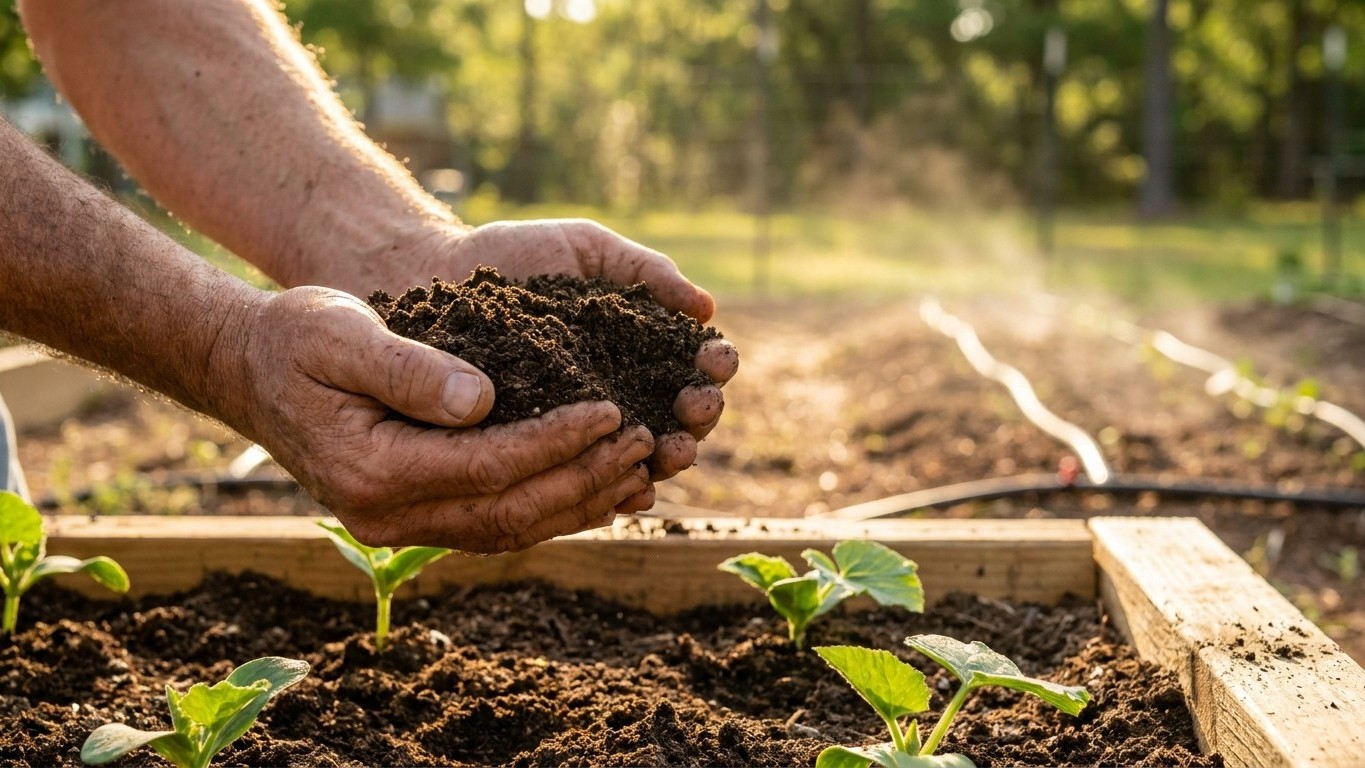

Summer Squash in Saskatchewan means working inside a short, cool window: soil that stays cold well past the last frost, a growing season of roughly four months, and summers with almost no extreme heat but modest rain. The plants can produce well here, but timing and water management carry more weight than they do farther south.
When the soil is warm enough in Saskatchewan
Gardeners want a date, so here is one: the average last spring frost at the Saskatoon SRC station is May 18, according to Environment and Climate Change Canada’s Canadian Climate Normals for 1981-2010. That number is worth sitting with for a second, because it is a mean, not a promise. Half the years on record had frost falling after May 18. Treat it as the midpoint of a window, not a green light.
Frost dates matter, but they answer the wrong question for summer squash. These plants germinate and grow from seed that came from tropical ancestry, and what stops them isn’t frost risk alone, it’s cold soil. A patch of ground can sit frost-free for two or three weeks and still be too cold at seed depth for Summer Squash to germinate reliably or for transplants to put out new roots. Soil temperature lags behind air temperature, sometimes by ten days to two weeks, especially on heavier clay ground that holds winter cold longer than sand does.
Why soil temperature outranks the calendar
Summer squash germinates poorly in soil colder than the upper 60s Fahrenheit, and it stalls out entirely below that. In a Saskatchewan spring, that threshold is often reached well after May 18, particularly in years when the frost date itself runs late (which, remember, happens close to half the time). This is also a province where a single climate normal doesn’t describe every garden. The Saskatoon SRC reading applies to that station; a garden in a river valley, at higher elevation, or farther north will run its own schedule, sometimes weeks behind.
Two adjustments compensate for a slow-to-warm soil. Black plastic mulch laid a week or two before sowing raises soil temperature measurably by trapping solar heat at the surface. Floating row cover does similar work above ground, holding a few extra degrees around young plants and cutting wind exposure, which matters on the open prairie. Neither trick moves the calendar much, but together they can close the gap between a frost-free date and a soil that’s actually ready to grow. Waiting for genuinely warm soil, rather than sowing on a fixed date, is the practice that saves a slow, disappointing start.
For anything more specific to a district, this is exactly the kind of local variation the Saskatchewan agriculture ministry tracks, and it’s worth a look at the provincial agribusiness resources before committing a sowing date to memory.
How long the season lasts here
Between the average last spring frost (May 18) and the average first fall frost (September 18), both from the Saskatoon SRC station’s 1981-2010 normals, Saskatchewan gardeners get about four months of frost-free growing. That’s not a generous window by North American standards, but it isn’t a punishing one either, and it shapes almost every decision that follows.
A four-month season is long enough for one full run of summer squash from sowing to a steady harvest, but it leaves little slack for mistakes. There usually isn’t room for a true second sowing timed to replace tired plants partway through summer, the way gardeners further south can plan a spring crop and a fall crop as two separate events. Here, the first sowing is effectively the only sowing, which raises the stakes on getting the soil-temperature timing right in the first place. A seed wasted on cold, unresponsive soil in late May isn’t a small loss; it can mean losing two or three weeks off an already short year.
What the short window changes about method
Because there’s little room to recover from a bad start, many Saskatchewan gardeners start summer squash indoors and transplant, rather than direct-sowing outright. That comes with its own tradeoff: summer squash resents root disturbance more than most vegetables, so transplants need to go out young, in biodegradable pots or with a careful root check, rather than being held back for size. A short season makes that risk worth taking; a longer one elsewhere might not.
Where a longer frost-free window exists, gardeners can stagger sowings two or three weeks apart and keep fresh plants coming through late summer, a technique covered in more depth in this site’s guide to succession sowing for summer squash. In Saskatchewan, that approach mostly doesn’t apply. The four-month window rewards getting one planting right, tending it carefully through the heat of July, and accepting that it’s the harvest for the year rather than the first of several.
Heat and water in Saskatchewan
Here is where Saskatchewan’s climate looks genuinely different from most of the summer squash territories on this site: the reference station records 0.0 average days a year above 90°F, per Environment and Climate Change Canada’s 1981-2010 normals. That is not a typo and not a rounded-down small number. It means the extreme-heat stress that limits squash pollination and fruit set in much of the United States essentially doesn’t happen in an average Saskatchewan summer.
That changes the whole conversation. In hot territories, squash pollen loses viability quickly once temperatures push into the high 90s, flowers can abort, and the huge, thirsty leaves outpace what a shallow root system can pull from the soil, forcing a choice between heavy irrigation and afternoon shade. None of that is the Saskatchewan story. Here, a cool season is the more likely constraint: slower fruit ripening, and conditions that favor powdery mildew and other foliar disease when nights stay cool and humidity lingers on leaves overnight.
Rain that arrives, and rain that doesn’t
Rainfall is modest rather than scarce. Saskatoon’s normals put summer rain (June through August) at about 6.6 inches, out of roughly 13.9 inches for the whole year, according to the Saskatoon Diefenbaker Int’l A station’s 1981-2010 normals. Broken down by month, June averages 2.59 inches, July 2.38 inches, and August is the driest of the three at 1.68 inches.
| Month | Average rainfall |
|---|---|
| June | 2.59 in |
| July | 2.38 in |
| August | 1.68 in |
That trend toward a drier August is worth planning around, since it’s also often when fruit is setting heavily and water demand peaks. With no extreme-heat days pulling moisture out of the soil the way a 95°F afternoon would elsewhere, the watering need here is steadier and more moderate than in hot-summer territories, but August’s dip in rainfall still means a rain gauge on the actual plot, not the regional average, is what should decide whether to water that week. Soil type changes the math too: the same rain soaks in fast on sand and lingers for days on clay, so two gardens under identical rainfall can need very different watering schedules.
Which summer squash suit Saskatchewan
The honest answer is: types, not names. This page won’t recommend a specific variety, and that’s a deliberate choice rather than an omission. Saskatchewan’s short season, cool summers, and disease pressure from lingering humidity mean that what performs well changes from district to district and year to year, and the only recommendations worth trusting are the ones tested locally.
Reasoning from this territory’s own facts still narrows the field usefully. The four-month frost-free window favors the earliest-maturing types available in any squash category, since there’s little slack for a slow finisher. The complete absence of extreme heat (zero days above 90°F on average) removes the usual argument for types bred to tolerate scorching afternoons, and shifts the priority toward types that ripen reliably in cooler, shorter conditions. Because cool, sometimes humid summers raise the risk of powdery mildew and related foliar disease, disease resistance moves up the list of what actually matters, ahead of size or shape.
Where to get a real answer
Saskatchewan sits in Canadian plant hardiness zone 3a, based on Natural Resources Canada’s 1991-2020 normals for the reference city. It’s worth flagging clearly: this is the Canadian zone system, built from seven climate variables, and it does not convert directly to the USDA zones used elsewhere on this site. NRCan’s own comparisons show a single Canadian zone can overlap several USDA zones, so treating 3a as equivalent to any specific USDA number would be a mistake.
What actually settles the variety question is trial data from growers working the same soil and same short season. The Saskatchewan agribusiness resources page is the starting point for that, since it tracks what’s been trialled and performed in the province rather than what happens to be popular in a seed catalog written for a different climate entirely.