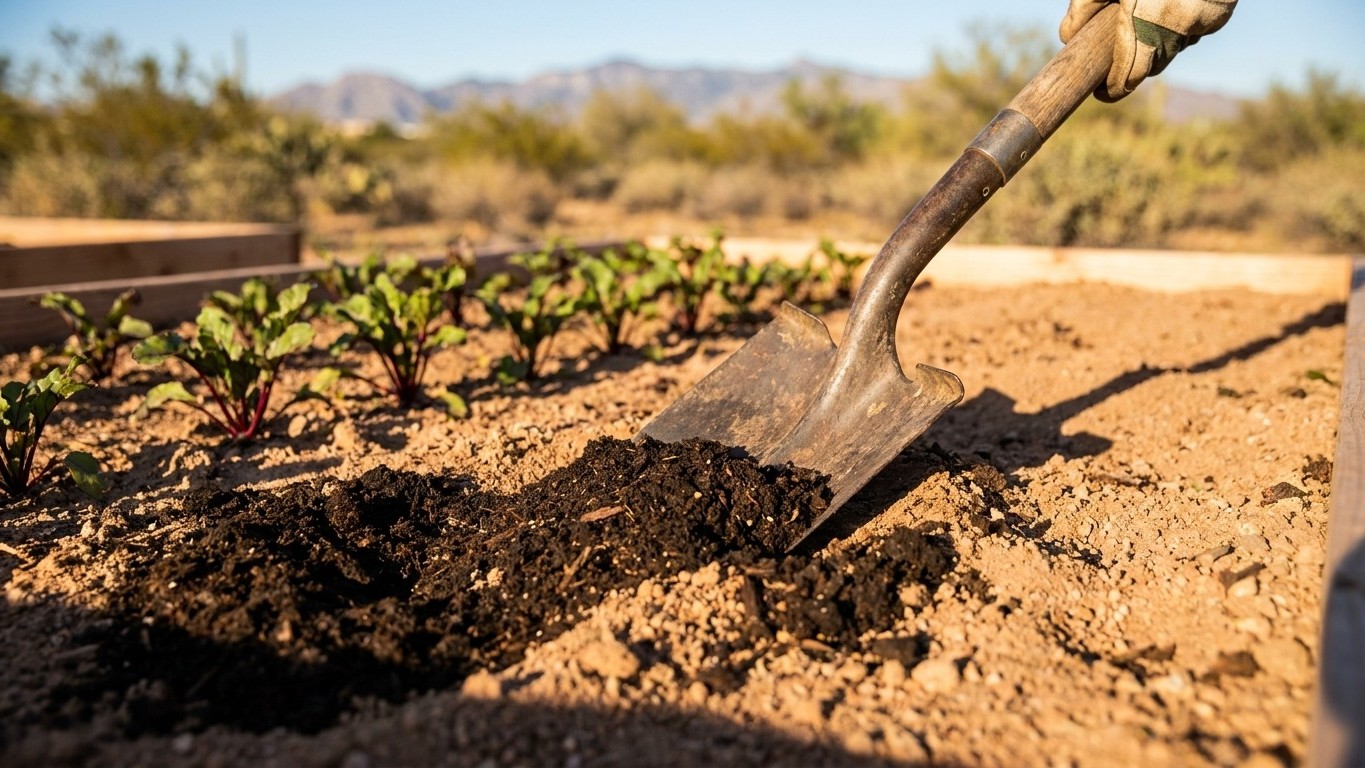

In Arizona’s low desert (Phoenix, Tucson, Yuma and the valleys around them) beets go into the ground from October through February, not in spring. Frost almost never shows up to set the calendar, so the real deadline is the heat that arrives by April and turns roots woody. Higher, colder ground around Flagstaff runs on a different clock entirely.
The short answer
The soil USDA lists as representative of Arizona is the Casa Grande series, an Aridisol typical of dry-climate ground: alkaline, often carrying salts, with a surface pH around 8.5. Texturally it’s 64 percent sand, 14 percent clay and 22 percent silt, and it drains well, but the organic matter sits at only about 0.8 percent. That’s a mixed bag for a beet. Utah State University Extension is clear that beets want deep, sandy, well-drained soil rich in organic matter, so the sand fraction of Casa Grande soil is close to ideal and the drainage is right. The organic matter is not. At 0.8 percent, a Casa Grande-type surface has almost none of the humus that helps hold moisture between waterings, which matters more in a state this dry than almost anywhere else in the country. Utah State’s guidance caps amendment at 1 inch of composted organic matter per 100 square feet worked into the bed, which is the kind of correction this soil is built for.
Where the alkalinity fits in
Beets tolerate alkaline soil better than many root crops, but 8.5 is on the high end, and it’s worth a soil test before assuming your own bed matches it, since a state spans hundreds of soil series and Casa Grande is only the one USDA flags as representative, not a guarantee about any single yard.
The heat side of the equation is the one that actually decides the sowing window here. NOAA’s climate record for the Phoenix station doesn’t publish a running count of days above 90°F in the data behind this page, but the same record shows a 365-day frost-free season and a freeze reaching only 6 of the last 30 springs. Put those two things together and the picture is straightforward: this is a place where cold almost never interferes, but the stretch of days above 85°F, which Utah State ties directly to woody roots once a beet plant is also short on water, arrives early and lasts for months. That’s the constraint that matters, not frost.
The six weeks that decide it here
Utah State’s rule of thumb, sowing 2 to 3 weeks before the last frost, doesn’t translate cleanly to Arizona’s low desert, because there usually isn’t a last frost to count back from. NOAA’s normals put the frost-free season at 365 days for the Phoenix station, and a freeze only showed up in 6 of the last 30 springs on record. So instead of counting forward from a frost date, low-desert gardeners are really counting backward from the heat: an October or November sowing puts the first six weeks of root development in the driest, mildest stretch of the local fall, before the peak of summer heat has fully broken but also before it returns.
Why that six-week window is dry by default
Arizona’s low-desert fall doesn’t deliver reliable rain the way a spring does farther north or east. That means the moisture a beet seedling gets in its first six weeks comes almost entirely from whoever is holding the hose, not from the sky. Utah State’s warning that water stress in the first six weeks causes premature flowering (bolting) is not a minor caveat here, it’s the central risk, because there’s no rainy spring pattern to fall back on if irrigation lapses even for a stretch of days. A bolted beet stops building a usable root and starts throwing up a flower stalk instead, and once that happens there’s no walking it back for that plant.
Higher elevation country around Flagstaff is a genuinely different climate, one that does freeze hard, so a spring sowing timed to an actual last-frost date makes sense there in a way it doesn’t in the low desert. For most of the state’s population centers, though, the six weeks that decide bolting risk are a fall six weeks, and they’re decided by the irrigation schedule, not the weather forecast.
What goes wrong here
- Low organic matter crusts the surface and slows emergence. At roughly 0.8 percent organic matter, a Casa Grande-type bed can seal over after watering before beet seedlings push through. Work in up to 1 inch of composted organic matter per 100 square feet, the ceiling Utah State recommends, and keep the top inch of soil from drying into a hard crust between waterings.
- Sandy texture drains moisture faster than the plant can use it. With 64 percent sand, water moves through this soil quickly, which is good for avoiding waterlogging but bad for keeping roots hydrated through a dry desert fall. Shorter, more frequent irrigation cycles do more good than one deep soak spaced too far apart.
- Sowing too late pushes the crop into 85°F-plus heat while it’s still establishing. Utah State’s research links heat above 85°F combined with water stress directly to woody roots. In the low desert that heat threshold arrives by spring, so a sowing pushed past the fall-winter window runs straight into it. Aim for the fall end of the window, not late winter, if there’s any doubt.
- Inconsistent watering in the first six weeks triggers bolting instead of woodiness. These are two separate failures with two separate causes. Bolting comes from thirst early on; woodiness comes from heat later, especially if the plant is also short on water at that point. A steady, unbroken watering schedule through establishment addresses the first problem; timing the sowing to avoid the hottest months addresses the second.
- Alkaline, salt-prone ground can mask itself as a watering problem. Because Casa Grande-type soil runs around pH 8.5 and can carry salts, poor growth sometimes gets blamed on irrigation when the chemistry is the real issue. A basic soil test settles which one is actually happening in a given bed.
Common questions
Can beets be grown through an Arizona summer? Not successfully in the low desert. Once daytime highs push past 85°F, Utah State’s research shows water-stressed beets turn woody, and Phoenix-area summers run well above that threshold for months at a stretch. The fall-through-winter window is the workaround, not a preference.
Does Arizona get a hard freeze that would kill beet seedlings? Rarely, in the low desert. NOAA’s record for the Phoenix station shows a 32°F freeze in only 6 of the last 30 springs, and lists a 365-day frost-free season overall. Higher elevations such as Flagstaff are a separate climate that does freeze hard and shouldn’t be planned around the same calendar.
How long does it take from sowing to harvest? Beets are sown directly in place, never started as transplants, and that 60 to 80 day window runs from the day the seed goes into the ground, not from any later stage.
Is Casa Grande soil the same as what’s in my own yard? Not necessarily. It’s the series USDA lists as representative of Arizona overall, drawn from surface-horizon data across 21 mapped components, not a measurement of any individual garden bed. A state spans hundreds of soil series, and a yard built on fill, near a wash, or in hill country can differ completely. A soil test is the only way to know what’s actually under a specific bed.