
Seven of the insects Arizona’s extension service documents for home gardens will actually feed on a carrot planting, and none of them touch the root before the leaves show something first. What decides whether a backyard carrot bed gets hit has less to do with the month on a calendar and more to do with what’s drying down in the yard around it: weeds, nearby crops, and wild hosts that carry these insects before they ever move over to the carrot row.
Which pests attack carrot in Arizona

University of Arizona Cooperative Extension documents ten insects and mites for home vegetable gardens across the state: Aphids, Beet leafhopper (vector of curly top virus), False chinch bug (Nysius raphanus), Grasshoppers, Green fruit beetle (Cotinis mutabilis), Spider mites, Squash bug (Anasa tristis), Thrips, Tomato hornworm (Manduca quinquemaculata), and Whiteflies.
Three of those ten have no business in a carrot bed. Green fruit beetle goes after ripening, soft fruit like figs and tomatoes, not root crops or their foliage. Squash bug is a cucurbit specialist tied to squash, pumpkin, and other vining plants, and it doesn’t cross over to a row of carrot tops. Tomato hornworm needs a solanaceous host, tomato, pepper, or eggplant, and carrot leaves aren’t on that list.
That leaves seven species documented for this territory that will actually feed on or affect a carrot planting: Aphids, Beet leafhopper, False chinch bug, Grasshoppers, Spider mites, Thrips, and Whiteflies. Checking the underside of a handful of leaves before assuming the worst is the habit that separates a small, manageable cluster of aphids from a bed-wide problem, and it costs nothing but a few minutes.
When each one shows up, and what it does first
Carrots are direct-seeded, so every count that matters here, including the 70 to 100 days it takes to reach harvest, runs from the seeding date, not from a transplant date that doesn’t exist for this crop. That means the earliest vulnerable stage is the thin, sparse seedling, not a young transplant with an established root ball.
Right after seeding, while carrot tops are still small and tender, false chinch bug and grasshoppers do the most damage relative to the plant’s size. False chinch bug shows up first as clusters of small grayish bugs crowding onto seedlings, often right after nearby weeds have dried down and pushed the insects to look for the next green thing available; affected seedlings wilt fast. Grasshoppers leave ragged notches chewed out of leaf edges, sometimes stripping a whole seedling row in a bad year.
As true leaves fill in, aphids and whiteflies build up on the undersides of foliage. Aphids show first as soft-bodied insects clustered on new growth, with leaves starting to cup or curl and a sticky residue left behind. Whiteflies announce themselves when the foliage is brushed and a small cloud of tiny white insects lifts off, followed by the same sticky honeydew and sometimes a sooty mold growing on it.
Later, as foliage matures and roots size up toward that 70 to 100 day window, hot dry stretches favor spider mites, which show first as fine light stippling across the leaf surface with thin webbing on the underside. Thrips leave silvery streaks or scarring on the leaf where they’ve rasped at the surface. Beet leafhopper is different from the rest: the insect itself is easy to miss, and the first real sign is the plant, with new leaves curling, yellowing, and stunting as curly top virus takes hold.
Telling the damage apart from everything else
Arizona’s representative soil, the Casa Grande series, runs sandy (64 percent sand, 14 percent clay, 22 percent silt), alkaline at a surface pH near 8.5, well drained, and low in organic matter at about 0.8 percent. Utah State University Extension notes that carrots want deep, sandy, well-drained soil rich in organic matter, and that heavy or rocky ground makes the root fork. That means Arizona’s representative soil starts out with the right texture and drainage for carrots but comes up short on organic matter, and it runs alkaline rather than neutral. None of that is a measurement of any one garden bed; a state spans hundreds of soil series, and a yard that’s been filled, graded, or built on can be nothing like the Casa Grande series. A soil test is the only way to know what’s actually under a specific row.
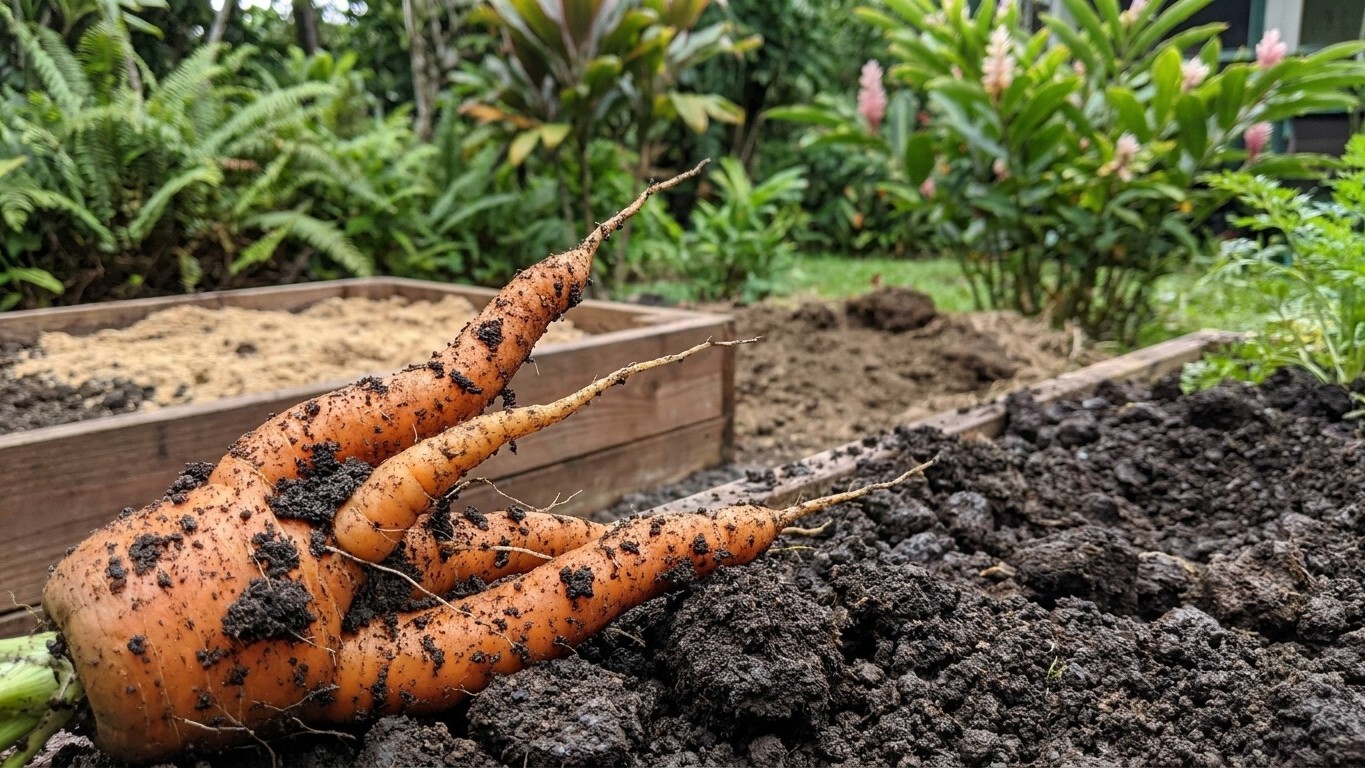
A forked root is a soil-texture problem, not a pest problem, and pulling one plant to look at the crown and root shape settles that question faster than examining the leaves ever will. None of the seven insects on this page feed underground on a healthy carrot root.
| Symptom | Likely cause | What tells them apart |
|---|---|---|
| Yellowing, curling, stunted new leaves | Curly top virus (beet leafhopper) or nutrient deficiency | Curly top hits scattered plants suddenly and unevenly; deficiency yellows the whole bed gradually and evenly |
| Forked or split roots | Heavy or rocky soil, not an insect | Pull the plant; no insect on this page reaches a root that deep in undisturbed soil |
| Ragged, chewed leaf edges | Grasshoppers or wind/mechanical damage | Chewing leaves irregular bite marks; wind tears follow a straight line along the leaf vein |
| Fine stippled or speckled leaves | Spider mites or drought stress | Mites leave fine webbing on the leaf underside; drought stress dries the leaf evenly with no webbing |
| Wilting seedlings | False chinch bug or underwatering | Chinch bug wilting comes with visible clusters of small bugs; underwatered plants recover once watered |
None of this replaces a look through a hand lens or a call to a local office. This page can narrow the possibilities; it can’t confirm what’s actually growing in a specific yard.
What actually works here, and what is a waste of time
Covering the row at seeding, before the first true leaves emerge, blocks more early damage than any treatment applied after the fact. A floating cover kept in place through the seedling stage keeps false chinch bug and grasshoppers off the plant when it’s least able to recover from feeding, and none of the seven pests documented here need access to pollinators to do damage, so the cover can stay on longer than it could on a fruiting crop.
Clearing dried weeds and mowed debris near the bed matters more than most gardeners expect, since false chinch bug and grasshoppers typically move in waves once nearby vegetation dries down or gets cut, not on a fixed date. Watering on a consistent schedule also limits spider mite buildup, since mites do their worst on foliage that’s already stressed by drought and heat.
What wastes time is treating on a fixed schedule regardless of what’s actually present. Several of these insects are sporadic and migratory, showing up only when conditions push them off a drying host plant nearby, so a calendar-based treatment often misses the actual window entirely. Treating for aphids when the real symptom is curly top virus is another common miss, since there’s no cure for a plant once that virus has taken hold; the only leverage is keeping beet leafhopper off the plant before it feeds. For anything beyond covers, sanitation, and steady watering, University of Arizona Cooperative Extension is the source for what’s actually labeled for use in the state; this page doesn’t name products or rates.
Where to check this for your own county
University of Arizona Cooperative Extension documents this list at the state level, but pest pressure inside Arizona is far from even. A low desert vegetable bed and a garden at higher elevation don’t carry the same insects at the same intensity, even within the same growing season, and a pest showing up somewhere in the state doesn’t mean it’s present in any one yard.
Calling the county extension office before treating anything is the step that turns a statewide list into an answer that actually fits a specific garden. Every Arizona county has a University of Arizona Cooperative Extension office, and staff there can look at photos of the actual damage, confirm which of these seven insects is involved, and point to a soil test if forking or poor growth looks more like a soil issue than a pest one.
The next useful step isn’t reading further on this topic; it’s pulling one affected plant, taking a clear photo of the leaf and the root, and calling that local office with it in hand.
Common questions
Do carrots in Arizona need row cover for the whole season?
No. Cover earns its keep most during the seedling stage, when false chinch bug and grasshoppers do the most damage relative to plant size; once true leaves are established, the plant tolerates far more.
Can curly top virus be treated once a carrot plant shows symptoms?
No. Once curly top virus shows up in curling, yellowing, stunted leaves, there’s no treatment for the plant itself. The only control point is managing beet leafhopper before it feeds.
Are forked carrot roots caused by insects?
No. Forking comes from heavy or rocky soil, not from any of the seven insects documented for this territory. Pulling the plant to inspect the root settles the question.
How long do carrots take to mature in Arizona growing conditions?
Utah State University Extension puts it at 70 to 100 days, counted from seeding, since carrots are sown directly in place with no transplant stage.