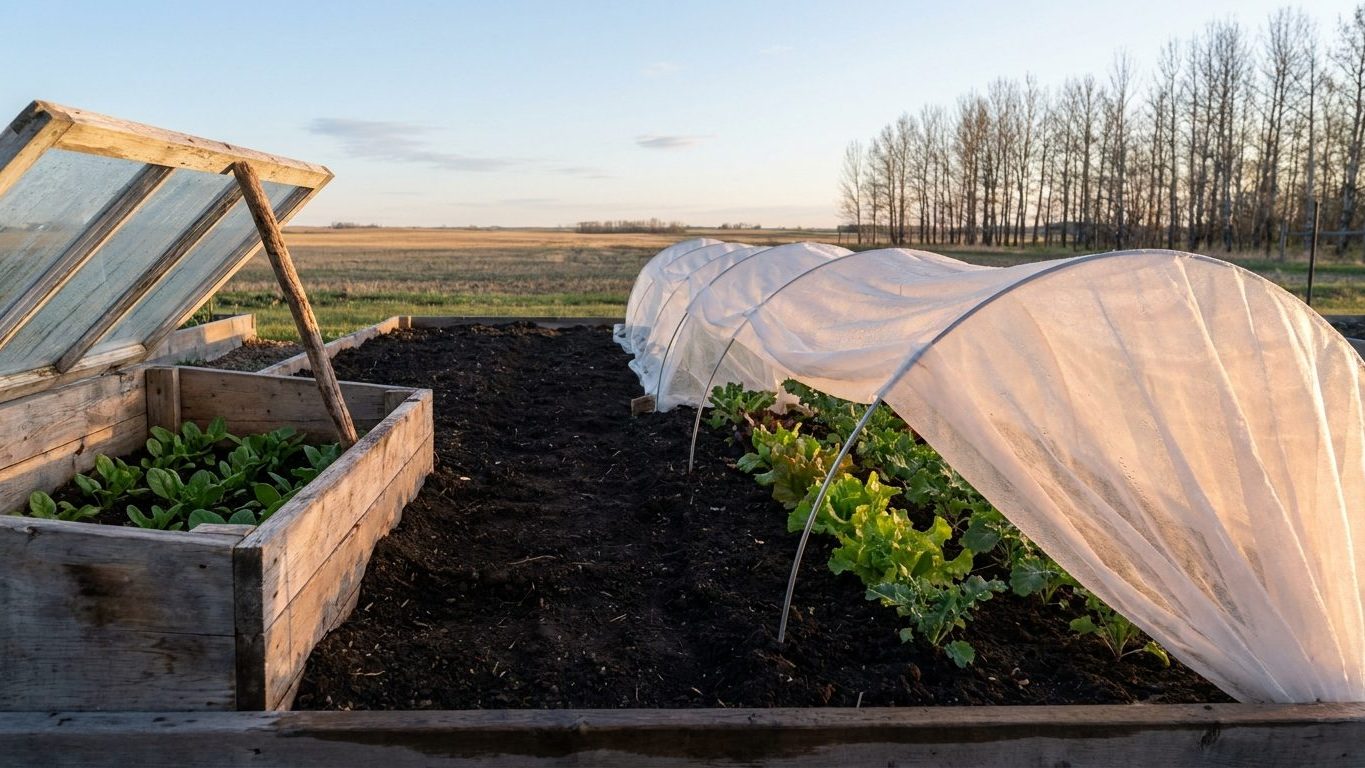

In the low desert around Phoenix, the extender that earns its keep is shade, not frost protection. Shade cloth carries cool-season crops later into spring and helps warm-season plants through the summer stall, while frost blankets stay in the shed most winters. Up in Flagstaff and the high country, the answer flips to covers, low tunnels, and cold frames.
The short answer for Arizona
Low desert: buy shade cloth first and a frost blanket second. High country: buy the classic cold-season kit, meaning row cover, low tunnels, and a cold frame. Those two sentences cover most of the state, and the reasons sit in the Phoenix numbers.
NOAA’s 1991-2020 normals for Phoenix (station USW00023183) list a frost-free season of 365 days. Phoenix reached 32F in only 6 of 30 springs, and when a rare cold snap does bring 32F, it lands between late December and mid January. The mean daily minimum of the coldest month is 45.3F. That is a mild winter night, not a killing one. You can check the raw data in the NOAA NCEI normals for Phoenix.
So a frost-date planting calendar makes no sense for the low desert. The limiting factor is summer heat, which stops fruit set for months. An extender that fights cold solves a problem most Phoenix gardeners rarely have. An extender that fights heat solves the one they always have.
| Extender | Low desert (Phoenix reference) | High country (Flagstaff area) |
|---|---|---|
| Shade cloth | Main tool, for spring and fall edges and summer survival | Minor, mostly for late-summer heat spells |
| Frost blanket or row cover | Occasional, for a rare winter cold snap | Main tool, used often |
| Low tunnel | Rarely needed for cold; can double as a shade frame | Core tool for early and late crops |
| Cold frame | Mostly unnecessary | Worth building |
For the cold-snap side of this, the page on when to cover your garden in Arizona covers timing. The broader picture is in Extending the Growing Season in Arizona.
What will not work here
Start with the habit that fails most gardeners moving to Arizona from the Midwest or East: planting by frost date. In Phoenix there is no reliable last spring frost and no reliable first fall frost. A calendar built on “two weeks after last frost” has nothing to count from. This page does not give one for the low desert because the data does not support it.
Cold frames and heavy plastic tunnels come next. A sealed, sun-facing box is a brilliant idea in a place where nights drop well below freezing for months. In a city where the coldest month averages a 45.3F nighttime low, it is a heat trap. Plastic that holds warmth in January can cook seedlings by the time afternoon sun hits it. If you use a tunnel frame in the low desert, treat it as a hoop for shade fabric, not a greenhouse.
Waiting out the summer also fails. Some gardeners assume that tomatoes and peppers will resume if watered well enough. Summer heat stops fruit set for months, and extra water does not restart it. Flowers drop, plants stall, and the harvest arrives in the shoulder seasons instead. Shade cloth can keep plants alive and reduce stress, but it does not turn July into May. Expecting it to is the most common disappointment.
The last failure runs the other way, and it matters in the north. A gardener in the high country who copies a Phoenix routine, with no covers because “it rarely freezes,” will lose tender plants to a hard frost. Flagstaff and the high country are a different climate entirely and do freeze hard. Advice that fits one end of Arizona can be flatly wrong at the other end, which is why nothing on this page should be read as a statewide rule.
Finally, thin frost cloth over a plant is not a heat solution. Light fabric that adds a few degrees on a cold night does little for a plant in an August afternoon, and in some cases it traps heat against the leaves. Match the fabric to the stress, and put it away when that stress ends.
What changes across Arizona
Arizona is not one garden. The USDA Plant Hardiness Zone Map (2023, based on 1991-2020 normals) spans zones 4b through 10b inside the state’s borders. That is a spread of about six zones, and the system is built on one variable only, the average annual extreme minimum temperature. There is no single hardiness answer for the state, and no single answer for what to use as an extender.
The Phoenix numbers on this page are a reference city, not a verdict for the whole territory. Someone in the low desert follows the Phoenix logic: shade first, frost cover as occasional insurance. Someone at altitude, or anywhere the winter minimum falls into the colder zones, should shift toward the cold-season kit: row cover, low tunnels, and a cold frame, with a real frost-date calendar. Where a town sits between those two worlds, expect to need both kinds of tools at different points in the year.
Latitude adds a second shift. Phoenix sits at 33.43 degrees north. Day length, not warmth, tells an onion to stop making leaves and start making a bulb, so a variety suited to Phoenix daylight may behave differently well north or south of that line. A reader near the northern edge of the state, or near the Mexican border, should check their own latitude rather than lean on the Phoenix figure.
To find where you fall in the spread, use the USDA Plant Hardiness Zone Map and look up your location there. Do not guess a zone from a neighbor’s advice or from a seed packet. The map is the right place to settle it, and your answer will then tell you whether to read this page as written or lean on the high-country side.
Where to check this for your own county
Your state extension service is the best next stop: University of Arizona Cooperative Extension. It is the land-grant university’s public outreach arm, and its staff work with gardeners in specific counties, not in the abstract.
Two things are worth looking for there. The first is the local planting calendar for your county. Arizona counties differ enormously, so a calendar written for one valley will not suit another at a different elevation. The second is the list of varieties trialled in your county. A variety that was tested where you live has been tried against your heat, your wind, and your soil, which no general advice can match.
A county recommendation beats a state one. This page is the state one: a framework for choosing the right kind of extender, built from Phoenix climate normals and a few honest cautions about the north. It does not have a county-level planting calendar for you, and it does not claim to. If your extension office publishes one for your area, use that over any date or rule here.
Call or visit your county office if the website does not make the calendar easy to find. Extension staff expect these questions, especially in spring and fall. Ask which extender they see local gardeners actually using, and whether a recent cold snap or heat wave has changed their advice.
Checking this against your own garden
Your own observation outranks every figure here. Three things are worth watching, and none needs equipment.
- Soil warmth by feel. Push your hand into the bed in the morning. Soil that still feels cool compared with the air warms slowly, which points to shade, a north-facing spot, or a low pocket. Soil that feels warm early on a bed that gets reflected heat from a wall suggests you will need shade sooner than the calendar says.
- The first flush of male flowers. On squash and cucumbers, male blooms appear before female ones. Note the date. When blooms show up earlier in one corner than another, that corner is your warm microclimate. When flowers drop without fruit, you are seeing the heat limit directly.
- The first true leaves. Seedlings first show seed leaves, then the true leaves that look like the mature plant. Slow true leaves on a cool-season crop mean the spot is cooler or shadier than you assumed. Fast, leggy growth followed by wilting afternoons means that spot needs shade fabric.
Keep a note of the dates for a season or two. Those notes will tell you more about your yard than any statewide table, and they make your extension calendar easier to read, because you will know where your garden runs ahead of it or behind it.
Common questions
Do I need frost cloth in Phoenix?
Seldom, but a light blanket is cheap insurance. Phoenix reached 32F in only 6 of 30 springs, and a rare cold snap can bring 32F between late December and mid January. Keep one handy for tender plants during that window.
Does shade cloth count as season extension?
Yes, in the low desert it is the main kind. It extends the season on the hot side, helping cool-season crops last longer into spring and giving warm-season plants a better chance through summer heat, which otherwise stops fruit set for months.
What should I use in Flagstaff or the high country?
Those areas freeze hard, so the standard cold-season tools apply: row cover, low tunnels, and cold frames. Check your location on the USDA Plant Hardiness Zone Map, since the state spans zones 4b-10b, and use your county extension for local dates.
Can I use a frost-date calendar in the low desert?
No. NOAA lists a 365-day frost-free season for Phoenix, so there are no reliable frost dates to count from. Heat, not cold, sets the planting windows, and this page does not provide a low-desert calendar. Your county extension office is the right source for one.