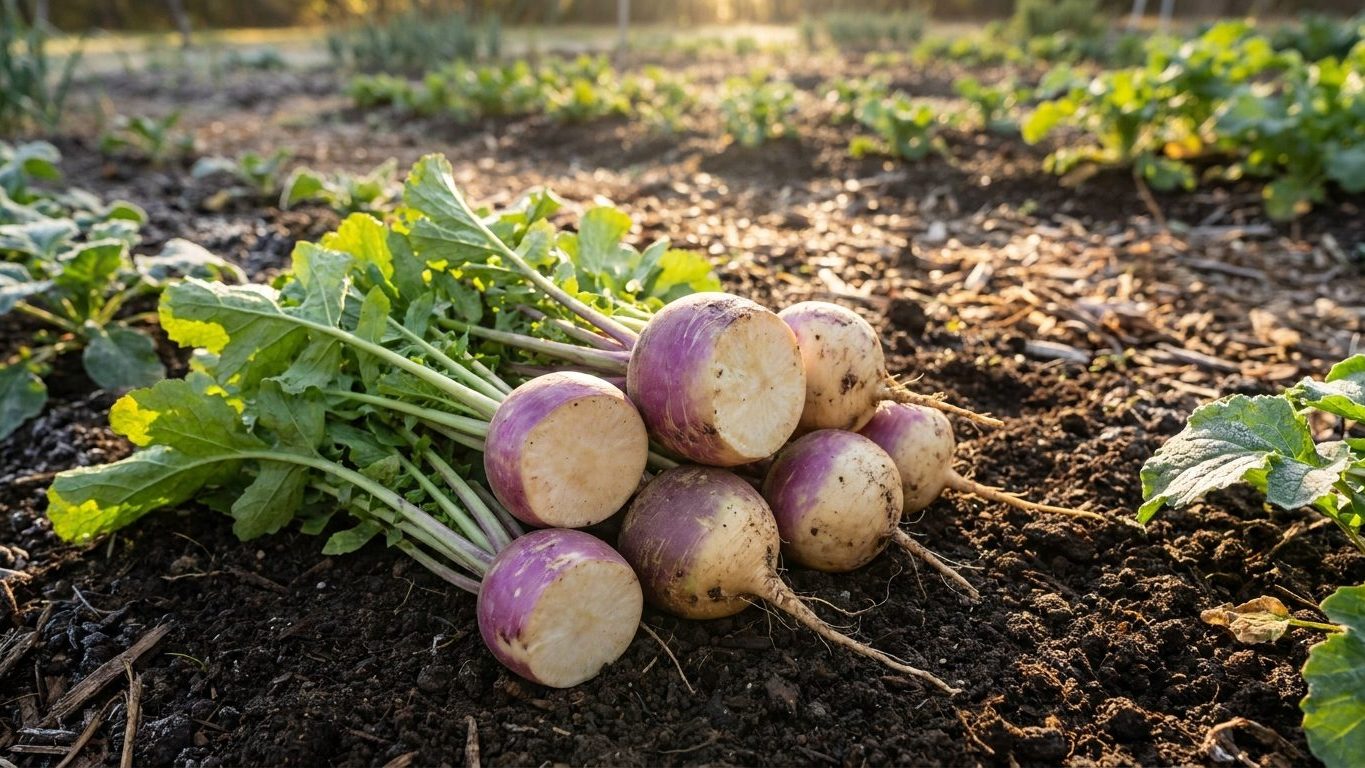

Turnips and rutabaga grow well in Nebraska, in spring and even better in autumn. The calendar that matters is the soil’s, not the wall’s. At the Omaha reference station the last spring frost falls between April 12 and April 23, but seed wants warmer ground than that date implies. The fall crop does the heavy lifting here, because cold nights turn starch to sugar in the root. This page covers dates, season length, heat and cold, and choosing types.
When the soil is warm enough in Nebraska
At the Omaha airport reference station, the last spring frost falls between April 12 and April 23, according to the NOAA NCEI U.S. Climate Normals 1991-2020. That span is the 30 to 70 percent probability band for a 32°F freeze, so a freeze after April 23 can still happen in any given year. A frost date is a probability, not a promise.
Reading the soil instead of the date
Frost is only a proxy. Turnips and rutabaga wait for warm soil, and soil warms after the frost risk ends, not with it. In mid-April the air can feel mild while the ground at seed depth still holds the winter. A cheap soil thermometer, read in the morning at seed depth, tells you more than any chart. The seed packet states the germination temperature the crop needs, and that figure is your green light, not the date on the calendar.
Cold, wet soil rarely kills seed outright. It stalls it, and a stalled seedling is the easiest meal a flea beetle will find all spring. Sowing into ground that is clearly waking up lets the seedlings outgrow the first wave of pests.
Your garden is not the airport
Those dates describe one reference city. Suburban and rural gardens typically see the last spring frost later than an airport does, often by one to two weeks, and more at elevation. Nebraska climbs steadily toward the Panhandle, so a garden in the west cannot borrow Omaha’s calendar. Check the frost data for your own county before you commit seed.
Talk of “turnips” hides a split worth knowing. Small, quick turnips suit a spring sowing. Larger storage turnips and rutabaga are mostly autumn crops, and rutabaga needs the longer run. The varieties actually trialled in the state are tracked by University of Nebraska–Lincoln Extension, and this page names none of them because it cannot source them.
One more thing before you plan the bed. Turnip and rutabaga are brassicas, and they share their pests and diseases with cabbage, kale and mustard. A gardener who rotates them into a spot where cabbage grew last year has rotated nothing. The crop rotation guide on this site explains how long to keep brassicas away from a bed.
How long the season lasts here
Both frost dates come from the same NOAA normals for the Omaha reference station. The last spring frost falls between April 12 and April 23, and the first fall frost between October 15 and October 26. Pair the earliest spring date with the latest fall date, April 12 to October 26, and the window runs 197 days. Pair the latest spring date with the earliest fall date, April 23 to October 15, and it shrinks to 175 days. Plan on something between those two numbers.
That is the airport’s version. A suburban or rural garden loses one to two weeks at each end, which can trim the window by as much as four weeks when both ends move the wrong way. A garden near the short end of that range has a very different season from one near the long end, even inside the same county.
What a window this long allows
A window of roughly 175 to 197 days is long enough for two sowings, and that is the real payoff. A spring sowing of a quick turnip comes out before summer heat settles in. A second sowing in late summer matures into the cool nights of autumn, which is when these roots taste best. To place the second sowing, count back from your first fall frost using the days to maturity printed on the packet, and leave a cushion. Turnips tolerate light frost, so the first frost is not the deadline, but a hard freeze is. The succession sowing guide on this site shows how to stagger sowings so you are not harvesting everything in one weekend.
The window also settles the transplanting question. In a short-season territory, starting seedlings indoors to gain a few weeks can be worth the trouble. Here there is room to sow where the plants will stay, which suits a crop that grows a taproot and resents disturbance. A kinked or broken root does not recover, and it tends to produce a forked, stunted vegetable. If you do transplant, check the root before it goes in the ground, and discard any seedling whose root is bent or damaged. For the general crop calendar, see Growing Turnips and Rutabaga: An Autumn Crop, Sweetened by Frost.
Heat and water in Nebraska
The verified figures for this page do not include a count of days above 90°F or a summer rainfall total, so none appear here. Guessing at them would be worse than leaving them out. Look them up in the NOAA normals for the station nearest you, and ask your county extension office how the local summer behaves. What can be said without a number is that Nebraska summers are hot enough to punish a spring crop that matures late. They are also hot enough to make late-summer seedbeds dry out fast, so the fall sowing needs even moisture, a little shade over the seedbed, and mulch to keep the root zone cool.
Wet stretches bring their own problems. A damp, humid spell brings mildew, slow ripening and root disease, and crowded plants with no airflow suffer first. Spacing and thinning are the practical defense. Neighbors with cooler, wetter climates face a heavier version of this, as in Growing Turnips and Rutabaga in Connecticut and Growing Turnips and Rutabaga in Wisconsin.
The two cold numbers that govern the crop
For an autumn crop, the facts that matter most are cold ones. The first is the coldest month. At Omaha, the mean daily minimum of the coldest month is 15.2°F (NOAA Climate Normals 1991-2020). That is an average, so individual nights run colder, and the ground freezes hard. For a Nebraska bed, that settles the overwintering question: mulch can stretch the harvest into late fall and through mild spells, but it is not a winter plan. Lift the roots before the ground locks up, trim the tops, and store them.
The second number is the winter low, and it decides how much sweetening the crop gets. Cold nights drive the root to convert starch into sugar, so a root that sits through several frosts in October and November tastes better than one pulled in warm weather. Leave them in as long as the ground stays workable, then lift. The USDA Plant Hardiness Zone Map 2023 puts the state at 4a to 5b. That is a range built on the average annual extreme minimum, so cite your own location rather than the whole state.
Storage touches food safety, so inspect every root you lift. Firm and dry is the starting point. A soft patch, a weeping spot or a moldy crown ends the question for that root, and a root that looks sound is not proof that it is safe. Check stored roots regularly and pull out any that show trouble. No keeping duration can be promised, because it depends on the condition of the root when it went in.
Which turnips and rutabaga suit Nebraska
Choose by type, and let the territory’s facts do the narrowing. Nebraska has a mid-length season of roughly 175 to 197 days at the reference station, hot summers, and hard winters. The table matches each type to that profile.
| Type | Why it fits Nebraska | What to watch |
|---|---|---|
| Quick, small-root turnips | Mature early in spring, before heat, and again in fall | Bolting and woody roots if sown too late in spring |
| Larger storage turnips | Make use of the long fall stretch and frost sweetening | Crowding and moisture swings in late summer |
| Rutabaga | Needs the longer run, which the window allows | Sowing too late, and cracking after dry spells followed by rain |
Beyond type, the other criteria follow from the climate. A garden at the short end of the window, a rural plot with a late spring and an early fall, favors the earliest types. Hot summers favor plants given airflow and shade at the root: proper spacing, mulch, and a taller crop nearby to throw afternoon shade. In a wet year, disease resistance moves to the top of the list, because mildew and root troubles spread through crowded, damp plants.
Named varieties are missing on purpose. A cultivar that thrives in one region can fail in another, and the only recommendation that means anything is one trialled where you garden. This page does not have those trial results, so naming a variety would be inventing a reputation. Instead, go to University of Nebraska–Lincoln Extension and ask for the varieties tested in the state, or contact your county office for local advice. Remember that every pick is a brassica, so it shares problems with cabbage, kale and mustard, and the rotation guide on this site applies to whichever type you choose.
Common questions
Can I sow turnips in spring in Nebraska?
Yes, with a quick, small-root type, once the soil at seed depth has warmed. The Omaha reference station’s last spring frost falls between April 12 and April 23, and your own county may run one to two weeks later. Aim to harvest before the heat of summer sets in.
When should I sow for a fall crop?
Count back from your first fall frost using the days to maturity on the seed packet, and add a cushion. The Omaha reference station shows first frost between October 15 and October 26, but rural gardens typically see it earlier. Rutabaga needs the longer run, so it goes in before a fall turnip does.
Will roots survive winter in the ground under mulch?
Not reliably. The mean daily minimum of the coldest month at Omaha is 15.2°F, and the ground freezes hard. Mulch extends harvest into late fall and mild spells, but plan to lift the roots before a hard freeze and store them.
How do I know a stored root is still good?
Inspect each one. A soft patch, a weeping spot or a moldy crown ends the question, and a root that looks sound is not proof of safety. Check the whole batch often and remove any root that shows trouble, since one failing root can spoil its neighbors.