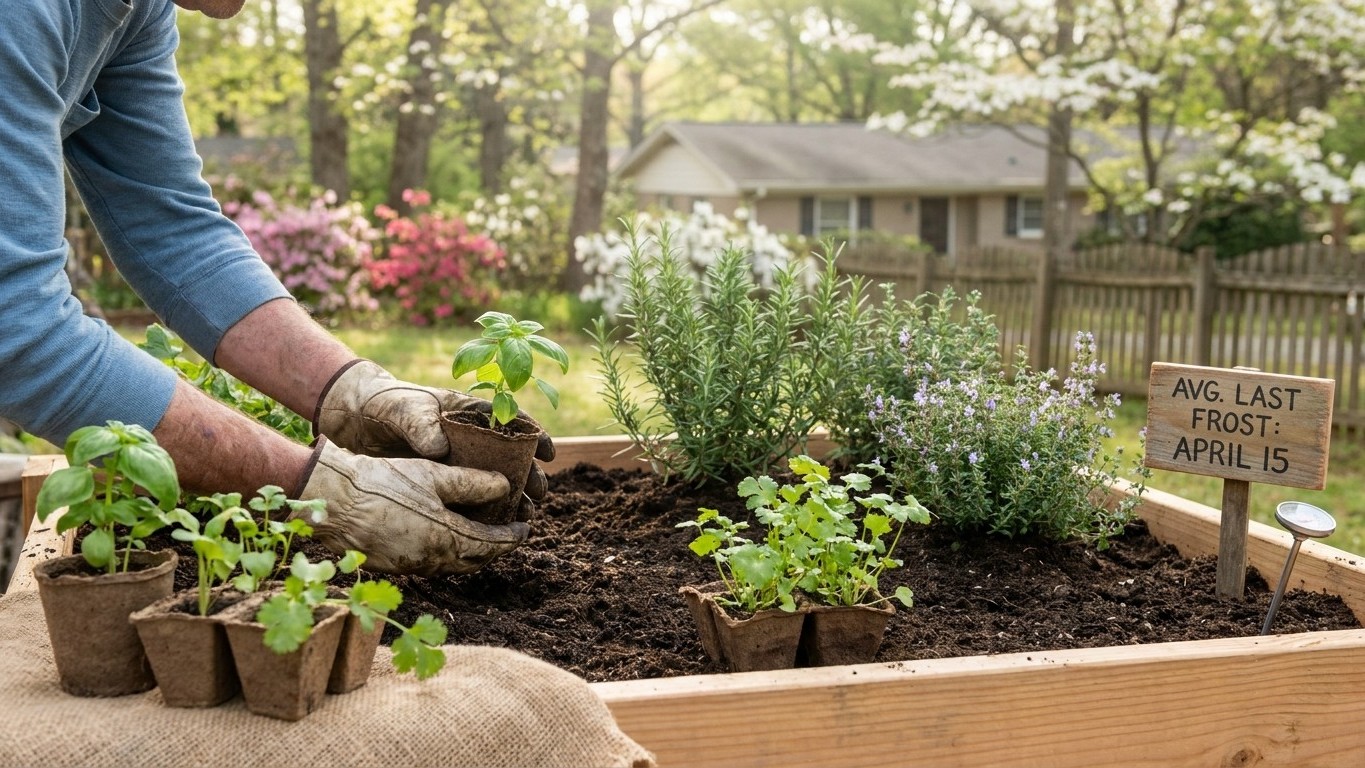

Arkansas gardeners get two different planting calendars depending on what they’re growing: hardy herbs like parsley and chives can go in the ground weeks before the last frost, while tender herbs such as basil need the soil to actually warm up, which in most of the state means waiting until early April.
The short answer for Arkansas
For cold-hardy herbs, plant three to four weeks before the last spring frost. NOAA’s 1991-2020 Climate Normals for station USW00013963 put that last spring 32F freeze somewhere between March 12 and March 28. That’s not a fixed date, it’s a 30-70% probability band, meaning there’s still real risk of a freeze before March 12 and a meaningful chance of one after March 28 too. Parsley, chives, cilantro, and dill germinate fine in cool soil and can shrug off a light frost, so seeding them in that window is a reasonable bet, not a guarantee.
Tender herbs play by different rules. Basil, in particular, sulks or dies outright below the mid-30s, so the 32F date isn’t the one that matters. NWS Little Rock’s light-frost (36F) threshold is the more honest number here: April 3 in spring, October 31 in fall. That’s the window that actually protects basil, and it’s roughly three weeks tighter on both ends than the frost-free season implied by the 32F normals.
On the back end of the season, first fall frost (32F) lands between November 7 and November 20 across that same NOAA dataset. Again, that’s a probability range, not a scheduled event. Hardy herbs planted for a fall crop, like a second round of cilantro or parsley, can push right up against that window. Basil and other tender herbs need to be harvested or covered well before it, ideally by the October 31 light-frost date, because a 36F night will blacken basil leaves days before an actual 32F freeze arrives.
: hardy herb sowing runs from mid-to-late March through early November. Tender herb planting is boxed into the narrower April 3 to October 31 stretch. Neither date is a promise. Both are drawn from thirty years of station data, which means roughly one year in three will break the pattern in one direction or the other.
What will not work here
Seeding basil, or transplanting it outdoors, in the second half of March because the 32F frost date has technically passed is a common mistake. Soil temperature lags air temperature, and basil seed sown into cold, damp Arkansas clay in March often rots before it germinates. Waiting for the April 3 light-frost date, and ideally a week or two past it, gives the soil time to catch up.
On the other end of the hardiness spectrum, treating woody perennial herbs like rosemary as a permanent fixture in every Arkansas garden doesn’t hold up everywhere. The coldest month’s mean daily minimum at the Little Rock reference station is 30.9F, which sounds mild, but that’s an average, not a floor. In the colder pockets of the state’s 6b zone, the average annual extreme minimum can still dip into the single digits or below zero in a hard winter, which is enough to kill an unprotected rosemary plant grown outside its hardiness range. In the warmer 8a pockets, the same plant often sails through untouched.
Heat and humidity do their own damage
Arkansas summers punish two different mistakes at once. Herbs planted in full sun and watered on a weekly schedule during July and August, when both heat and evaporation spike, tend to bolt early or wilt between waterings, especially in raised beds or containers that dry out fast. At the same time, the state’s humidity makes basil and other close-spaced herbs vulnerable to downy mildew and other fungal issues when plants are packed tight without airflow. Wide spacing that would feel excessive in a drier climate is often the right call here.
Slow-maturing herbs also run into a wall. French tarragon and some longer-season fennel varieties need a stretch of mild weather to establish before summer heat arrives, and in years when spring is short or a late frost pushes planting back, that establishment window can close before the plant is ready for it.
What changes across Arkansas
Arkansas isn’t one climate. The USDA Plant Hardiness Zone Map (2023 edition, built on 1991-2020 normals) places the state across zones 6b to 8a, a spread built entirely on average annual extreme minimum temperature. That’s roughly a two-zone difference between the coldest corners and the warmest, which in practical terms can mean a difference of ten degrees or more in the coldest nights a garden is likely to see in a typical winter.
That spread matters most for perennial herbs left outside year-round. A rosemary or lavender variety rated for zone 7 might return reliably every spring in the southern and lowland parts of the state, while the same plant, grown unprotected in a higher-elevation or northern pocket closer to 6b, risks winterkill in a harder-than-average year. Annual herbs are less affected by the zone spread itself, but they’re still shaped by it indirectly: colder pockets tend to have shorter frost-free seasons, which trims the planting window on both ends.
There’s no single answer for “when does Arkansas warm up,” because the state spans nearly two full hardiness zones. A reader gardening in the Ozark or Ouachita highlands should expect a later safe planting date and an earlier fall cutoff than a reader in the southern lowlands. Rather than guess which side of that line a given garden falls on, check the current USDA hardiness zone map directly using a home address, since zone boundaries follow elevation and local geography in ways that county lines don’t always capture.
Where to check this for your own county
The University of Arkansas Division of Agriculture’s Cooperative Extension Service, at uaex.uada.edu, is the source built for exactly this problem. State-level frost dates and hardiness zones give a useful starting point, but they average over a lot of local variation, and a county-level recommendation from the people trialing varieties in that specific soil and microclimate will beat a statewide estimate every time.
On the extension site, look for two things specifically. First, the county-level planting calendar, which adjusts the general Arkansas frost dates for local elevation and microclimate, sometimes by a week or two in either direction. Second, look for variety trial results or recommended cultivar lists for herbs, since extension programs often test which basil strains resist downy mildew locally, or which rosemary cultivars have survived recent winters in that county’s conditions. That kind of ground-truthed information doesn’t show up in a national climate dataset.
Statewide NOAA and USDA figures are the right tool for understanding Arkansas as a whole and for comparing it to neighboring states. They are not a substitute for a county agent who has watched actual gardens through actual winters in that specific stretch of the state. If the extension calendar for a given county disagrees with the dates here, trust the county calendar.
The Moon calendar is a separate, older custom: see when to plant herbs by the moon, written as tradition rather than fact.
Checking this against your own garden
Every date here is a statistical average built from three decades of weather records. A single garden, in a single year, can and often does run ahead of or behind those averages by two or three weeks. Three direct observations tell more than any calendar.
Soil warmth checked by hand, a few inches down, first thing in the morning before the sun has warmed the surface, is the most reliable signal for tender herb seed. If the soil feels cool and damp rather than merely cold, basil and other warm-season herbs are usually safe to go in, regardless of what the calendar date says.
Watching how quickly cool-season weeds like henbit and chickweed fade out of a bed is a rough but useful proxy for how far the soil has warmed, since those weeds thrive in cool ground and thin out once temperatures climb into basil’s comfort range.
The appearance of true leaves, the second set that emerges after the initial seed leaves, on any direct-sown herb confirms the plant has actually started active growth rather than just sitting in cold soil waiting. A bed where true leaves show up within a week of sowing is running warm for the season; one where they take three weeks is running cold, and that’s worth remembering for next year’s timing in that same spot.