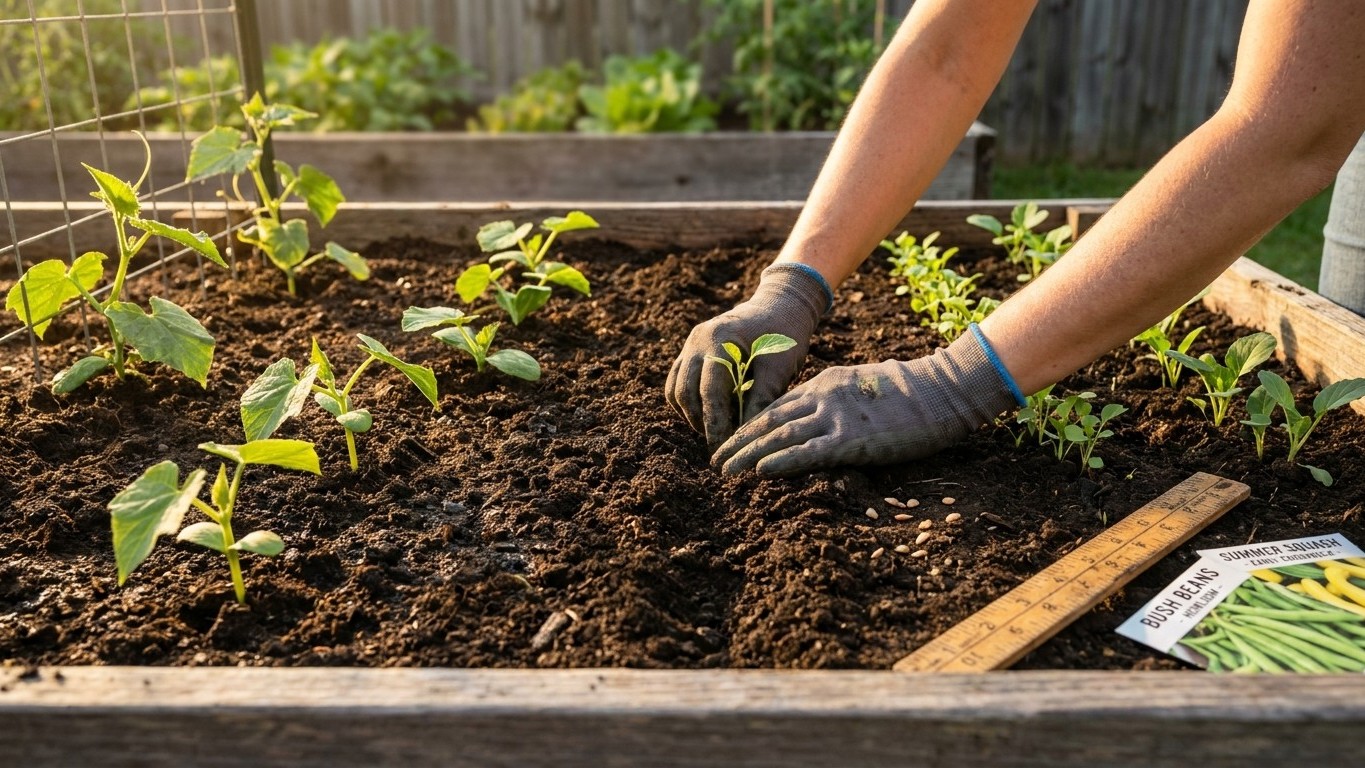

August in Arkansas still has room to plant. Early in the month, quick warm-season crops, bush beans, summer squash, cucumbers, southern peas, can still go into the ground. By the third week, the math shifts toward fall: mustard, turnip greens, collards, and root crops timed to finish before the season’s first hard frost. The line between the two isn’t the calendar. It’s the number of days a seed needs, counted backward from frost, not forward from today.
What goes in the ground in August

The arithmetic starts at the far end of the season. NOAA’s 1991-2020 Climate Normals put the state’s first fall frost, the 32-degree threshold, between November 7 and November 20, based on data from station USW00013963 (source: NOAA NCEI). Count backward from the earlier date, November 7, and a seed sown on August 1 has roughly 14 weeks left. Sow the same seed on August 25 and the clock reads closer to 10 weeks. That difference decides what belongs in the ground and what doesn’t.
Bush beans mature in 50 to 55 days and southern peas in 60 to 70, so both still fit comfortably in the first two weeks of August. Summer squash and cucumbers, at 50 to 65 days, are a tighter call: safe through roughly the first week, a gamble after that unless the plant is protected into fall. Once the calendar turns past mid-month, the safer bet is short-season greens. Mustard and turnip greens finish in 30 to 45 days, collards in 55 to 75, and either can go in through the end of August with room to spare before frost. Carrots and beets, at 50 to 70 days, need to be in the ground by mid-month to reliably size up.
Soil temperature matters as much as the days-to-maturity math. Lettuce and spinach seed often stalls or rots in soil above roughly 80 degrees, which is common at the surface through most of an Arkansas August even when the air cools in the evening. The days-to-maturity arithmetic might say there’s time, but the seed won’t cooperate. That’s a reason to start those two under cover rather than sow them straight into the bed, a distinction worth carrying into the next section.
What to start under cover
The same backward count applies to transplants, just shifted by however many weeks a seedling needs before it’s sturdy enough to go outside. Fall broccoli, cabbage, and cauliflower are usually started in July, but a second batch sown in early August still leaves 8 to 10 weeks before the November 7 end of the frost window, once transplanted out in early to mid-September.
Lettuce and spinach are the clearer case for starting indoors this month. Sow them in trays or flats kept out of direct afternoon sun rather than in open ground, where surface heat can keep the seed from germinating at all. Move the seedlings out once daytime highs start easing, typically once the worst of the heat has broken.
Two ways this goes wrong. Start too early and the seedlings sit in small cells through the hottest stretch of the month, bolting or going rootbound before they ever reach the garden. Start too late and they’re still small when the frost window arrives, cutting the harvest short before the plants have had time to size up. The backward count from November 7 to November 20 is the check against both mistakes: work out how many weeks the transplant needs to mature, then how many more weeks it needs in the ground, and sow indoors that far ahead of frost, not by a fixed date on the wall calendar.
What is ready to pick
August is the peak of the harvest calendar in Arkansas, not a lean stretch. Tomatoes, peppers, eggplant, summer squash, cucumbers, melons, okra, southern peas, and basil are all coming in, often faster than a household can use them.
Ripeness signals differ by crop. Tomatoes should color fully and give slightly under gentle pressure rather than staying firm. Okra pods turn woody fast, so pick them at 2 to 4 inches rather than waiting for a bigger pod. Cucumbers held to 6 to 8 inches keep the vine producing longer than ones left to grow oversized. Summer squash follows the same logic: smaller and more frequent harvests push the plant to keep flowering instead of putting its energy into one large fruit. Melons give a subtler clue, a slight browning and drying of the tendril nearest the stem, along with a change in the blossom end from firm to slightly yielding.
Bush beans sown in the first days of August, at 50 to 55 days to maturity, should start coming in by late August or early September, giving a second bean harvest before the ground cools. Checking the harvest daily during this stretch isn’t optional busywork. Squash, cucumbers, and okra left unpicked for even a few extra days signal the plant to slow production, which shortens the total yield for the season.
The jobs that matter this month
Watering rhythm matters more in August than in almost any other month. Established beds generally need about 1 to 1.5 inches of water a week during peak heat, delivered in one or two deep soakings rather than light daily sprinkling, which encourages shallow roots that struggle once the heat peaks. Morning watering, rather than evening, gives foliage time to dry before nightfall and cuts down on fungal disease.
Mulch does double duty this month, holding soil moisture and moderating the swings in soil temperature that stress both germinating seed and established roots. A few inches of straw or shredded leaves around tomatoes, peppers, and squash pays for itself in reduced watering and steadier fruit set.
Pest scouting can’t wait either. Squash vine borer and spider mites both do their worst damage in dry heat, and by the time a squash plant visibly wilts, borer larvae are usually already inside the stem, past the point where early treatment helps. Checking the base of stems and the undersides of leaves every few days catches both before they take hold.
Staking and caging tomatoes and peppers still loaded with fruit keeps a heavy plant from splitting or toppling in a summer storm. Succession sowing of bush beans, roughly every two to three weeks through the first half of the month, keeps a steady supply coming until the backward count from frost closes the window. And clearing spent spring crops, bolted lettuce, finished garlic beds, spring peas, frees up space and lets compost or aged manure work into the soil before the fall planting push begins in earnest.
What not to do in August
The most common mistake is treating August soil like spring soil. Direct-sowing lettuce or spinach seed into hot ground and expecting a spring-style germination rate almost always disappoints; the seed either sits dormant or rots before it sprouts. Starting those two under cover, as covered above, avoids the problem entirely.
Skipping mulch and letting watering swing between bone-dry and soaked is another classic August error. That inconsistency is a leading cause of blossom end rot in tomatoes and peppers, and it splits cucumbers and melons that were otherwise close to ready. A steady watering rhythm matters more than the total volume applied over a week.
Heavy nitrogen fertilizer applied now is a mistake with tomatoes and peppers already loaded with fruit. Nitrogen pushes leaf and stem growth at the expense of the fruit already set, delaying ripening rather than speeding it up. If feeding at all this late, a fertilizer leaning toward phosphorus and potassium supports the fruit already on the vine instead of competing with it.
Ignoring early squash vine borer damage rounds out the list. A wilting leaf or two on an otherwise healthy squash plant is often the first visible sign, and waiting a week to investigate usually means the larvae have already tunneled too far into the stem to save the plant.
Checking this against your own county
A statewide frost window is a starting point, not an instruction for a specific yard. Elevation in the Ozark highlands of northern Arkansas can push frost dates earlier than the Delta lowlands or the southern part of the state, shifting the safe planting window by weeks in either direction. The 32-degree dates cited here come from a single station (USW00013963), and a light, 36-degree frost, the kind that damages tender seedlings well before a hard freeze, arrives even earlier: NWS Little Rock gives April 3 and October 31 as that threshold’s dates. For a planting decision tied to a specific county, the University of Arkansas System Division of Agriculture Cooperative Extension Service is the source built for that level of detail.
Common questions
Can you plant tomatoes in Arkansas in August?
Transplanting new tomato plants in August rarely leaves enough time to reach harvest before the first fall frost between November 7 and November 20. Existing tomato plants set earlier in the season should still be producing through the month.
What vegetables can be planted in August in Arkansas?
Bush beans and southern peas fit in the first two weeks. Summer squash and cucumbers are a tighter fit early in the month. Mustard, turnip greens, and collards can go in through the end of August, and carrots or beets should be sown by mid-month.
Is it too late to plant a garden in August in Arkansas?
No. August is when the fall garden begins in earnest, built around short-season greens, root crops, and a second flush of beans, all timed to finish before the first frost.
When should fall garden crops go in the ground in Arkansas?
It depends on the crop’s days to maturity counted backward from the first fall frost, which the NOAA Climate Normals place between November 7 and November 20 for the reference station used here. Fast greens can wait until late August; root crops and transplants need to go in earlier in the month.