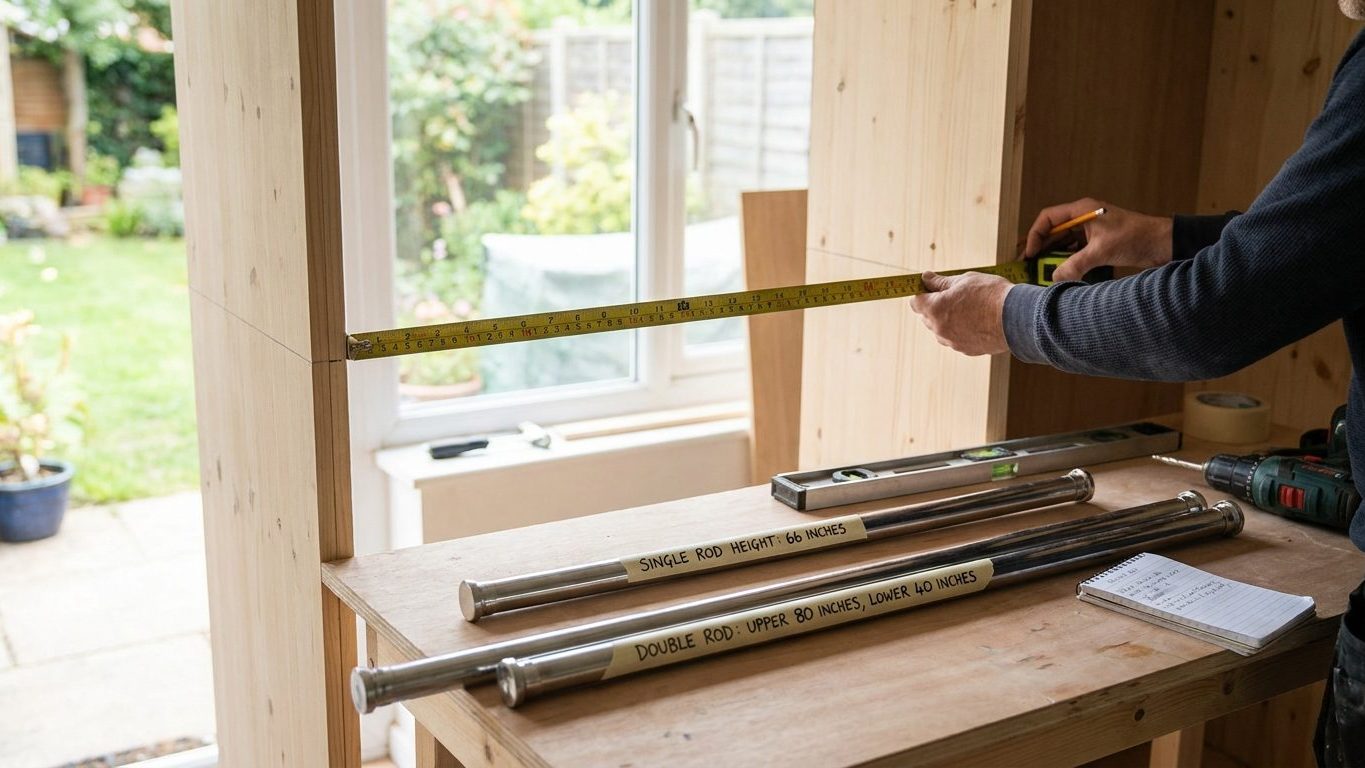

Sixty-six inches is the standard height for a single closet rod, high enough to keep a full-length coat off the floor. A double-hang answers a different question: instead of one rod at that height, it stacks two rods lower down, splitting the same wall between shirts and folded trousers without wasting the space above them. Measure your longest garment before you commit to a double-hang, since that’s the check that decides whether it fits your closet at all.
The heights for a single and a double rod

A single rod sits about 66 inches above the floor, a figure that comes from closet-planning convention rather than any building code. No section of a residential code sets closet rod height, so this number is a trade default, not a permit requirement. It’s measured from the finished floor to the centerline of the rod, and it works because it clears a full-length coat with a little room to spare at the hem.
A double-hang runs at about 42 and 84 inches, also measured floor to rod centerline, doubling the shirt-and-trouser capacity you get out of the same width of wall. The lower rod carries folded-over trousers and shirts, the upper one carries shirts and jackets, and closet-planning convention treats both figures as a starting point that a closet designer nudges up or down for a specific wardrobe, not a fixed minimum. A double-hang works best on a wall wide enough to plan two full rods without notching around a door casing, which is worth checking against the Minimum Walk-In Closet Size guide before you build one from scratch.
| Rod type | Height above floor | Set for |
|---|---|---|
| Single rod | about 66 inches | full-length coats |
| Double-hang, lower rod | about 42 inches | folded trousers and shirts |
| Double-hang, upper rod | about 84 inches | shirts and jackets |
| Accessible reach (ICC A117.1-2017) | 48 inches maximum | forward reach from a wheelchair |
What each height is measured against: the longest garment
Why 66 inches, not more or less
The 66-inch height is measured against the longest thing anyone hangs in a coat closet: a full-length coat on a hanger. Closet designers set the rod high enough that the coat’s hem clears the closet floor by a couple of inches, because a coat that drags picks up dust and catches on shoes every time the door opens. Go higher and you start losing the space a shelf needs above the rod. Go lower and a long coat needs a different closet. The number is a compromise between garment length and what people actually own, not a safety margin.
The double-hang’s two targets
The double-hang’s 42 and 84 inches are measured the same way, against folded trousers and shirts on the lower rod and shirts or jackets on the upper one, not against a coat. A double-hang assumes nobody is hanging full-length coats on either rod, which is also why the layout doesn’t double as a coat closet: nothing about an 84-inch upper rod leaves room below it for something that reaches close to the floor. The gap between the two rods is set by shirt length plus clearance for a hanger hook, not by any risk it’s guarding against. A shirt sleeve brushing the rod below it doesn’t hurt anyone, so this pair of numbers stays purely practical, unlike the accessible reach figure covered below.
The shelf, the rod, and the 12 inches from the wall
The 12 inches most closets keep between the rod and the back wall, and the 2 to 3 inches of clearance between the rod and the shelf above it, come from the same source as the rod heights themselves: closet-planning convention, not a building code. No inspector checks either measurement, because neither one is a code minimum anywhere. A cabinet shop or closet-system installer plans to those figures because they keep a hanger from banging the shelf and keep the rod far enough from the wall for a hanger hook to clear both the wall and the shelf bracket.
That changes the moment a closet has to meet an accessibility requirement. ICC A117.1-2017, section 308.2 requires that the highest operable part reached from a forward position, in a wheelchair, sit no higher than 48 inches above the floor. A rod or rod-mounted accessory in a closet designed to that standard has to come down to 48 inches or below, well under both the 66-inch single-rod height and the 84-inch upper rod on a double-hang. Whether that standard applies to a given closet is a matter of which code your state or municipality has adopted for that building and occupancy, and that’s a question for your local building department, not a tape measure. Closet-planning convention, by contrast, isn’t enforceable anywhere. Nobody fails an inspection over a rod set at 64 inches instead of 66.
Marking rod height before fixing the cleats

Measure from the finished floor, not the subfloor and not the top of the baseboard. If the closet is getting new flooring, add that thickness before you mark the cleat position, or the rod ends up higher than planned once the floor goes in.
Mark the height on the side walls first, then check the mark with a level across the back wall before driving a single screw into a cleat. Drywall in an older closet is rarely dead flat, and a rod hung level to one wall mark and not the other pulls to one side under a full load of clothes.
The mistake that shows up most often is marking to the top of the rod instead of its centerline, then hanging a rod-and-cleat kit whose cleat height is specified to the centerline. The difference is usually only about the radius of the rod, but it’s enough to push a shelf mounted at the standard 2 to 3 inches above it closer than planned, or to catch the top of a coat that fit fine on paper.
- Finished floor height, not subfloor, especially if new flooring is coming
- Rod centerline versus the cleat height printed on the hardware
- Level checked across the full width, at both side walls
- Clearance above the rod if a shelf goes in at 2 to 3 inches over it
The double-hang that leaves nowhere for a coat
A double-hang planned for a closet that later needs to double as a coat closet leaves nothing that clears a full-length coat. The upper rod at 84 inches puts the hem of anything ankle-length well below the lower rod, and the lower rod at 42 inches puts that same hem dragging on the closet floor. The upper rod has to come out and the bracket holes get patched, because there’s no adjustment that turns a double-hang back into single-rod coat clearance without pulling hardware.
That mismatch shows up most at resale, when a buyer opens what’s listed as a coat closet and finds two rods with nowhere to hang a full-length coat, or opens a bedroom closet outfitted for shirts and pants with no double-hang at all in a house that needs one. It’s a fit problem, not a safety one, and it’s fixable with new brackets rather than an inspection. A bedroom closet’s footprint also has to sit inside the room’s total floor area required by Minimum Bedroom Size: 70 Square Feet, and 7 Feet in Any Direction, so a deep double-hang closet can eat into that number faster than a single rod would.
The one case where the mismatch becomes a compliance question is a closet built to meet the 48-inch maximum reach under ICC A117.1-2017. Lowering an accessible rod later, or raising it back to 66 inches for a standard single-hang, changes whether that closet still meets the reach requirement it was built to. That’s the point to call whoever certified the unit as accessible, not to guess from a tape measure.
Common questions
Can I hang my closet rod higher than 66 inches?
Yes. Closet-planning convention treats 66 inches as a starting point, not a fixed rule, so raising it works fine as long as the longest coat you own still clears the floor. Check the ceiling and shelf clearance above the new mark too, since a rod moved up eats into shelf space.
What height should a closet rod be for a child’s room?
There’s no published convention figure for a child’s closet the way there is for an adult single or double rod, since it depends entirely on the child’s height and how much they’re expected to reach it themselves. Many households use an adjustable-height rod system in a kid’s closet for exactly that reason, lowering it now and raising it as the child grows.
Do I need separate cleats for each rod on a double-hang, or one long bracket?
Either works. Some rod-and-shelf kits use a single vertical bracket that carries both rod heights on one piece of hardware, others use separate cleats for the upper and lower rod. The load rating and the wall material behind the drywall matter more than which style you pick.
Will a home inspector flag my closet rod height?
Generally no, because rod height is a trade convention rather than a code requirement, so there’s nothing in a standard home inspection checklist tied to it. The exception is a unit built or sold as accessible under ICC A117.1-2017, where the 48-inch reach limit is an actual standard someone certified the closet against, and that’s worth confirming with whoever issued that certification rather than assuming.