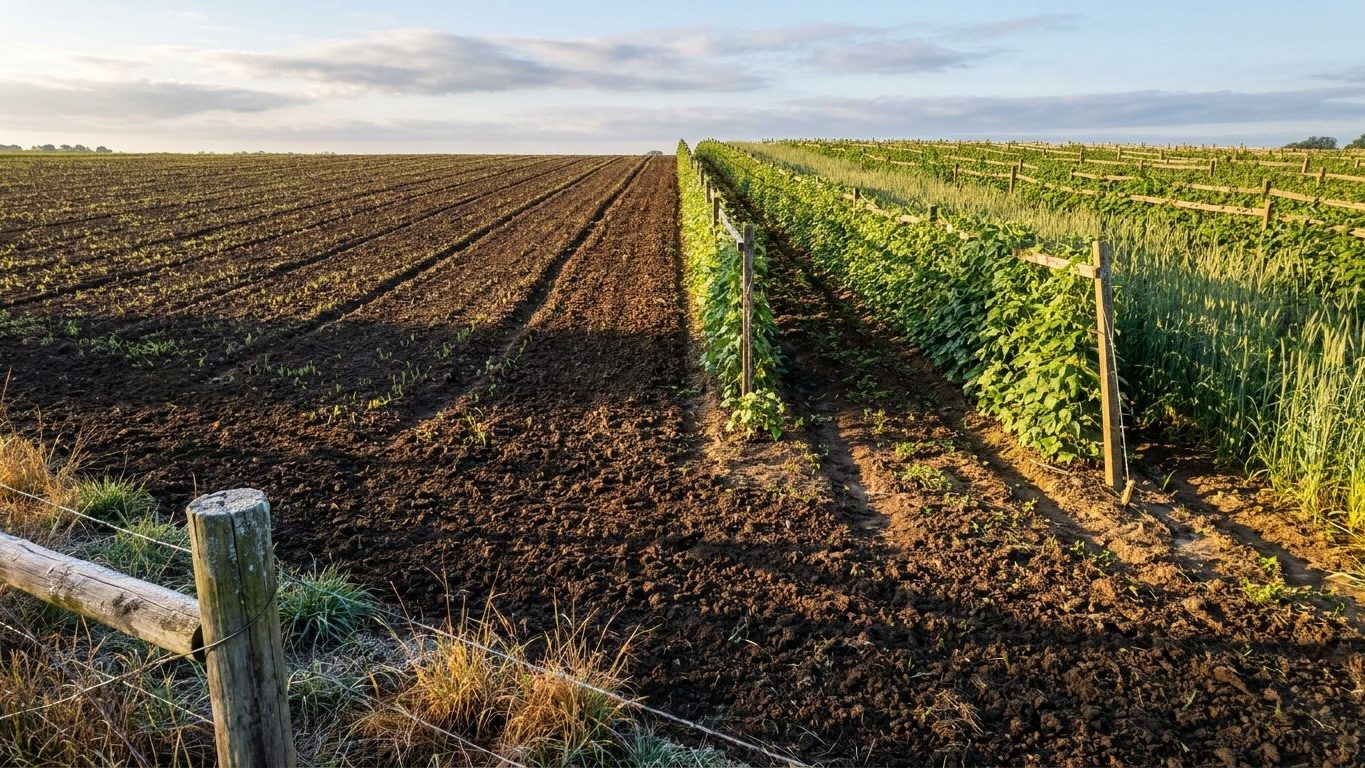

The mean last spring frost near Vancouver Int’l A is March 18, and the mean first fall frost is November 10, but treat both as a coin flip, not a calendar promise. That gives coastal British Columbia two sowing windows: spring-sown covers from roughly mid-March onward, and fall-sown covers seeded through August and September, ahead of that November frost date.
The short answer for British Columbia
Two sowing windows exist here, and which one you use depends on what the cover crop is for. The frost-free stretch bracketed by a March 18 mean last frost and a November 10 mean first fall frost runs close to 237 days at the Vancouver Int’l A station, a long season by Canadian standards, and long enough to make spring sowing forgiving once the soil actually warms.
For spring-sown covers, buckwheat, oats, field peas and annual clovers are typically seeded from mid-March through May. But March 18 is a mean date from Environment and Climate Change Canada’s 1981-2010 normals, not a safe cutoff. A mean means that in one year out of two, the last frost lands later than March 18. Sow frost-tender buckwheat right on that date and you’re betting on a coin flip you’ll lose about half the time. The practical move is to treat March 18 as the midpoint of a window, not its start, and hold tender species back into April unless the soil has clearly warmed.
For fall-sown covers, the calculus flips. Winter rye, crimson clover, hairy vetch and fava beans are usually sown from mid-August through September so they can put on real growth before the mean November 10 frost slows them down. These species don’t need protection from that frost; some of them barely notice it. What matters more for this group is the coldest month min of 33.5°F, the average daily low during the coldest month at the reference station. That figure is mild enough that winter-hardy covers sown in early fall can keep growing, slowly, right through winter rather than going fully dormant.
The hardiness zone for the reference city is 9a on the Canadian system, which uses seven climate variables rather than the single minimum-temperature figure the USDA system relies on. That zone number describes Vancouver specifically, not the province, and it should never be read as a USDA equivalent : Natural Resources Canada is explicit that the two systems don’t convert directly.
This page doesn’t have summer heat or rainfall figures for British Columbia, so any advice about hot-season stress or watering frequency below would be borrowed from elsewhere and shouldn’t be trusted as a fact for this province.
What will not work here
The failure mode that trips up gardeners in coastal British Columbia isn’t a short season, at 237 days between mean frost dates, the season here is long. The failure mode is relying on a hard winter to do the work for you.
A lot of cover-crop strategy elsewhere depends on winter-kill: sow a species like forage radish or spring oats in early fall, let a hard freeze knock it flat by December, and skip the spring tillage or herbicide pass entirely because the residue is already dead. That plan needs sustained temperatures well below freezing. Coastal British Columbia’s coldest month min of 33.5°F is the average daily minimum for the coldest month of the year, meaning the typical cold night doesn’t even reach the freezing mark by much. Species picked specifically because they’re supposed to die over winter often don’t die here. They limp along, regrow in late winter, and turn into an unplanned second crop competing with whatever you meant to plant next. If your plan for spring depends on last fall’s cover crop being dead, coastal British Columbia is a poor place to bet on that.
The other trap runs the opposite direction. Cover crops that need sustained heat to perform (species bred for long, hot summers with consistently warm nights) tend to sit and sulk in a marine climate mild enough to keep winter lows near freezing rather than well below it. The same maritime moderation that keeps this zone at a mild 9a on the Canadian scale also caps how much summer heat accumulates. A species chosen because it thrives in a scorching interior valley or a Prairie summer isn’t reasoning from the same climate as the Vancouver-area coast.
Sowing frost-tender covers right at the mean last-frost date is the third trap, and it’s a timing error rather than a species error. Because March 18 is a fifty-fifty mark, half of all years bring a colder finish to winter than that date suggests. A grower who sows buckwheat or a warm-season legume the week of March 18 every year will lose the stand to a late frost in roughly half those years, not because buckwheat is wrong for the region, but because the date was read as a guarantee instead of a midpoint.
What changes across British Columbia
British Columbia is not one climate, and the 9a hardiness zone cited above belongs to the reference city near Vancouver, not to the province as a whole. That single figure can’t stand in for the Okanagan, the Peace River region, or anywhere at elevation in the interior, those areas sit in colder Canadian zones, sometimes many zones colder, because the province’s terrain runs from sea-level coast to mountain plateau within a short driving distance.
This matters directly for sowing dates. The mean frost dates used above (March 18 last frost, November 10 first frost) come from one coastal station. Move inland or upward in elevation and both dates shift: the last frost arrives later in spring, the first frost arrives earlier in fall, and the whole frost-free window compresses. A grower at altitude or well north of the coast should expect to push spring sowing later and pull fall sowing earlier than anything calculated from the Vancouver station, sometimes by weeks rather than days.
The winter-kill dynamic described above flips too. Where the coastal coldest month min sits at a mild 33.5°F, interior and northern British Columbia routinely drop well below freezing for sustained stretches. In those colder zones, a cover crop chosen specifically to winter-kill can actually behave as intended, because the hard freeze that fails to arrive on the coast is a near-certainty inland.
There is no single sowing date for “British Columbia.” The province spans a wide enough spread of Canadian hardiness zones that a reader in one district and a reader three hours away by car can be planting cover crops on schedules a full month apart. Rather than guess which end of that spread applies to a given yard, check the reader’s own zone on Natural Resources Canada’s plant hardiness map before adjusting any date on this page.
Where to check this for your own county
This page describes a provincial-level pattern built from one weather station and one hardiness zone reading. That’s useful for a first pass, but it’s not a substitute for a local recommendation, and a regional or county-level source will almost always beat it.
British Columbia’s agriculture ministry publishes regional guidance through its provincial site at gov.bc.ca’s Agriculture & Seafood section. That’s the right first stop for anyone trying to refine the windows described above into something specific to their own district. Look there for two things in particular: any planting or seeding calendar published for your specific region of the province, and any list of cover-crop or forage varieties that have actually been trialled locally rather than recommended generically.
A regional trial matters because it tells you something this page can’t: how a given variety actually performed in soil and weather conditions close to yours, not just whether the species theoretically tolerates the province’s mildest or coldest extremes. If a regional guide names a specific winter rye or clover variety that performed well in trials near your district, that name is worth more than the general species-level advice given above.
Treat this page as the broad, provincial-level answer, and treat anything published for your specific region as the correction to it. Where the two disagree on timing or variety choice, the regional source should win, it was built from conditions closer to your own soil than a single airport weather station three hours away can capture.
Checking this against your own garden
Every date on this page is built from averages recorded at one station, and no average knows what your particular yard is doing this particular spring. Your own observation outranks all of it. Three things are worth watching before trusting a calendar date over what’s in front of you.
- Soil warmth by feel: push a bare hand a few inches into the seedbed in the morning. If it still feels cold and slightly damp rather than merely cool, most cover crop seed will sit and rot rather than germinate, regardless of what the calendar says.
- Volunteer weed germination nearby: once weed seedlings start popping up on their own in untouched ground nearby, the soil has crossed whatever threshold your local microclimate needs for germination that year, which is a better real-time signal than a mean frost date calculated three hours away.
- First true leaves on your own seedlings: the first set of true leaves, rather than the initial sprout, is the sign that a seedling has actually taken hold and started real growth rather than just imbibing water. Slow true-leaf emergence after sowing is a sign your particular spot is running colder or wetter than the provincial average this page describes.
None of these require anything beyond a hand and a set of eyes, and all three will tell you faster than any date on this page whether your yard is running ahead of or behind the coastal averages it’s built from.