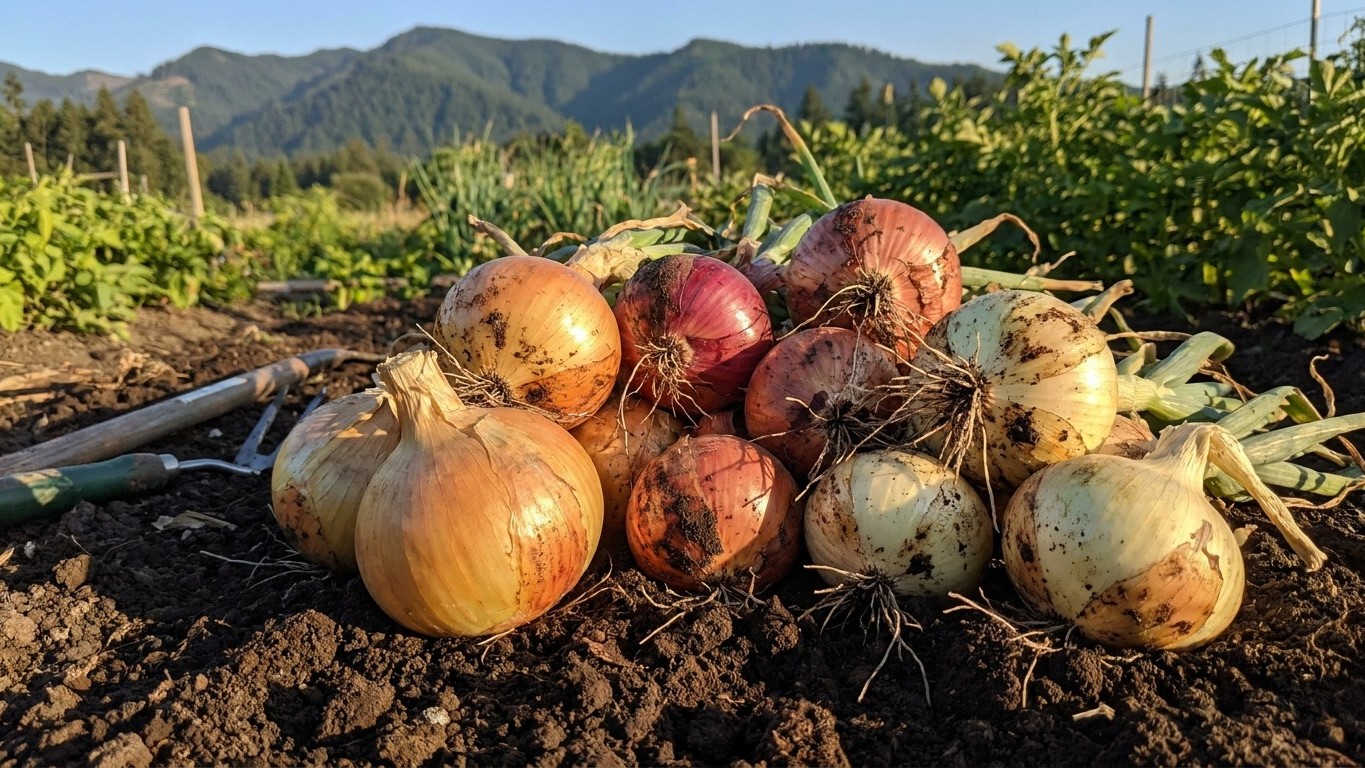

British Columbia sits at a latitude where summer days run long enough to trigger bulbing in long-day onions, and only long-day onions. The reference point is Vancouver, at 49.20 degrees north, where the longest day of the year delivers 16 hours and 1 minute of daylight. That number rules the whole conversation: onions bulb on day length, not on heat, and 16 hours and change is squarely long-day territory. Varieties such as Ailsa Craig, Walla Walla Sweet, Redwing, and Patterson are built for exactly this kind of summer.
The short answer for British Columbia

Thirteen of the 28 onion varieties documented on this site have a published latitude range that covers 49.20 degrees north, which means they’re a workable match for a garden near Vancouver, the Fraser Valley, or the southern Interior. All of them are long-day types, with one intermediate-day exception. That grouping matters more than soil type, more than fertilizer, more than watering schedule. An onion plant reads the calendar through the length of the day, and once daylight crosses its genetic threshold, it stops building leaves and starts building a bulb, whether the plant is ready or not.
The varieties that fit the Vancouver latitude are Ailsa Craig, Barolo, Blush, Bridger, Frontier, New York Early, Patterson, Redwing, Rossa di Milano, Safrane, Talon, and Walla Walla Sweet, all long-day, plus Red Long of Florence, an intermediate-day onion whose published range still reaches this far north. These are the names worth starting with if you’re planting anywhere from Victoria to Kamloops.
One more sits right at the edge: Red Long of Tropea, an intermediate-day variety with a published range of 35 to 48 degrees north. Vancouver’s 49.20 is only a degree and a bit past that upper bound, close enough that the boundary is more of a gradient than a wall. Treat it as a variety that may bulb here rather than one that’s guaranteed to, and don’t be surprised if results vary from one summer to the next.
Sixteen hours of daylight is a lot. It’s the kind of summer day length you’d associate with the northern half of the continent, not with a coastal Canadian city that also gets a fair amount of winter rain and mild temperatures. That combination, long summer days paired with a moderate coastal climate, is precisely why long-day onions do well in British Columbia gardens while a whole category of popular varieties bred for the American South simply cannot perform here.
What will not work here
Fourteen of the documented varieties have a published latitude ceiling that falls below 49.20 degrees north. That’s not a caution, it’s a disqualification. Plant a short-day onion in a British Columbia garden and you’ll get a plant that grows leaves through the whole season and never rounds into a bulb, or bulbs so early and so small that the harvest isn’t worth the bed space. An intermediate-day variety with a ceiling in the low 40s runs into the same wall, just a little later in the process. Either way, the mismatch is genetic, not something a gardener can fix with better feeding, more water, or a sunnier spot.
Here’s the full list, with the reason each one is off the table for British Columbia:
- Cabernet (intermediate-day, 35-45N): ceiling ten degrees south of Vancouver, bulbs too early and too small.
- Calibra (intermediate-day, 35-45N): same threshold problem as Cabernet.
- Candy (intermediate-day, 33-40N): a nine-degree gap; this one is bred for much shorter summer days.
- Elsye (intermediate-day, 32-45N): ceiling well south of the coast.
- Expression (intermediate-day, 32-45N): same range as Elsye, same result.
- Gabriella (short-day, 20-35N, no page of its own on this site): a short-day variety this far north triggers while the plant is still tiny.
- Madalyn (short-day, 20-35N, no page of its own on this site): same short-day mismatch.
- Monastrell (intermediate-day, 35-46N): three degrees short of Vancouver’s latitude.
- Powell (long-day, 43-47N): a long-day variety, but its calibrated ceiling still sits south of the reference city.
- Red Carpet (long-day, 40-45N): same issue, further from the mark.
- Red Rock (short-day, 30-36N, no page of its own on this site): classic short-day mismatch for a northern coastal garden.
- Scout (intermediate-day, 32-46N): ceiling south of the city, bulbs too early.
- Sierra Blanca (intermediate-day, 32-45N): same pattern as Scout.
- White Castle (short-day, 30-38N, no page of its own on this site): eleven degrees south of Vancouver, a poor fit by a wide margin.
A short-day variety doesn’t know it’s in the wrong garden. It follows its own internal clock and bulbs as soon as day length crosses its 12-hour trigger, according to the Clemson Cooperative Extension’s guidance on onion physiology. In British Columbia that trigger arrives while the plant has barely gotten started, which is why the harvest from a short-day variety planted here is small, not late.
What changes across British Columbia
British Columbia is not one latitude, it’s a stretch of coast and mountains running from roughly the 48th parallel at the US border to the 60th parallel at the Yukon line, a span of about 12 degrees. The figures in this article come from Vancouver, at 49.20 degrees north, which sits near the southern edge of the province. A gardener in Victoria or the Fraser Valley is close enough to that reference point that the numbers apply almost directly. A gardener in the Peace River region or further north is a different story.
| Location | Latitude | Summer day length | What it changes |
|---|---|---|---|
| Vancouver (reference city) | 49.20N | 16h 01m on the longest day | Baseline for the long-day varieties listed above |
| Southern Interior / Okanagan | ~49-50N | Nearly identical to Vancouver | Same variety group applies with little adjustment |
| Northern BC (Peace River area and beyond) | ~55-58N | Noticeably longer than Vancouver’s | Long-day varieties trigger earlier in the season; cold hardiness and a shorter frost-free window become the bigger limiting factor |
The direction of the shift matters more than the exact hours. As you move north through the province, summer daylight gets longer, not shorter, so the varieties that fit Vancouver’s day length remain in the long-day category the whole way up. What changes is the growing season around that day length: northern British Columbia has a shorter frost-free window, which can matter more for a young onion transplant than the extra daylight does. A gardener near Prince George or Fort St. John is working with the same variety list as Vancouver, but on a tighter calendar.
Checking this against your own garden
Every figure in this article is tied to Vancouver’s latitude, not to a province-wide average, and British Columbia’s geography is varied enough that a single reference point can’t speak for every backyard. Before ordering seed, it’s worth confirming a few things specific to where you actually garden.
- Find your own latitude if you garden more than a degree or two from Vancouver, especially in the Interior or the north.
- Check your local frost-free dates rather than assuming they match the coast.
- Contact your local agricultural extension office or the provincial Ministry of Agriculture for microclimate notes specific to your valley or coastline.
- Watch how a borderline variety, like Red Long of Tropea, actually performs in your bed for a season before relying on it.
- Reconsider raised beds or season-extension covers if you’re gardening well north of the reference city, since day length will work in your favor but the frost calendar may not.
None of the numbers here replace a look at your own thermometer and calendar. They’re a starting point, drawn from one city’s measured latitude and daylight, in a province where the distance between the southern border and the Yukon line is greater than the distance between Vancouver and San Francisco.