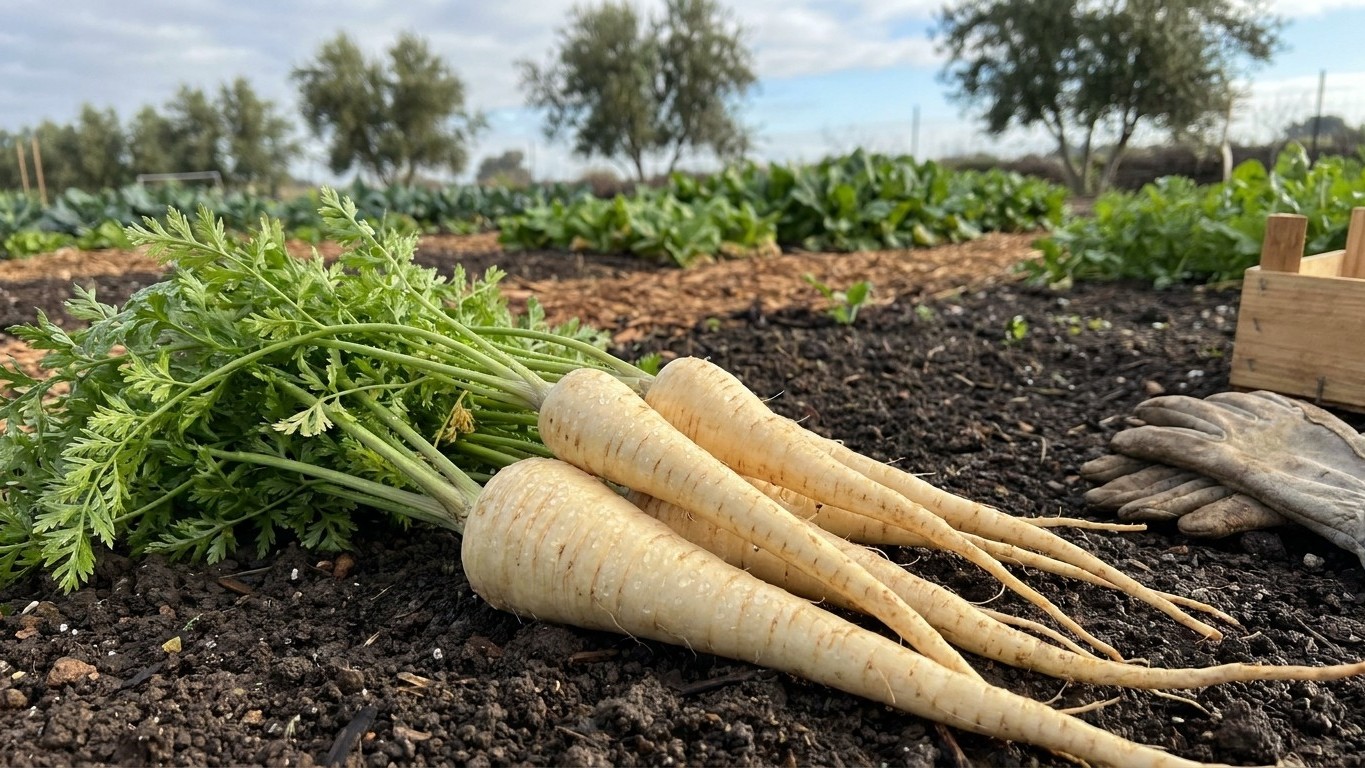

The pests documented for parsnip in this region are aphids, carrot rust fly, cutworms, flea beetles, grasshoppers, slugs, spider mites, and wireworms. Not every insect that shows up in a garden touches this root crop, and the ones that do arrive in a fairly predictable order tied to frost dates rather than a calendar month. Knowing which pest matches which symptom, and when it shows up, keeps a gardener from treating the wrong problem.
Which pests attack parsnip in British Columbia

The University of Idaho Extension and WSU Extension, the two services this region’s pest documentation draws on, list a long roster of garden insects: Aphids, Brown marmorated stink bug, cabbage, Cabbage maggot, Carrot rust fly, Colorado potato beetle, Corn earworm and earwigs, Cutworms, Cutworms and armyworms, Flea beetles, Grasshoppers, Imported cabbageworm, Imported cabbageworm and loopers, Onion maggot, Onion maggot and onion thrips, Pea leaf weevil, Slugs, Spider mites, Squash bug, Tomato hornworm, Western spotted cucumber beetle, and Wireworms.
Most of that list has nothing to do with a parsnip bed:
- Cabbage maggot, Imported cabbageworm, and Imported cabbageworm and loopers feed on cabbage-family roots and leaves only.
- Onion maggot and Onion maggot and onion thrips stay on onions and their relatives.
- Colorado potato beetle and Tomato hornworm feed on nightshade foliage, potatoes, tomatoes, eggplant, never parsnip tops.
- Pea leaf weevil is a legume specialist, and Squash bug and Western spotted cucumber beetle stick to vine crops.
- Brown marmorated stink bug and Corn earworm and earwigs target fruiting crops and corn ears, not root vegetables.
- The entry simply listed as cabbage is the crop itself, not a pest, and belongs to a different page entirely.
That leaves eight worth watching for: aphids, carrot rust fly, cutworms (named twice, once alongside armyworms), flea beetles, grasshoppers, slugs, spider mites, and wireworms. Carrot rust fly is the only one on this list built specifically for the carrot family that parsnip belongs to, which makes it the one worth the closest attention. The rest are generalists that include parsnip among the plants they’ll feed on when it’s what’s growing.
When each one shows up, and what it does first
Parsnip goes into the ground as seed, not as a transplant, and the timing that matters is the region’s frost dates rather than a named month. The average last spring frost at Vancouver International Airport falls around March 18, and seed is sown two to three weeks ahead of that date. Germination takes 14 to 21 days, which leaves nearly three weeks of bare-looking soil, and that stretch is exactly when the first two pests strike.
Wireworms live in the soil year-round and chew into the seed and the emerging taproot before a single leaf appears; a patchy stand with no visible cause often traces back to them. Cutworms wait until the stem stands above ground, then sever seedlings at the soil line overnight, leaving a wilted plant lying flat beside an otherwise healthy row.
Once true leaves appear, flea beetles arrive next, riddling young foliage with small, round holes that can stunt a seedling before its root has any size. Aphids follow through the rest of the season, clustering on leaf undersides and curling new growth as they feed. Carrot rust fly adults lay eggs at the base of the plant through the same stretch, and the larvae tunnel into the root itself, damage that stays hidden until harvest.
Slugs turn up whenever the ground stays damp, which here can mean much of the growing season, rasping ragged holes in leaves and scarring root shoulders near the surface. Grasshoppers and spider mites tend to show up later, during the driest, warmest stretches of summer. Activity across the board slows as the season cools toward the first fall frost around November 10, right when the crop is at its best left in the ground.
Telling the damage apart from everything else
A parsnip bed can look chewed, stunted, or twisted with no insect involved, and treating a soil or watering problem as a pest infestation wastes a season. A forked or twisted root has two separate causes here, heavy or stony ground and overwatering, and they are not the same fix: one calls for a deeper, looser bed, the other for cutting back on irrigation. No insect on the documented list causes forking.
| What you see | Could be mistaken for | What settles it |
|---|---|---|
| Small, round holes in young leaves | Flea beetle feeding | Holes stay small and shot-like; tiny jumping beetles are often visible on the leaf |
| Wilted seedling, stem severed at soil level | Cutworm damage or damping-off disease | A cutworm leaves a clean cut; damping-off shows a soft, water-soaked stem instead |
| Yellowed, curled new growth | Aphids or nutrient deficiency | Aphid colonies are visible on leaf undersides; deficiency shows evenly across the whole bed |
| Tunnels inside the root at harvest | Carrot rust fly larvae or tool injury | Rust fly tunnels run lengthwise with a rust-colored stain; tool injury is a clean gouge from one direction |
| Fine bronze stippling on leaves in hot weather | Spider mites or heat stress | Mites leave faint webbing on the leaf underside; heat stress does not |
| Forked, twisted, or stubby root | Heavy or stony soil, or overwatering | Neither is a pest sign; check soil texture and recent watering habits nearby |
When the cause still isn’t obvious after checking the table, that’s the point to bring a sample, root and leaf together, to a local extension office instead of guessing at a treatment.
What actually works here, and what is a waste of time
On a growing season this long, timing a physical barrier beats reaching for any treatment after the fact. A floating row cover put down at sowing, and left on through the 14- to 21-day germination window and beyond, keeps carrot rust fly adults from ever laying eggs at the base of the plant, which matters because once the larvae are inside the root, nothing applied to leaves or soil surface reaches them. The same cover keeps flea beetles off the first true leaves, the stage where they do the most damage per bite.
Cutworm collars, a simple cardboard or plastic ring pushed into the soil around each seedling, stop overnight stem-cutting that a spray can’t prevent after it’s already happened. For wireworms, the useful move comes before sowing: working the bed and rotating away from ground that grew potatoes or turf the previous year cuts down on larvae already living several inches deep, out of reach of anything applied on top.
Slugs respond better to a dry strip of ground or a physical barrier around the bed than to anything poured on the leaves, especially where soil rarely fully dries between rains. The real waste of time here is waiting until damage is visible: a cover installed after flea beetles have already found the seedlings, or a treatment applied after rust fly larvae are already tunneling, spends effort on damage already done. Matching a specific product to a specific insect isn’t something to guess at region by region, and a local extension office knows what’s actually registered and effective here.
Where to check this for your own county
The pest list behind this page comes from the University of Idaho Extension and WSU Extension, the closest documented sources for this growing region, not from a British Columbia-specific agency. That matters because pest pressure shifts within a single province, not just between countries, and a garden near the coast, where the coldest month’s average daily minimum sits around 0.8°C (33.5°F), sees a different mix of insects than one in a colder interior valley a few hours inland.
Gardeners near the Washington and Idaho borders can check directly with the county extension offices of those states, since insect pressure doesn’t stop at a boundary line. For confirmation closer to home, a local nursery, master gardener program, or provincial agriculture office is the better first call, ideally with a sample in hand rather than a photograph, since some of the differences noted above, a rust stain inside a root, faint webbing under a leaf, are easier to see than to describe.
What’s documented at the state or province level is a starting point, not a guarantee of what’s living in one particular bed. A planting that’s never seen carrot rust fly for several seasons running can still get a wireworm problem the next, especially after a season of lawn or pasture on that same ground. The next useful step is a direct question to a local office: what has actually shown up on parsnip nearby this season, and what worked against it.
Common questions
Does frost hurt parsnip roots left in the ground?
No, the opposite: parsnip needs several weeks of cool, frosty weather to convert its stored starch into sugar, which is what makes a fall-dug root sweeter than one pulled in warm weather. The average first fall frost here lands around November 10, and roots can stay in the ground well past that as the season cools.
Why doesn’t a British Columbia garden get a hard freeze most winters?
The coldest month’s average daily minimum near Vancouver sits at only 0.8°C (33.5°F), mild compared to many inland growing regions, so a hard freeze is inconsistent rather than a given feature of every winter here.
How long does parsnip take from seed to harvest here?
Around 100 to 120 days from seeding, plus the 14 to 21 days it can take just to germinate, so a sowing in early March, two to three weeks ahead of the average March 18 last frost, points toward a harvest well into fall.
Can heavy soil cause the same twisted roots as a pest would?
Yes, and it’s one of two common non-insect causes, along with overwatering. Heavy or stony ground should be double dug or replaced with a deep, sandy bed before sowing, since no pest documented for this region actually causes forking.