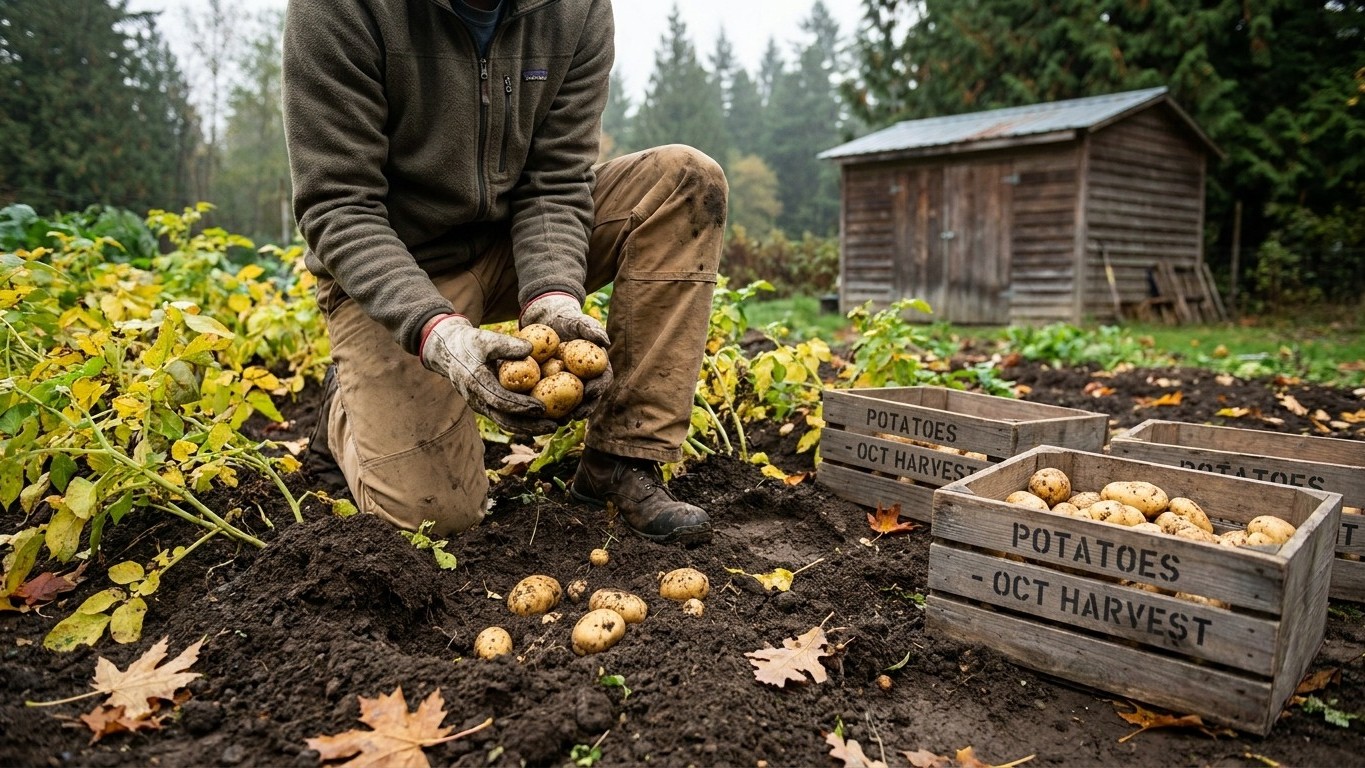

Coastal British Columbia’s mild, wet fall gives growers a wide harvest window, but the same mild winter that protects crops outdoors can leave an unheated shed too warm for potatoes to hold. Get the timing right and match the storage space to the season, and a home crop keeps into spring without sprouting or rotting.
The short answer
Two numbers frame everything that follows. Around Vancouver, the average date of the first fall frost is November 10, and the mean daily minimum temperature of the coldest month sits at 33.5 F (Environment and Climate Change Canada, Canadian Climate Normals 1981-2010, station Vancouver Int’l A). Neither figure is a guarantee. The frost date is a midpoint, not a boundary: in roughly half of all years, the first frost lands later than November 10, and in the other half it comes earlier. Treat it as a planning marker, not a deadline you can set a calendar to.
The 33.5 F figure matters more for storage than for harvest. That’s the average of the coldest overnight lows across the season’s chilliest month, not the lowest temperature ever recorded, and not a daytime reading. It tells you that a typical winter night near the coast hovers just above freezing rather than well below it. Practically, that means most crops should come out of the ground before the ground itself turns cold and wet enough to invite rot, generally through October and into early November for coastal growers, with earlier harvest advisable the further inland or upland a garden sits.
On the storage question, the answer splits by location. An unheated garage, shed, or crawl space near the coast, where winter lows average in the low-to-mid 30s, will often avoid a hard freeze most nights but won’t reliably hold the 40-45 F range that Utah State University Extension recommends for keeping potatoes. It runs too cold for comfort on some nights and borderline mild on others, which is actually the harder problem: a structure that never quite freezes but also never quite stays cool enough will let potatoes soften and sprout over the winter rather than freeze outright.
Inland and northern parts of the province see colder winters than the Vancouver station captures, and an unheated outbuilding there is a real freeze risk. There’s no single figure published for those regions in the data used here, so anyone gardening away from the immediate coast should treat the 33.5 F average as describing a milder climate than their own and plan storage accordingly, leaning toward more insulation rather than less.
Curing, and where
Before potatoes go into long-term storage, they need to cure. Utah State University Extension recommends holding freshly dug potatoes at 55-60 F with high humidity for two to three weeks, a step that toughens the skin and closes over any nicks from digging so the crop doesn’t rot in storage. Skip curing and even a well-managed storage space won’t save a crop with thin, easily bruised skin.
- Dig on a dry day, ahead of the average frost window. With the region’s frost typically arriving around November 10, plan the harvest for a dry stretch in the weeks before that, since digging in soggy soil brings mud and moisture into storage along with the crop.
- Brush off soil without washing. Washing removes the protective layer of dirt and adds moisture right before curing, working against the whole point of the step.
- Move the crop to a shaded, ventilated spot in the 55-60 F range. A covered porch or an open garage often lands in that range during the harvest weeks along the coast, when daytime temperatures are still mild and nights haven’t yet turned cold; a basement can work too if it isn’t already running cooler than that.
- Keep humidity high but keep air moving. A single layer on newspaper or in shallow crates, out of direct sun, lets air circulate around the tubers instead of trapping damp heat against the skins.
- Hold that spot for two to three weeks before moving potatoes to final storage. Interior and upland gardens, where fall evenings cool faster, may need an enclosed porch or a heated corner of a garage to stay in range for the full curing period, since an open structure can slide below 55 F sooner than it does near the coast.
Storing through this winter
Once cured, potatoes want a specific combination for the months ahead: dark, and 40-45 F, according to Utah State University Extension, or as cool as 38 F with 95 percent humidity by the University of Maine Cooperative Extension’s figures. Both sources agree on the essentials, cold, dark, and humid, they just define the cool end of the range slightly differently.
Matching that target against a mean coldest-month minimum of 33.5 F shows the real challenge for coastal growers isn’t freezing, it’s overshoot in the other direction. A detached, uninsulated shed sitting near that average low on a typical winter night is closer to freezing than to the 40-45 F window, and on the sharper cold snaps that occasionally push below the seasonal average, tubers stored right against an exterior wall or on a concrete floor can freeze even when the air a few feet away stays fine. Wrapping bins in blankets, elevating crates off the floor, or moving storage to an insulated interior room solves that without adding heat.
A basement or an interior closet against an exterior wall tends to land closer to the ideal range than an outbuilding does, since basement temperatures follow the ground more than the air and rarely swing as widely as a garage does over a winter. For growers well inland or at higher elevation, where nights run colder than the coastal average, extra insulation, or moving storage indoors altogether during the coldest stretch, keeps the crop from freezing on nights the coast never sees.
Darkness matters as much as temperature. Light exposure turns potato skins green and encourages sprouting regardless of how well the temperature is managed, so a covered bin or an opaque cloth over open crates does real work even in an otherwise well-chosen space.
What goes wrong here
- Digging too early, before the crop finishes bulking. With frost only arriving on average around November 10, and later in half of all years, pulling potatoes at the first cool snap can mean harvesting before the plants have put on their full size. Watch the foliage rather than the calendar, and dig once the vines have died back.
- Skipping curing because the weather still feels warm. Coastal falls can stay mild enough that growers dig, brush off, and go straight to storage. Without the two to three weeks at 55-60 F that Utah State University Extension recommends, thin skins bruise and rot sets in early during storage.
- Storing in a space that runs too mild rather than too cold. Because the region’s winter lows average in the low-to-mid 30s rather than deep freezes, growers often assume an unheated space is automatically cold enough. It’s frequently the opposite problem, an outbuilding that stays in the high 40s or 50s on many nights will let potatoes sprout well before spring.
- Losing the crop to a single cold snap in an uninsulated shed. Average lows near 33.5 F mask the occasional sharper dip. A run of harder frost can freeze tubers stored directly on a shed floor or against an exterior wall even in a climate that’s mild on average. Insulating the storage container solves this without heating the whole space.
- Assuming one part of the province behaves like another. The 33.5 F figure and the November 10 frost date both come from a coastal station. Inland valleys and higher elevations run colder in winter and see frost earlier in fall, and growers there should shift both harvest timing and storage insulation earlier and heavier than the coastal average suggests.
Common questions
How do I know when to dig potatoes if the frost date is only an average?
Watch the plants instead of the calendar. Once the foliage yellows and dies back on its own, the tubers have typically finished sizing up, and that signal is more reliable than any single date, especially given that the region’s first frost lands later than November 10 in about half of all years.
Can I store potatoes in an unheated garage all winter?
It depends on how cold that garage runs. Near the coast, where the average winter low is 33.5 F, a garage may avoid freezing most nights but often runs too warm for the 40-45 F range Utah State University Extension recommends, letting potatoes sprout. Insulating the storage bins, or choosing an interior room instead, generally works better than relying on the garage alone.
What’s the difference between the 40-45 F and 38 F storage recommendations?
Utah State University Extension lists 40-45 F as the target storage range, while the University of Maine Cooperative Extension cites 38 F at 95 percent humidity. Both aim for cold, dark, humid conditions; the slight difference in the lower number reflects two extension sources rather than a contradiction, and either range is workable as long as darkness and humidity are also maintained.
Do potatoes need curing if I’m eating them right away rather than storing them?
Curing mainly protects potatoes meant for weeks or months of storage by toughening the skin against rot. Potatoes intended for the table within a short time don’t strictly need the full two to three weeks at 55-60 F that Utah State University Extension recommends, though a short rest still helps skins set before handling.