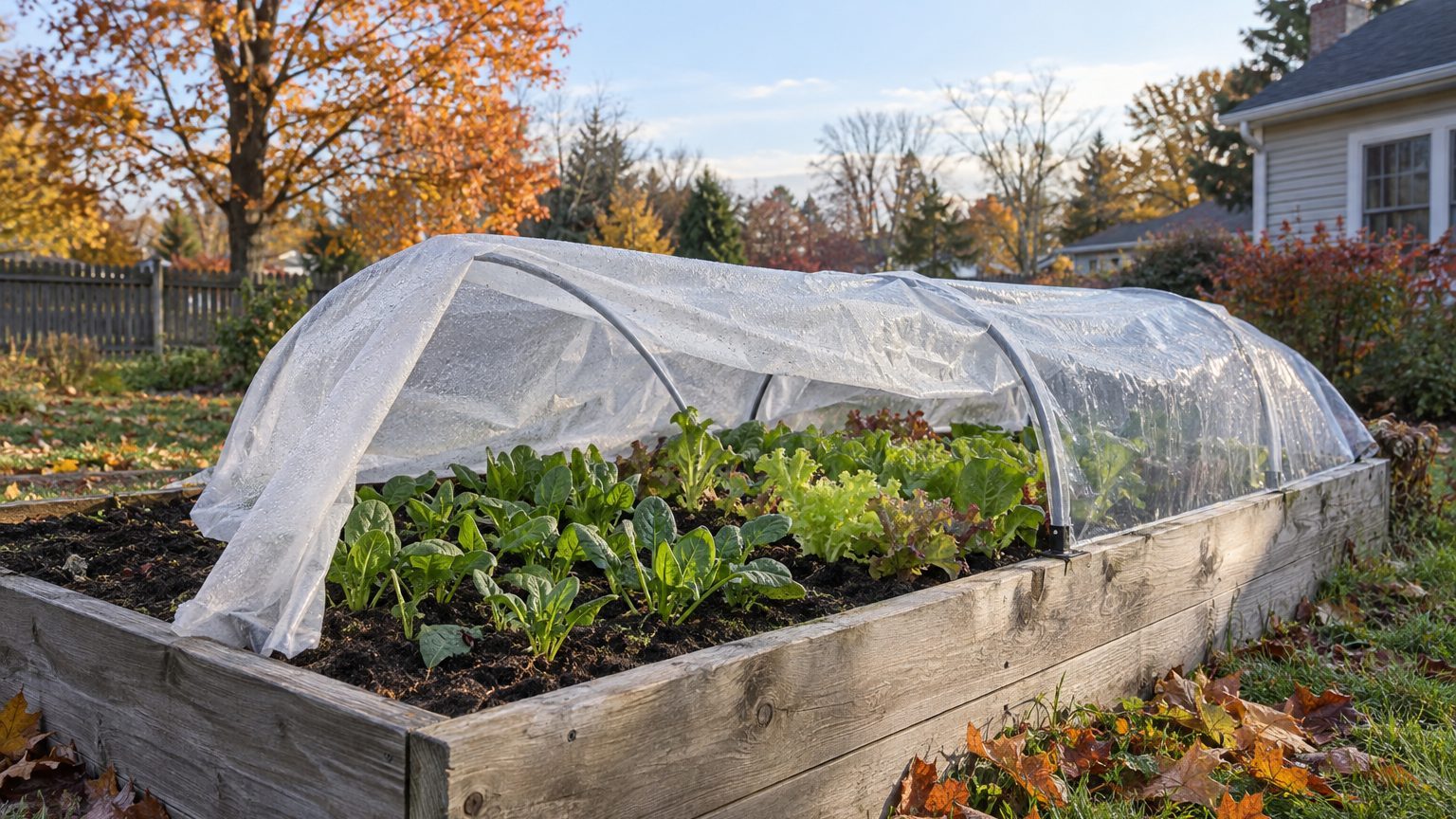

On the south coast, season extension has less to do with beating a short summer than with working around cold, wet soil in spring and short, dim days in fall. At the Vancouver airport station, the mean last spring frost is March 18 and the mean first fall frost is November 10. Covers push both ends outward, but the Interior and the north run weeks behind, so those dates belong to the coast.
When the soil is warm enough in British Columbia
When is the last spring frost in Vancouver?
Environment and Climate Change Canada’s 1981-2010 Canadian Climate Normals put the mean last spring frost at March 18 for the VANCOUVER INT’L A station (climate ID 1108447). That is the midpoint of a window. In one year out of two, the last frost falls later than that date, so a gardener who plants on March 18 is gambling on even odds.
The station sits at sea level beside the water, which makes it a poor stand-in for a lot of the province. Upland districts, the Interior valleys and the north all run weeks behind it. Canadian normals also cover 1981-2010, while the U.S. figures elsewhere on this site cover 1991-2020, so compare across the border with that in mind.
Why does the frost date matter less than the soil?
A frost date marks when freezing air stops being a risk. Seeds and roots respond to the temperature of the ground, and the ground warms after the frost risk ends. In a coastal spring, with its frequent rain and long cloudy stretches, soil can stay cold and saturated for weeks past the last frost. Seed sown into it sits and rots, and transplants hold still instead of rooting.
A cover can help here before any seed goes in. Laying clear plastic or fabric over a bed one to two weeks ahead lets the sun warm the soil underneath while the cover holds that warmth in still air. Rain-soaked beds also drain and dry out a little under cover, which matters as much as temperature on heavy coastal clay.
How do you know the bed is ready?
Two checks work. First, grab a handful of soil from a few inches down. If it crumbles when you squeeze it, it is workable. If it holds as a sodden ball, wait. Second, push a soil thermometer a few inches deep on several mornings in a row. Hardy crops such as peas, spinach and radishes germinate in cool ground and can go in first. Beans, squash and cucumbers need ground that feels clearly warm, and a steady thermometer reading over several mornings tells you more than any single afternoon.
What does a cover actually do on a cold night?
The soil soaks up heat during the day and releases it after dark. A cover traps part of that heat in a pocket of still air, and a second layer inside the first, such as fabric under a low tunnel, adds another buffer. The gain is real but it varies with the material, the night, the wind and whether the ground was warm to begin with. A clear, calm night after a cold day gives the smallest gain, because the ground has little heat to give back.
A cover shifts the limit. It does not remove it, and no crop under cover is frost-proof. Everything described here is passive: no heaters, lamps or candles belong inside a covered bed or frame, because fire and carbon monoxide are real hazards in a closed space. A closed cold frame also needs venting on any sunny spring day. Without it, the contents can cook in an hour, even when the air outside feels cool.
How long the season lasts here
The reference station has a frost-free season between the mean last spring frost (March 18) and the mean first fall frost (November 10). Because both dates are means, half of all years bring the first fall frost earlier than November 10, and a late spring frost is always possible.
For a gardener on the south coast, a window that long allows a second and even a third sowing of quick crops. Lettuce, radishes, spinach and other fast greens can go in every few weeks from early spring into early fall. Fall and winter crops can be started in summer so they are well established before the light fades. The succession sowing guide on this site covers the spacing of those rounds.
It also changes the transplant question. Where the window is long, starting warm-season crops indoors is optional, and a gardener can often direct-sow them once the soil warms. Where the window is short, as in the Interior and the north, the first sowing may be the only one, and transplants earn their keep. Each transplant gets a root check at setting out, so for roots that resent disturbance (carrots, beets, radishes, parsnips), direct sowing wins even in a short season. Gardeners in a much colder province can compare notes in Extending the Growing Season in Manitoba.
The frost-free count also overstates the useful growing time at both ends. In March and again in November, cold and low light slow growth to a crawl, even though no frost is on the ground. Most of the productive growth happens in the middle of the window, and the covers’ main job is to make the edges more usable. The broader logic of what a cover can and cannot gain is laid out in Extending the Season: What a Cover Buys, and What It Cannot.
Heat and water in British Columbia
Is summer heat a concern on the coast?
Rarely as the governing factor. The coastal climate runs mild, and days that top 90°F are few and brief at the reference station. That count describes Vancouver International airport and nothing wider. Parts of the Interior run far hotter in summer and far colder in winter, so a reader there should treat the coast as a different climate altogether. A gardener in a region where heat and humidity do more of the work can read Extending the Growing Season in New York for contrast.
Water arrives in a different pattern. Rain falls mostly from fall through spring, and summers are drier. The trouble comes in the cool, damp shoulder seasons, when covers hold humidity against leaves. Under those conditions, expect mildew, grey mold, slow ripening and slug damage. A covered bed with no airflow in October is a good place for disease to start.
What do latitude and light have to do with it?
Latitude sets the date when daylight falls below what a crop needs to grow. After that date, a cover holds a crop alive but does not push it to grow. Vancouver sits at 49.20 degrees north, and by the time the mean first fall frost arrives on November 10, the days are already short. Crops under cover from then on mostly stand and wait. That is why fall crops need sowing in summer, so they are nearly full size when the light runs out.
The 49.20 figure belongs to Vancouver. A reader farther north on Vancouver Island, in the Interior or toward the northern coast should look up their own latitude, because each degree moves that light threshold earlier in fall and later in spring.
Does a light fabric protect enough in winter?
The mean daily minimum of the coldest month at the reference station is 0.8 °C (33.5 °F). That sits just above freezing, which is mild by North American standards, and it explains why a light fabric over hardy greens often suffices on the south coast. But a mean minimum averages away the clear, still nights when the temperature drops well below it. In cold snaps, or in any district with a colder winter, a fabric layer alone may not hold. Past that point, a framed structure with a second layer is the sturdier choice.
For context, Natural Resources Canada rates the reference city as Canadian hardiness zone 9a (1991-2020 normals). That is a Canadian zone, built from seven climate variables, and it does not convert to a USDA zone. Treat it as a description of Vancouver, not of the province.
Wherever a structure is closed, ventilation protects the crop. On a coastal winter day with weak sun, a sealed frame can still turn humid and stagnant, and that invites rot. Crack it open daily.
Which season extension suit British Columbia
Match the type to the problem the garden actually has. On the south coast, the problems are cold wet soil in spring, damp stagnant air in fall and short winter light. In the Interior and north, the added problems are a shorter window and deeper cold.
| Type | Best use | Watch for |
|---|---|---|
| Floating row cover | Warming soil in spring; light frost cover over hardy greens | Weight of wet fabric; pests getting in at edges |
| Low tunnel with hoops | Earlier sowings; winter greens on the mild coast | Heat build-up on sunny days; trapped moisture |
| Cold frame | Hardening off seedlings; fall and winter salad crops | Overheating when closed; needs daily venting |
| Cloche for single plants | Early transplants of tender crops | Fast overheating; slugs hiding underneath |
| Unheated hoop house or greenhouse | Colder districts; a true second layer in winter | Disease from humidity; airflow and ventilation |
A short season favors the earliest types: crops that are quick to mature and tolerant of cold, grown under the lightest cover that works. A hot spell, which can arrive in Interior valleys, favors crops given airflow and shade at the root, with the cover ventilated or removed. A damp climate makes disease resistance the first thing to look for, ahead of yield or flavor. On the coast, where the shoulder seasons are wet, that criterion often decides the whole choice.
Specific varieties are a different matter. A recommendation only means something if it was trialled in the district where it will grow, and a coastal rainforest valley, an Okanagan orchard slope and a northern bench behave like three different countries. For varieties and local timing, ask the B.C. Ministry of Agriculture and Food, and check with local growers and garden clubs who have worked the same soil for years.
Common questions
Can I plant out on March 18 on the B.C. coast?
March 18 is the mean last spring frost at the Vancouver airport station, so half of all years bring a later frost. Warm-season crops should wait until the soil is warm as well. Hardy crops like peas and spinach can go in earlier, ideally with a cover as backup.
Does a cover make a crop frost-proof?
No. A cover traps heat radiating from the soil and holds it in still air, which raises the temperature a little at the plant. The gain depends on the material, the night, the wind and the state of the ground. A hard freeze on a clear night can still kill what is underneath.
Do I need to vent a cold frame in winter?
Yes, whenever the sun is out, even if the air outside is cold. A closed frame can overheat quickly in sun, and trapped humidity feeds disease in a wet coastal climate. Open it a crack on mild days and close it again before the evening chill.
Is Canadian zone 9a the same as USDA zone 9a?
No. Natural Resources Canada builds its zones from seven climate variables, while the USDA system uses one, and the two do not convert. Zone 9a is the rating for Vancouver, and it does not describe the rest of the province.