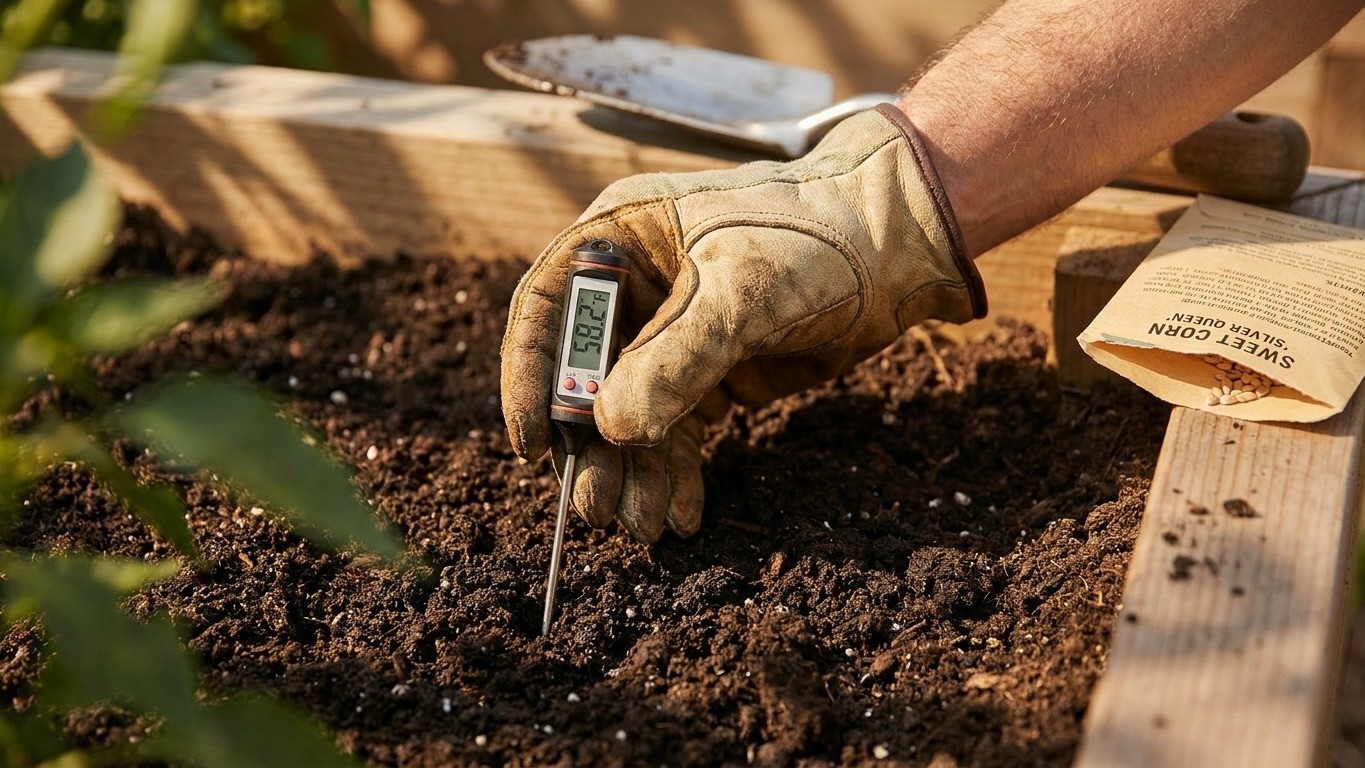

Sweet corn in British Columbia’s coastal valleys goes into the ground once the soil holds steady at 60°F, not on the average frost date of March 18. That soil threshold typically arrives weeks later, and from there a 60- to 90-day variety needs to mature before the mean first fall frost of November 10. The math works, but the timing depends on watching the ground, not the calendar.
The short answer
Most gardening advice starts with frost dates, and British Columbia’s coastal reference station, Vancouver Int’l A, puts the average last spring frost at March 18. That date is useful for tender transplants, but sweet corn doesn’t care about frost the same way. It cares about soil temperature, and soil takes its time warming up after the air stops freezing. The seed simply sits and rots in cold, wet ground if it goes in too early, no matter how mild the air feels on a sunny afternoon in late March or early April.
Utah State University Extension is blunt about the requirement: sweet corn needs soil above 60°F to germinate reliably, and that threshold routinely lags the last frost date by a stretch of weeks in a coastal climate like this one. There’s no soil-temperature date published for this station, so the practical move is to check the ground yourself with a soil thermometer rather than count days from March 18 and assume the soil has caught up. Push the thermometer four inches down, check it at the same time of day for several days running, and wait for a consistent reading, not a single warm afternoon.
Once soil crosses that 60°F line, the clock that matters starts running: 60 to 90 days from planting to harvest, depending on the variety. The other end of the season is the average first fall frost, November 10. Between a soil-warming date that lands somewhere in spring and a frost date in November, the frost-free window in this region runs long, on paper well over 200 days measured from the March and November averages alone. That’s generous room for a 60- to 90-day crop, even allowing for the fact that soil temperature, not frost, sets the real starting line.
One more number shapes how that season actually feels for the plants: this station averages 0.0 days a year at 90°F or hotter. Sweet corn is not a plant that demands scorching heat, but it does grow faster with warmth, and a summer with essentially no hot spells means growth happens at a steadier, sometimes slower pace than in a region that regularly hits the 90s. The days-to-maturity figure on a seed packet assumes typical warmth for that variety’s breeding region; a cool coastal summer can stretch the calendar time needed to actually reach the days-to-maturity count, even though the frost-free window itself is not the constraint.
Both frost averages come from Environment and Climate Change Canada’s 1981-2010 climate normals for the Vancouver Int’l A station, and they’re means, not guarantees. In one year out of two, frost arrives later than March 18 in spring and earlier than November 10 in fall. Treat both dates as the midpoint of a range, not a safe cutoff, and remember that inland, upland, or northern parts of the province run weeks behind this coastal reference point.
Does a late variety fit here?
The frost-free window here is wide enough on paper to fit almost any maturity length sweet corn offers, but the real question is whether the soil-warming delay and the cool summer average eat into that margin once a gardener actually sows.
A 60-day variety
A short-season type built to mature in about 60 days has plenty of breathing room in this climate. Even allowing for soil that doesn’t reach 60°F until well into the traditional planting season, a 60-day count still leaves a wide cushion before the November 10 average first fall frost. This is the safer choice for anyone who wants to plant once soil conditions finally allow and not worry about a late-arriving fall frost cutting the season short. It also tolerates a second, later sowing if a first attempt fails to germinate in cold soil, since there’s enough calendar left to try again.
A 90-day variety
A 90-day type also fits within the frost-to-frost window when measured purely by the calendar, since the gap between the two average frost dates is large enough to absorb both the soil-warming delay and a full 90-day maturity period. Where it gets tighter is heat. With an average of 0.0 days a year reaching 90°F, the plant won’t get the warm push that speeds development in hotter regions, and a 90-day count can run longer in actual days than the number on the packet suggests. It’s not that the late variety doesn’t fit here; the frost-free season is generous enough that it does. It’s that a gardener should expect the harvest to land later in the calendar than in a hot-summer region growing the same variety, and should plant as soon as the soil genuinely reads 60°F rather than losing any of that early margin.
What goes wrong here
- Sowing before the soil is actually warm. The average last frost date of March 18 tempts gardeners into planting corn right after it passes, but frost-free air and 60°F soil are two different things. Seed sown into cold, damp ground swells, stalls, and often rots before it sprouts. The remedy is simple: check soil temperature directly with a thermometer over several consecutive days and wait for a steady 60°F reading, rather than counting days from the frost date.
- Choosing a maturity length that outruns the season’s warmth. The frost-free window here is long enough for a 90-day variety on paper, but with an average of 0.0 days a year at 90°F or above, growth can lag behind the days-to-maturity figure printed on the seed packet. A crop planted late, after a cool, slow start, can end up racing the November 10 average frost more closely than the raw calendar math suggests. Planting as early as soil conditions allow, and choosing shorter maturities when the spring runs cold, keeps that margin intact.
- Losing sweetness because two types tasseled together. This one has nothing to do with soil or frost. Standard (su), sugary-enhanced (se), and supersweet (sh2) sweet corn types cross-pollinate, and if their tassels shed pollen at the same time, the kernels lose the sweetness and tenderness each type was bred for. Utah State University Extension doesn’t publish a distance for keeping these separate; what it specifies is the timing condition, that the different types must not tassel at the same time. The fix is to stagger plantings so their tasseling windows don’t overlap, or to grow only one type in a given season, and to keep each variety in a block of three or more rows rather than a single thin row, since block planting improves pollination within that variety.
Common questions
Is March 18 safe to plant sweet corn in British Columbia?
No. March 18 is the average last spring frost at the Vancouver Int’l A reference station, and in one year out of two frost arrives later than that. Sweet corn also needs soil at 60°F, a threshold that comes well after the frost date itself, so planting right at March 18 risks both frost and cold, seed-rotting soil.
How do I know the soil has actually reached 60°F?
Use a soil thermometer pushed about four inches deep, and check it at the same time of day for several days in a row. A single warm afternoon reading isn’t reliable; a steady run of readings at or above 60°F is what signals the soil is ready for seed.
Can I grow both a supersweet and a standard sweet corn in the same garden?
Only if their tasseling windows don’t overlap. Utah State University Extension’s guidance is that su, se, and sh2 types lose their characteristic sweetness when they tassel at the same time; no separation distance is published, so the practical solution is timing plantings so tasseling happens weeks apart, or sticking to a single type in a given season.
Does a cool BC summer change how I judge when corn is ripe?
The days-to-maturity count can run longer in a cool summer like this one, which averages 0.0 days a year at 90°F, so calendar counting alone isn’t enough. Look for all three ripeness signs together: silks turned dry and brown, husks still moist and green, and juice that runs milky when a kernel is punctured. One sign alone isn’t a reliable test.