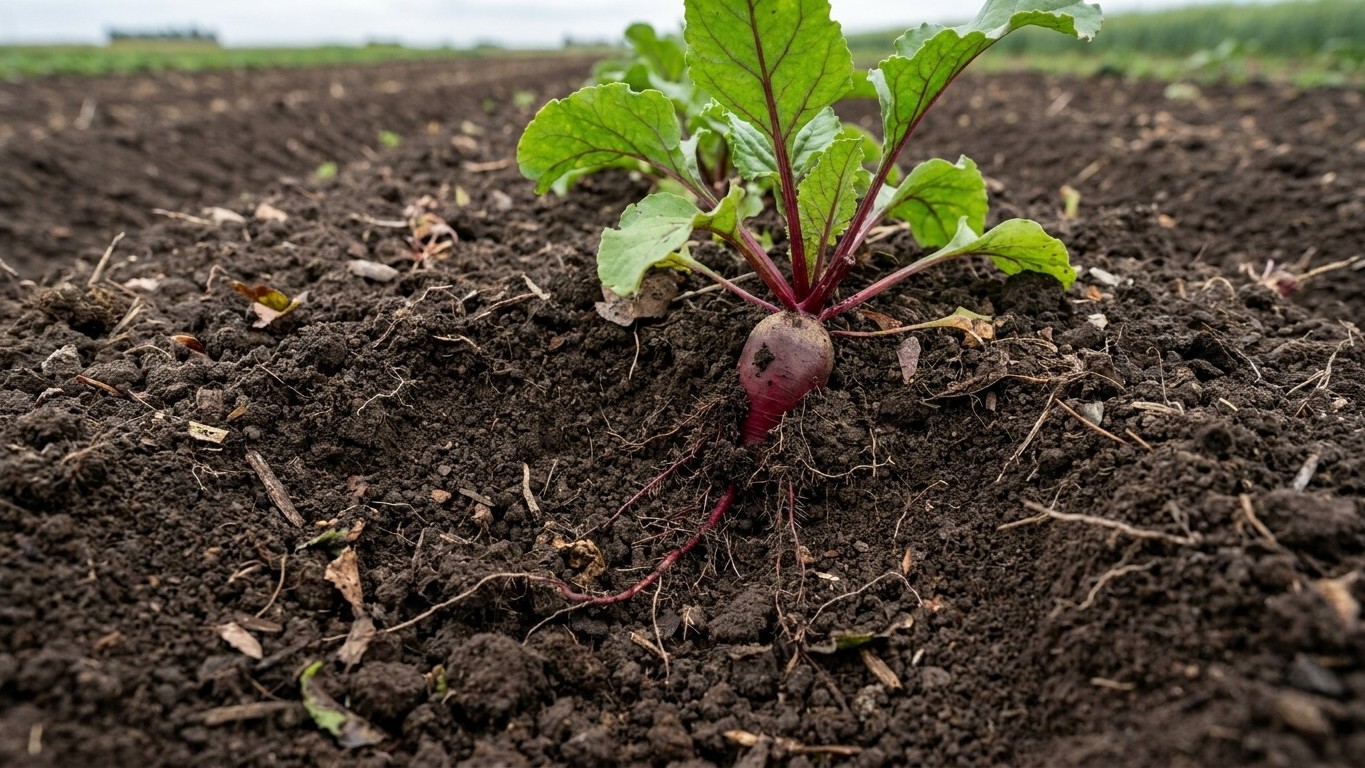

Pull beets 60 to 80 days after the seed goes in, and get them out before midsummer heat turns the root woody. Storage flips what other root crops teach you: top the roots, then hold them at 33 to 36 F, not at freezing. USDA’s storage handbook found more black spot and rot at 32 to 34 F than a little warmer. For the full season plan, see Growing Beets in Idaho.
The short answer
Idaho’s state soil is the Threebear series, an Andisol, which means a volcanic-ash soil. USDA NRCS Soil Data Access lists representative surface values of 35 percent sand, 15 percent clay and 50 percent silt, a loam-to-silt texture, with moderately well drained conditions and a surface pH of about 5.0, which is strongly acid. Ash soils are light and porous, and Threebear is unusually good at holding both water and phosphorus. The mapped surface also shows about 75.0 percent organic matter. That is a natural organic layer, the forest-floor kind of material, and a cultivated bed will not look like it.
What that ground does for a beet
Utah State University Extension describes the beet’s ideal as deep, sandy, well-drained soil rich in organic matter. Threebear is only partly that. It is less sandy than the ideal and only moderately well drained, but its knack for holding water is useful, because water stress in the first six weeks is what makes a beet flower prematurely. A steady reservoir helps there.
This is a starting point, not a diagnosis. Idaho spans hundreds of soil series, and the bed behind your house may be nothing like Threebear. River bottoms, hill country and any lot a builder has scraped or filled will behave differently. A soil test gives you your own pH and texture, and Beet Soil in Idaho: What the Root Will Meet walks through what to do with the numbers.
What the heat does
Boise is the reference city here. The number of days a year it passes 90 F is not published in the data behind this page, so I won’t guess at it. The woodiness threshold sits lower anyway. Utah State University Extension says heat above 85 F combined with water stress makes the root woody, so a count of 90 F days would understate your exposure.
Woodiness is a later failure than bolting, with a different cause. Bolting comes from thirst early on. Woodiness comes from heat plus thirst as the root fills out. Boise’s last spring frost falls between April 23 and May 7 (NOAA NCEI climate normals, 32 F freeze probabilities in the 30 to 70 percent band). Seed sown two to three weeks ahead of that goes in between about April 2 and April 23. Add 60 to 80 days and the pulling window runs from roughly the first days of June to mid-July. The earlier end of that range keeps the root out of the worst heat, and the later end walks straight into it.
Boise is a low valley. Most of Idaho sits higher and colder, with much shorter seasons, so gardeners there should anchor sowing to their own last frost and expect to pull later.
The six weeks that decide it here
Sowing two to three weeks before the last frost puts the first six weeks of a beet’s life in a predictable stretch of Idaho spring. In the Boise valley, seed sown between about April 2 and April 23 spends its first six weeks running from early April through roughly mid-May to early June. That is when the interior West is at its most changeable: warm, bright afternoons, then frost on a clear night, then a windy day that dries the top inch of bed by lunchtime. Spring in the valley is usually on the dry side, and gardeners lean on irrigation rather than rain.
Where the bolting risk sits
The risk sits in those six weeks and nowhere else. The mechanism is the one Utah State University Extension names: water stress in the first six weeks causes premature flowering. A beet that stalls for lack of water early can send up a flower stalk instead of fattening a root, and no amount of watering later brings the root back. This is a thirst problem, not a heat problem, and it is separate from the woody roots of July.
Threebear-type ground helps here, since it holds water well. The catch is that a surface kept moist by one deep soaking can still dry in a few windy hours, and beet seedlings have shallow roots to start with. Push a finger two inches down before you decide the bed is fine. A bed that is damp below and dusty on top is the one to worry about.
The opposite spring causes trouble too. In a cold, wet stretch, moderately well drained ground can sit saturated, and the seed rots or sulks. Beets are sown in place, so there is no transplant to rescue. The 60 to 80 days run from the day the seed goes in, which means a late, patchy emergence pushes your pulling date back with it.
At higher elevations the same logic applies on a later calendar. Count back two to three weeks from your own last frost, and watch the following six weeks for dry spells. Chewed leaves are a separate problem, covered in What Eats Beet in Idaho, and When.
What goes wrong here
The failures below come from this soil, this climate, or the way beets are handled after the pull. Each item carries its remedy.
- Bolting after early thirst. A dry week in the first six weeks can send the plant to flower. Check moisture two inches down and water before the bed dries, not after the leaves sag.
- Woody roots in summer heat. Heat above 85 F combined with water stress toughens the root. Sow early enough to pull in early summer, and keep the bed evenly moist once warm weather arrives.
- A sealed surface. Silt-heavy ground like Threebear (50 percent silt) can crust over after irrigation and dry out, which can hold back seedlings. Water gently, and keep the seedbed loose and fine.
- Too much compost. Utah State University Extension caps amendment at no more than 1 inch of composted organic matter per 100 sq ft. The 75.0 percent organic matter on Threebear’s map is natural forest-floor material, not a target for your bed.
- Acid ground, unchecked. The series runs strongly acid at the surface (about 5.0), but your garden may not. Test first, and let the report, not the state soil, decide any liming.
- Storing them with the leaves on. Bunched beets keep only about 10 to 14 days at 32 F with humidity above 98 percent. Top them first if they need to last longer.
- Storing them too cold. Here colder is not better. USDA Agricultural Handbook 66 found that more black spot and rot occur at 32 to 34 F than at higher temperatures. Target 33 to 36 F and 98 percent humidity for topped roots. In a pit or cellar, stay between 31 and 41 F.
- Keeping the small roots. Small roots lose water and shrivel faster. Eat them first and save the big ones for storage, where they keep much better.
Common questions
How many days after sowing do I pull beets?
Plan on 60 to 80 days from seeding. Beets are sown where they grow, so the count starts the day the seed goes in, not on some transplant date. In Boise, an early April sowing points to early June, while a late April sowing points to mid-July.
Do Boise’s frost dates work for the rest of Idaho?
No. Boise’s last spring frost falls between April 23 and May 7, but Boise is a low valley and most of the state is higher and colder, with far shorter seasons. Count back two to three weeks from your own last frost date instead.
Is colder really worse for stored beets?
For topped roots, yes. USDA Agricultural Handbook 66 puts them at 33 to 36 F and 98 percent humidity, and notes more black spot and rot at 32 to 34 F. Cellars and pits should stay between 31 and 41 F. The full text is in the USDA handbook.
Which beets do I store and which do I eat first?
Store the big roots and eat the small ones first. Large roots keep much better because they lose water and shrivel more slowly. Top every beet you plan to keep, since bunched beets with leaves last only about 10 to 14 days.