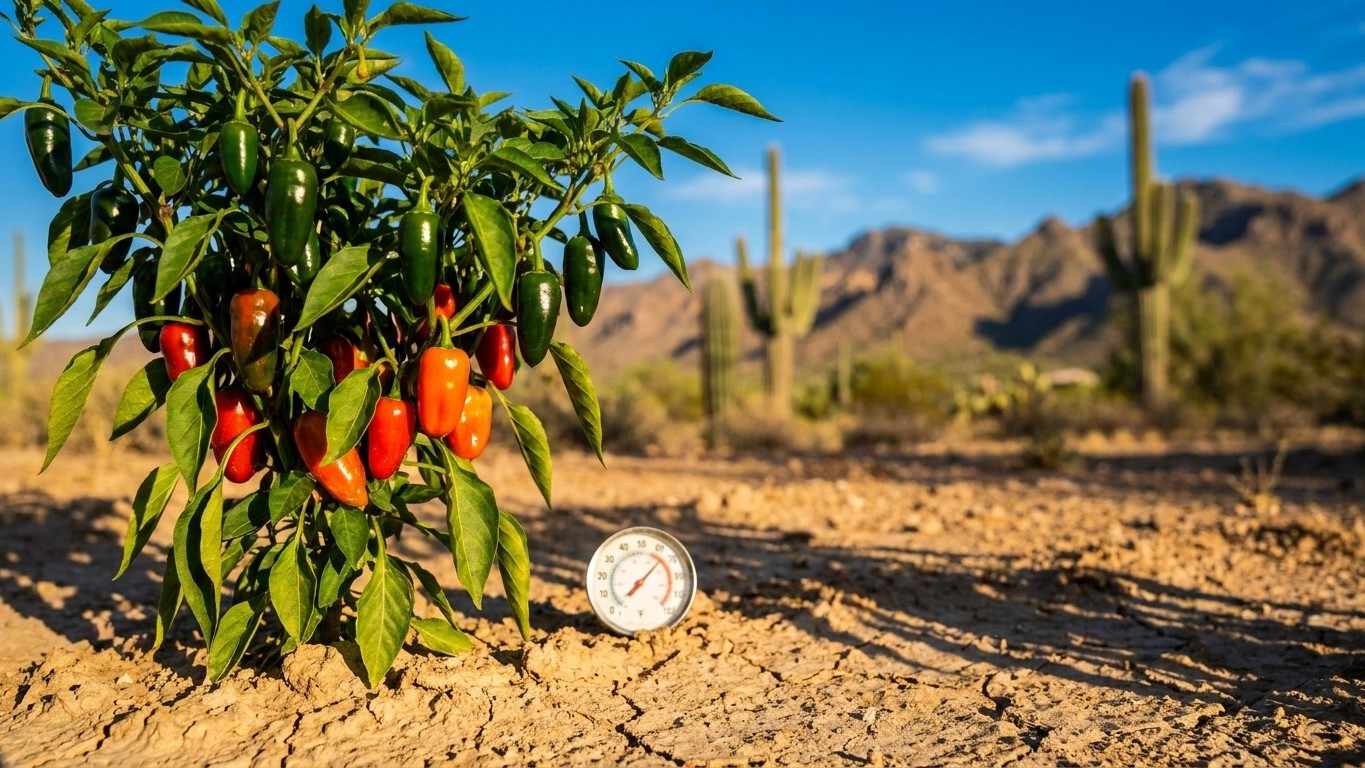

Pick a pepper when it has reached full size, feels firm and glossy, and the plant is roughly 70 to 85 days past transplanting. Then keep it out of the refrigerator. A home fridge runs colder than peppers tolerate, and below about 45 F the skin pits and the flesh turns soft. Kansas adds two complications of its own: a long run of 90 F days that can stall flowering, and cool nights that can do the same. Both push the picking date around.
The short answer
The hot end of the problem
Wichita, the reference station for this site, averages 57.6 days a year at or above 90 F, according to NOAA NCEI climate normals. That figure measures summer heat load, not average summer temperature. It works out to a bit more than eight weeks’ worth of days hot enough to interfere with peppers, though they don’t arrive in one block. Utah State University Extension states that pepper fruit set fails at both ends: with days above 90 F or with nights below 55 F. Flowers that open during a hot spell tend to drop rather than turn into fruit. The plant keeps growing and looks healthy, but the harvest slides later and then arrives in a bunch once the weather eases. Your own yard may run hotter or cooler than the airport, so treat 57.6 as a regional yardstick, not a promise.
The cool end, which you have to watch yourself
Nights under 55 F do the same damage from the other direction. This site does not carry summer night minima, so there is no number here for how many such nights your county gets, and guessing from latitude or from how cold winter gets would only mislead you. A cheap min-max thermometer set beside the bed and checked each morning around flowering will tell you more than any regional average. Two weeks of readings is enough to see whether your garden has a cool-night problem.
What that does to the picking date
Clemson Cooperative Extension puts harvest at about 70 to 85 days after transplanting. Treat that as the smooth-season baseline. A stretch of failed flowering in a heat wave or a cold snap moves the first ripe fruit later, so count on the plant, not the calendar. Pick when the fruit is full size and firm, cutting the stem with pruners rather than twisting, since branches snap easily. For why flowers sometimes fail to turn into fruit at all, see Why Peppers Fail to Set Fruit in Kansas. For the basics of the whole season, start with Growing Peppers in Kansas.
Storage is where most home gardeners lose the crop they worked so hard for. Clemson’s pepper factsheet lists the best storage conditions as 45 to 50 F with 80 to 90 percent relative humidity, good for two to three weeks. Read that as a ceiling under ideal conditions, not a guarantee. A domestic refrigerator runs colder than that range. Below about 45 F peppers suffer chilling injury: sunken pits appear, the walls go soft, and the fruit rots faster once it warms up. Nearly everyone makes this mistake, because the fridge feels like the obvious place for vegetables. A cool pantry, basement or cellar that holds the right range does better. Failing that, a cool kitchen counter is fine for a few days.
When to start seed here
Peppers need 8 to 10 weeks indoors before they go out, and they go out only after frost has passed and the soil has reached 60 F. Work backward from that date and you have your sowing window. Here is the arithmetic, step by step, so you can redo it for your own county.
- Find the last spring frost. At the Wichita airport station, NOAA NCEI shows April 4 to April 18 as the 30 to 70 percent probability band for a freeze. That is the reference-city figure, not a statewide rule. Suburban and rural gardens typically see the last frost one to two weeks later, and more at elevation.
- Find the date your soil reaches 60 F. This is a separate test from the frost date. Use a soil thermometer and take a reading in the morning, when the ground is at its coolest. Your transplant date is whichever of the two conditions comes later.
- Subtract 8 weeks from the transplant date to get the latest sowing day, and 10 weeks to get the earliest. The range gives you about two weeks of leeway.
- Check it with an example. Say your soil reaches 60 F on May 10 (an illustration, not a Kansas soil date). Eight weeks earlier is March 15, and ten weeks earlier is March 1. Sow between those dates.
- Project the harvest forward. Add 70 to 85 days to the transplant date. From May 10, that lands between July 19 and August 3 for the first mature fruit, assuming flowering goes smoothly.
Redoing it for your county
Swap in your own frost date and your own soil reading and the same five steps work anywhere in the state. Starting earlier than the window does not buy you earlier peppers. Seedlings held indoors too long get leggy and root-bound, and a stressed transplant can sulk for weeks. Starting later pushes the first harvest toward the second half of summer, when the 90 F days are piling up and the next frost is closing in. The first fall frost date is not published on this site, and as with spring, expect rural and suburban gardens to see it earlier than the airport does.
What goes wrong here
Kansas weather tests peppers in several ways, and most of the damage shows up between flowering and harvest. Holes, chewed leaves and scarred fruit are a different matter, covered in What Eats Pepper in Kansas, and When. The problems below come from the climate and the way you handle the crop.
- Blossom drop. Flowers fall off instead of setting fruit when days climb above 90 F or nights dip below 55 F. In a hot spell, shade cloth over the bed during the afternoon helps, and so does steady watering. For cool nights, a light row cover pulled on at dusk and removed in the morning takes the edge off. Heavy nitrogen feeding makes leaves lush at the flowers’ expense, so go easy.
- Sunscald. Pale, papery, sunken patches appear on the side of the fruit facing the sun, usually where leaves have been lost to disease, pests or heavy pruning. Leave the foliage alone, and use shade cloth in the hottest part of the summer. Scalded fruit is still edible if you cut the patch away, but it spoils quickly, so use it first.
- Blossom-end rot. A dark, leathery spot forms on the bottom of the fruit. The usual driver is uneven watering, which keeps calcium from reaching the developing pepper even when the soil holds plenty. Water deeply and on a regular schedule, and mulch to hold moisture steady through dry spells. Pick off affected fruit so the plant puts energy into the healthy ones.
- Chilling injury after picking. Peppers stored below about 45 F develop pits and soft spots, which is the reason the fridge ruins them. Keep them in the 45 to 50 F range at 80 to 90 percent humidity if you can, and treat two to three weeks as the best case, not the norm.
Common questions
Can I refrigerate peppers if I plan to eat them soon?
A day or two will do little harm, but the damage builds with time below about 45 F. A home fridge sits colder than the 45 to 50 F range Clemson recommends, so anything you hold longer than a few days is better off on the counter or in a cool pantry. Cut or cooked peppers are a separate case and belong in the fridge.
Should I pick green or wait for color?
Either works. A pepper can be eaten once it reaches full size and is firm and glossy. Waiting for red, yellow or orange leaves the fruit on the plant for more weeks, exposed to heat swings and to the approach of frost. If frost is in the forecast, pick everything that has reached full size whatever the color.
How do I know when frost is close enough to harvest everything?
Watch your local forecast from late summer on. This site does not publish a first fall frost date, and the airport figures run earlier-to-later than gardens outside town, which usually freeze sooner. Pick all mature fruit the day before a frost night, since frost-damaged peppers go soft and spoil fast.
My plants flower but I get no peppers. Why?
Look at the temperature first. Fruit set fails when days run above 90 F or nights drop below 55 F, and the plant can bloom for weeks without producing anything. Wichita sees 57.6 days at or above 90 F in an average year, so some years will run well above that and others below, which is why one summer’s failure says little about the next.