
California’s apple calendar is set by winter chill and heat, not by frost, across the mild parts of the state. NOAA’s 1991-2020 climate normals put the coldest month’s average nightly minimum at 48.7°F in Los Angeles, and NOAA’s RCC ACIS daily records show zero days at or below 32°F there across thirty years, so a grower near the coast or in the south reads the season off the tree’s stage, not a frost date. Start by finding out whether your orchard sits in that frost-free zone or in a Central Valley or Sierra location that still freezes most winters, because that single fact decides which varieties will fruit at all.
The short answer for California
The chill-hour number on an ‘Anna’ or ‘Dorsett Golden’ tag looks like a formality, the kind of print you skip on the way to the planting instructions. It isn’t. That figure, 100 to 400 hours against the 800-plus a Northeastern apple demands, is what actually writes the California calendar. Frost barely enters into it along the coast; heat and chill accumulation set the pace instead, and only inland, at elevation, does the old frost worry come back to matter.
Low-chill cultivars such as ‘Anna’, ‘Dorsett Golden’ and ‘Fuji’ were selected precisely for winters like this one, needing on the order of 100 to 400 chill hours rather than the 800 or more that a classic Northeastern apple wants. That published chill requirement is a catalogue fact printed on the nursery tag, the same everywhere it’s sold, and it is the single most useful number a California grower can check before buying.
The short answer, then, is that the calendar in the mild parts of the state is written by chill accumulation and heat, not by frost. Further inland and at elevation, where real freezes return, the constraint flips: the tree gets its chill easily, but a late-season freeze during bloom becomes the risk to manage instead. What this depends on is where in the state you’re standing, since distance from the coast, elevation and how many nights actually drop into the 32-45°F range each winter all decide whether a given tree behaves the way its tag says it will. None of those numbers are available for the whole state from one reference station, so treat the Los Angeles figures above as describing the coastal basin only.
Working through it

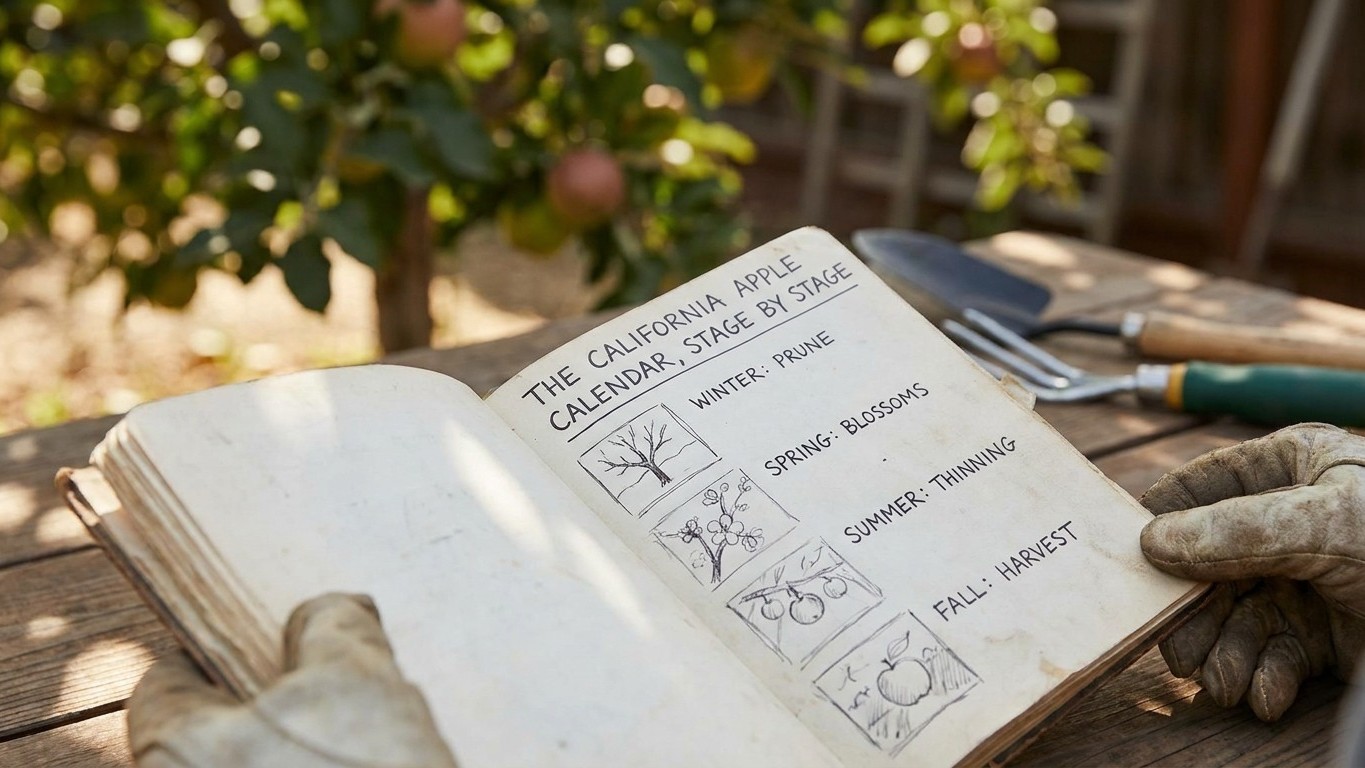
Apples move through the same physiological stages everywhere: dormancy, green tip, pink, bloom, petal fall, fruit set and harvest. What changes from one part of California to another isn’t the order of those stages, it’s how much cold and how much heat the tree needs to move through them, and whether frost is a real threat while it does.
Dormancy

This is the stage that decides everything else. The tree needs enough hours near or below 45°F to break dormancy evenly the following spring. In the Los Angeles basin, where NOAA’s 1991-2020 normals put the coldest month’s average nightly minimum at 48.7°F, that chill shortfall is the bottleneck, not frost. A tree that never gets cold enough leafs out late, unevenly, and blooms over a stretched-out window instead of all at once.
Green tip

Buds swell and the first sliver of leaf shows through the bud scales. In a frost-free winter like Los Angeles’s, per NOAA’s RCC ACIS record of zero sub-32°F days in thirty years, there’s no frost risk to this stage at all. Further inland, where real freezes still occur some winters, this is the point growers start watching night temperatures again, because tissue is no longer fully dormant and can’t shrug off a hard freeze the way bare wood does.
Pink

Flower buds show color but stay closed. This is traditionally the most frost-sensitive stage of the whole calendar, since the flower parts are fully formed but not yet protected by open petals. In the coastal basin it carries no extra risk, given the same NOAA freeze record cited above. Inland, it is the stage growers try to push past the last realistic freeze night, through variety choice and site selection.
Bloom

Open blossoms need pollinators active and days warm enough for bees to fly, which is a heat question in California more often than a cold one. Growers with several apple varieties on the property stagger bloom deliberately, which is one reason picking companion cultivars matters as much as picking a single tree. See The Best Apple Varieties for California for combinations that overlap in bloom time.
Petal fall

Petals brown and drop, leaving a small green fruitlet behind at the base of each flower cluster. This is when a grower finally sees how much of the bloom actually set fruit, and it’s the signal to start thinning.
Fruit set

Fruitlets swell from pea-sized to marble-sized over the following weeks. Thinning to one fruit per cluster, and keeping the tree watered through this stage, matters more in the mild, dry parts of the state than in the cold ones, since heat and water stress do more damage to fruit size here than any lingering chill problem.
Harvest
Named varieties ripen at their own pace, and that pace is a catalogue fact, not a calendar date: an early cultivar can finish six to eight weeks ahead of a late one planted the same spring. Read the fruit, not the month, and cross-check the variety’s published ripening window against what you actually see on the tree before you pick.
What changes across California
The Los Angeles basin figures above describe one climate among several very different ones in this state. Coastal Southern California, including Los Angeles, is frost-free in an average year according to NOAA’s 1991-2020 normals and RCC ACIS daily records, and the limiting factor there is a lack of cold, not too much of it. Move inland and the picture reverses.
The Central Valley floor, from Sacramento south through Fresno and Bakersfield, sits in a basin that traps cold air on winter nights even though the region is a long way from any mountain snowline, which gives it enough chill for a wider range of apple varieties than the coast gets. It also means valley orchards see real freezes that a Los Angeles-based frost record says nothing about.
The Sierra Nevada foothills and higher valleys run colder still, simply because elevation drops the air temperature, and a late spring freeze during bloom is the risk that growers there actually have to manage, the opposite problem to the coast’s chill shortage.
The north coast, from the Bay Area up toward the Oregon line, sits somewhere between the two: cool, often foggy summers moderate the heat, and winters are colder than Los Angeles but rarely as cold as the valley floor or the mountains.
None of these regions has a published freeze normal in the same NOAA dataset used for Los Angeles in this piece, so treat every figure above as a Los Angeles-basin fact only. A grower in Fresno, Placerville or Redding needs their own station’s numbers before applying any of this calendar literally.
| Region | Winter pattern | Main constraint |
|---|---|---|
| Coastal Southern California (Los Angeles basin) | Frost-free most winters, mild nights | Not enough chill for standard-chill cultivars |
| Central Valley (Sacramento to Bakersfield) | Cold air pools overnight, occasional freezes | Adequate chill, but spring frost risk during bloom |
| Sierra Nevada foothills and higher valleys | Colder with elevation, longer dormancy | Late frost during bloom the main risk |
| North Coast | Cool, often foggy, moderate winters | Chill usually adequate, heat can be limited |
The mistakes this climate punishes
The costliest mistake in the mild parts of the state is planting a standard-chill or long-chill variety because it’s a familiar name from somewhere else. A cultivar like ‘Honeycrisp’, commonly listed at 800 to 1,000 chill hours, gets only a fraction of that in a Los Angeles-basin winter with a 48.7°F average nightly minimum in its coldest month. That tree leafs out late, blooms over weeks instead of days, and often skips fruiting almost entirely the following summer. The failure shows up in year two or three, once the tree is established and the grower is expecting a crop.
The reverse mistake shows up inland: choosing an early-blooming, low-chill cultivar for a Central Valley or Sierra foothill orchard where a late frost can still arrive during bloom. Because the Los Angeles frost record used for the coastal calendar in this piece doesn’t apply to those regions, a grower who assumes the whole state is frost-free and plants for early bloom can lose the entire flower set to a freeze that a coastal orchard would never see. Check your own region’s frost pattern before choosing bloom time as a selling point.
Feeding a tree late in the season pushes soft new growth right when a freeze-prone region needs the wood to be hardening off, not growing. This one shows in Central Valley and Sierra foothill orchards specifically, since a coastal, frost-free block has no equivalent freeze to punish soft growth in the first place.
Underwatering during fruit set is the mild-climate version of the same problem. It doesn’t kill the tree, but it produces small, cracked or sunburned fruit in a summer that runs hot and dry, which is the actual stress a Los Angeles-basin apple tree has to survive instead of a freeze.
Checking this against your county
Every figure in this piece comes from a single NOAA station in the Los Angeles basin, and California is too large and too varied for one station to stand in for the whole state. Before committing to a variety or a planting date, check the numbers for your own county with the University of California’s statewide extension service.
- Ask for your county’s average winter chill hours, not just its USDA hardiness zone
- Ask whether your specific site has a local freeze record on file, since valley and foothill microclimates vary block to block
- Ask which apple varieties the local farm advisor has actually seen fruit reliably nearby
Find your county’s office through UC ANR, and pair whatever they tell you with the stage-by-stage calendar above rather than a fixed date. If you’re only starting out, the groundwork on rootstock and site is worth reading before you order a tree at all: see Growing Apples in California.
Common questions
Can I grow apples in Los Angeles without any real winter cold?
Yes, but only with cultivars bred for low chill, and even then bloom can run uneven in some years. A tree bred for 800 or more chill hours struggles badly in a winter with a coldest-month average minimum around 48.7°F, per NOAA’s normals for the Los Angeles basin.
Do I need to worry about frost if I’m right on the coast?
Not for frost itself. NOAA’s RCC ACIS daily records for the Los Angeles station show zero days at or below 32°F across thirty years, so the coastal basin’s problem is chill, heat and water, not freeze damage.
Why did my tree bloom for six weeks instead of all at once?
That’s the classic sign of insufficient chill, not a disease or a pest. Buds that never went fully dormant break unevenly, and the fix is usually a lower-chill cultivar rather than any change in care.
Does the Central Valley freeze the same way the Sierra foothills do?
No, and this piece doesn’t have station-level figures for either to compare directly. The valley floor traps cold air overnight and can still freeze on clear nights, while foothill and mountain sites get colder simply from elevation, so check your own county’s data through the extension service rather than assuming one pattern fits both.