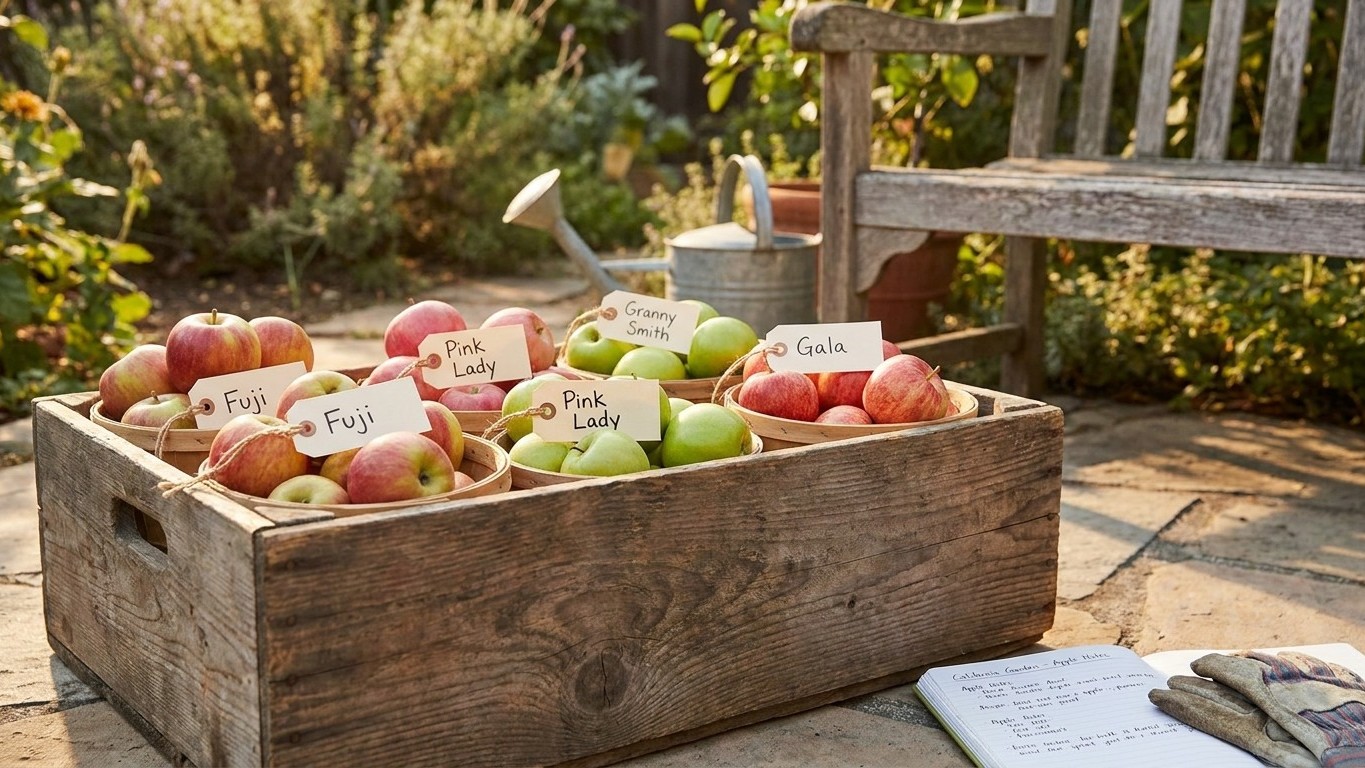

California doesn’t ask which apple tastes best, it asks whether your winter ever gets cold enough to grow one at all. Near the coast or anywhere in the LA basin, that answer is usually no unless the tree was bred for a short, mild cold spell; inland in the Central Valley or up in the foothills, real winter cold means a tougher, more traditional tree is what actually fruits. So before you fall for a variety name, go check what your own yard hits in January.
The short answer for California
For coastal and southern California, including the Los Angeles basin where NOAA’s 1991-2020 normals put the coldest month’s average minimum at 48.7°F and record zero measured freezes in 30 years, the workable choice is a low-chill apple type bred to flower and fruit after a short, mild winter. For the Central Valley, the Sierra foothills and the colder interior of Northern California, where real winter cold and regular freezes occur, a higher-chill, more cold-hardy type is the one that will actually set a full crop rather than dropping blossoms or skipping bloom altogether.
That answer depends on two separate filters, and growers routinely confuse them. Hardiness tells you whether the wood survives a freeze at all. Winter chill tells you whether the buds accumulate enough cold to break dormancy and flower on schedule, and it has nothing to do with how cold it gets, only with how long it stays cool. A tree can be perfectly hardy and still fruit poorly if the winter never gets cold enough, long enough, and that is exactly the situation across the mild Los Angeles basin and much of coastal Southern California.
If you haven’t settled the basics yet, site, soil and rootstock choice come before variety selection. That groundwork is covered in Growing Apples in California, and it’s worth reading first if you’re starting from a bare yard. Once the site is set, the variety decision comes down to matching the category of apple, low-chill or high-chill, to the winter your specific address actually gets, not the winter the rest of the state gets.
Working through it

Low-chill types for coastal and southern California
These are the apples bred specifically to flower after a short, mild winter, the kind that Los Angeles and most of coastal Southern California deliver every year according to NOAA’s normals. The trade-off is that they generally store less well off the tree than classic high-chill apples, and their flavor tends to be milder. They are also the only realistic option where NOAA’s data show essentially no freeze at all, since a variety that needs a long stretch of real cold will simply flower thin, or not flower, in that climate no matter how well you care for it.
Moderate-chill types for the Central Valley
The Central Valley runs distinctly colder in winter than the coast, with regular freezes that the Los Angeles-based NOAA figures above do not describe. A moderate-chill apple, one bred for a real but not severe winter, is the category that fits here, though the exact chill and frost numbers for your specific valley town should be checked locally rather than assumed from a coastal reference.
High-chill types for the Sierra foothills and colder interior
Higher elevation and the colder interior of Northern California get the long, cold winters that classic high-chill apples were originally bred for. The cost here runs the other way: a tree suited to this climate can be damaged by a late spring freeze hitting an already-open bloom, which is a timing problem, not a variety problem, and it’s covered stage by stage in The California Apple Calendar, Stage by Stage.
Apple cultivars are ranked here by category rather than by name. For a specific recommendation tied to your county, the state’s cooperative extension keeps regionally tested variety lists, and that’s the right next stop before you order a tree.
| Region | Winter profile | Frost risk | Apple category that fits |
|---|---|---|---|
| Coastal & southern California (LA basin reference) | Mild, essentially frost-free per NOAA’s 1991-2020 normals | Very low | Low-chill |
| Central Valley | Cold winter fog, distinctly colder than the coast | Regular freezes; check locally | Moderate-chill |
| Sierra foothills & colder Northern California interior | Long, cold winters | Hard freezes, including late-season risk | High-chill |
What changes across California
The Los Angeles figures above describe one reference point, not the state. Move a few miles inland from the coast and the marine layer that keeps LA winters mild thins out fast, so towns just an hour from the ocean can run noticeably colder and see real frost that the coastal normals do not capture. Elevation matters just as much: gain a few thousand feet into the Sierra foothills and you leave the low-chill zone entirely, into a winter cold enough that high-chill apples are not just tolerated but required for reliable bloom.
The Central Valley adds a wrinkle of its own. Cold air pools and lingers there on winter nights because the valley floor traps it, producing the tule fog California’s Central Valley is known for, and that cold-air pooling is a large part of why the valley’s winter chill runs so much higher than the coast’s despite similar latitude. Northern California’s interior, further from any moderating ocean influence, runs colder still through the winter months.
None of this shows up in a single statewide chill map worth trusting at the county level. A grower in the hills above a Central Valley town can have a meaningfully colder yard than a grower in the valley floor a few miles away, simply because cold air drains downhill and settles in low spots overnight. If your property sits in a low pocket, a swale, or the bottom of a slope, expect more winter chill and more frost risk than a neighbor on a hillside a quarter mile away, regardless of what any regional average says.
The mistakes this climate punishes
- Planting a high-chill apple on the mild coast. It shows up as sparse, erratic bloom the first spring after the tree matures, or flowers that open but barely set fruit, because the winter never delivered enough sustained cool weather to break dormancy evenly.
- Planting a low-chill apple in the Sierra foothills or a cold valley pocket. These types tend to flower early once their light chill requirement is met, and an early bloom sitting out in a foothill or valley yard is exposed to a late freeze that a later-blooming, higher-chill tree would have avoided.
- Feeding late into summer or early fall in any part of the state that freezes. Late nitrogen pushes soft new growth that has not hardened off by the time cold arrives, and that soft growth is what gets killed back first.
- Irrigating on a fixed calendar through a coastal or southern California heat spike. The binding constraint in the Los Angeles basin and most of coastal Southern California is heat, drought and water restrictions, not frost, and a tree watered on a schedule rather than by actual soil moisture and heat will show stress by midsummer even in a mild winter climate.
Each of these mistakes tends to surface at a different point in the season: the chill mismatches show up at bloom, the late-feeding problem shows up at the first real cold snap, and the irrigation mistake shows up as leaf scorch or fruit drop during the hottest weeks of summer, not in winter at all.
Checking this against your county
The figures in this piece come from a Los Angeles reference station, and Los Angeles is not the Central Valley, the Sierra foothills or the North Coast. Before you commit to a category of apple, or a specific named variety, check your own county’s winter chill and frost pattern with the University of California’s cooperative extension, which keeps regionally tested fruit variety information county by county.
That’s also the right place to ask about a specific named cultivar for your address, since a recommendation that holds for the Los Angeles basin may not hold sixty miles inland, and a statewide guide cannot make that call for you.
Common questions
Can I really grow an apple tree in Los Angeles with basically no winter cold?
Yes, but only with a low-chill type bred for a short, mild winter. NOAA’s 1991-2020 normals for Los Angeles show an average coldest-month minimum of 48.7°F and no measured freezes in 30 years, which rules out traditional high-chill apples but doesn’t rule out apples altogether.
My tree bloomed fine but almost nothing set fruit. What happened?
The most common cause in a mild-winter area is a chill mismatch, where the tree flowered unevenly because the winter didn’t deliver enough sustained cool weather. Poor pollination overlap between varieties, or a late-season heat spike right at bloom, can also cause fruit to drop before it sets.
Do I need a hard freeze for an apple tree to fruit at all in California?
Not a hard freeze specifically, but a period of sustained cool weather. That’s the winter chill requirement, and it’s a different threshold from frost hardiness, which is only about whether the wood survives cold, not whether the tree flowers well.
How do I find out what the actual winter chill is at my own address?
Start with the University of California’s cooperative extension office for your county, since chill accumulation varies with elevation, distance from the coast and whether your yard sits in a low spot that traps cold air overnight. A regional average, including the Los Angeles figures, will not match every yard within that region.