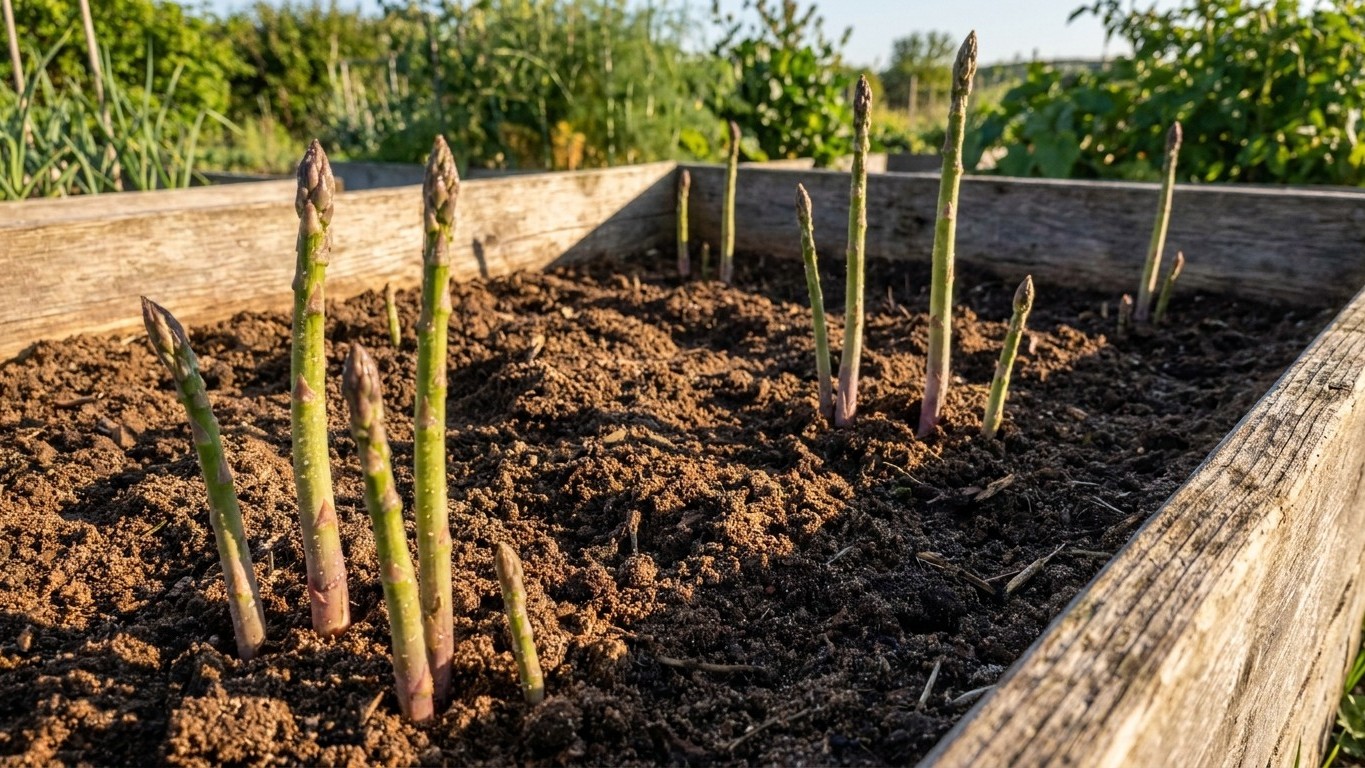

Stop cutting when most of the spears coming up are thinner than a pencil. That is the signal, and no calendar date replaces it. Once cut, spears hold best at 32°F to 35.6°F in nearly saturated air, and they toughen fast above 50°F. A new bed gets no cutting at all until its third year, then four weeks of harvest, then six, then eight. The rest of this guide covers how to keep what you cut and what to do with the bed afterward.
Keeping it, and for how long
The UC Davis Postharvest Technology Center, which publishes produce fact sheets for growers and handlers, puts the optimum for green asparagus at 32°F to 35.6°F (0°C to 2°C). Its optimum relative humidity is 95 to 100 percent, and it says high humidity is essential to prevent desiccation. Spears are mostly water, and they lose it fast.
The window is narrow, and both edges cost you. Above 50°F (10°C), UC Davis reports that spear toughening occurs rapidly. A bunch left on a warm counter or in a hot car can go fibrous in a matter of hours, and no amount of cooking brings the tenderness back. At the cold edge, freezing injury is likely at 30.9°F (-0.6°C) or lower. The spears take on a water-soaked look and then turn extremely soft. A spear that has frozen looks fine in the fridge and collapses when it is cooked.
That leaves a target of about 32 to 35°F with air close to saturated. It is only a few degrees wide.
How long do cut spears actually last?
Any storage life quoted for asparagus is a ceiling that applies only when temperature and humidity both sit in that optimum range from the moment of cutting. Fresh spears are always the best case. A bunch that sat warm in the garden for an afternoon, or lived in a door shelf, has already used up part of its time. Drift a few degrees above the range and the clock runs faster. Cross 50°F and it runs out quickly. Plan to eat spears soon after cutting, and treat any longer hold as a bonus.
Water is the other half of the puzzle. Spears lose moisture through the cut ends faster than anywhere else, so the butts are where storage is won or lost. Standing them in water, or wrapping the ends in something damp, is how a home kitchen approximates 95 to 100 percent humidity.
Harvest timing helps too. In the Central Valley and other hot inland areas, cut early and get the spears into shade or a bucket of water right away. Heat stress builds long before they reach the fridge.
Where in the house that actually is
A domestic fridge usually runs warmer than the optimum, and the door runs warmest of all, because every opening lets in room air. A door shelf is the worst spot for spears. The coldest, most stable place is low in the main compartment, on the bottom shelf toward the back. Cold air settles there and the temperature swings less. Keep the spears a little away from the rear wall and any vent, since a spot that runs too cold can drop below the freezing line and damage the tips.
An inexpensive appliance thermometer settles the question. Leave it on the shelf you plan to use overnight and read it in the morning. If it shows more than 35.6°F, that shelf is warmer than the optimum. If it dips toward 31°F, move the spears to a warmer spot. The produce drawer sometimes holds humidity well, but it is not always the coldest place, so check it the same way.
For humidity, a bag and a wet base do the work. Trim a little off the bottoms, stand the spears upright in a jar or glass with water covering the cut ends, and loosely cover the tops with a plastic bag. Another route is wrapping the butts in a damp paper towel and sealing the bunch in a bag. Skip the water and the cut ends dry and toughen even at the right temperature. Change the water if it clouds.
The counter is out for anything beyond a short wait, since most kitchens sit well above 50°F. The freezer is no help for fresh storage, because slow freezing in a home freezer is the freezing injury UC Davis describes.
How long should you cut asparagus each year?
Utah State University Extension is the guide here. Asparagus goes in as crowns, set in 8-inch furrows in early spring, and the bed is not harvested until year 3. After that it produces for 10 to 15 years. The first cutting year runs four weeks. The next runs six, and the one after that eight.
Resist taking a few spears early. Every spear you leave grows into a fern, and the ferns feed the crown for the following season. Cutting in the first two years takes from a plant that is still building its root system.
Within each season, the end of harvest is a thing you can see. When most of the new spears come up thinner than a pencil, the crown is running low on stored energy. Stop cutting and let everything grow. A few thin spears among thick ones is normal, so look at the whole row rather than one stalk. Counting weeks on the calendar will mislead you, because a vigorous bed may thin out later than a weak one.
Frost is no help as a signal in much of California. Coastal and Southern California are frost-free, with no freeze in an average year at the reference station. Northern California, the Central Valley and the Sierra do freeze. A frost-free bed keeps growing, so only the pencil test tells you when to quit.
What should you do with the bed after the last cut?
Let the ferns grow tall and water them through summer. NOAA climate normals for a coastal Southern California reference station show about 0.1 inch of rain across June, July and August combined, and 12.2 inches over a full year. June averages 0.08 inch, July 0.04 and August 0.0. Treat those as what the region can usually expect, because a slope, a city or a rain shadow changes it. A rain gauge on your own plot settles it. In most California summers the ferns depend on your hose or drip line.
Backfill the furrow gradually.
Then there is the ground itself. You are choosing a spot for up to fifteen years, so drainage matters more here than for any annual crop. The state soil, the San Joaquin series, is a loam to silt: 51 percent sand, 18 percent clay and 32 percent silt, with about 0.8 percent organic matter, and it is moderately well drained. That suggests ground that tends to drain acceptably. It is the soil that represents the state, though, and not necessarily yours. River bottoms, hill country and any lot a builder has scraped or filled can behave very differently. A soil test and a simple drainage test, filling a hole with water and watching how fast it empties, will tell you more. Utah State says most soils will do if they drain well, so if yours holds water, build a raised bed. For more detail, read Will California Soil Hold an Asparagus Bed for Fifteen Years? The full planting calendar is in Growing Asparagus in California, and for what chews on the spears and ferns, see What Eats Asparagus in California, and When.
Common questions
When can I first cut asparagus I planted from crowns?
Not until year 3. Crowns go in early in spring, and Utah State University Extension says the bed is not harvested before the third year. The first harvest lasts four weeks, then six, then eight. After that, the bed produces for 10 to 15 years.
How do I know it’s time to stop cutting?
Look at the row. When most spears are thinner than a pencil, stop and let the ferns grow. The rule does not depend on a week or a month.
Does frost end the asparagus season in California?
Only where it freezes. Coastal and Southern California is frost-free in an average year, so there is no frost date to wait for. Northern California, the Central Valley and the Sierra do get freezes. Use the pencil test everywhere. Check with your county extension office for local timing.
Which varieties should I plant?
Utah State University Extension names four. The listing gives sex only, with nothing on flavor or yield, so no one variety has a published edge. Choose by what you can find locally.