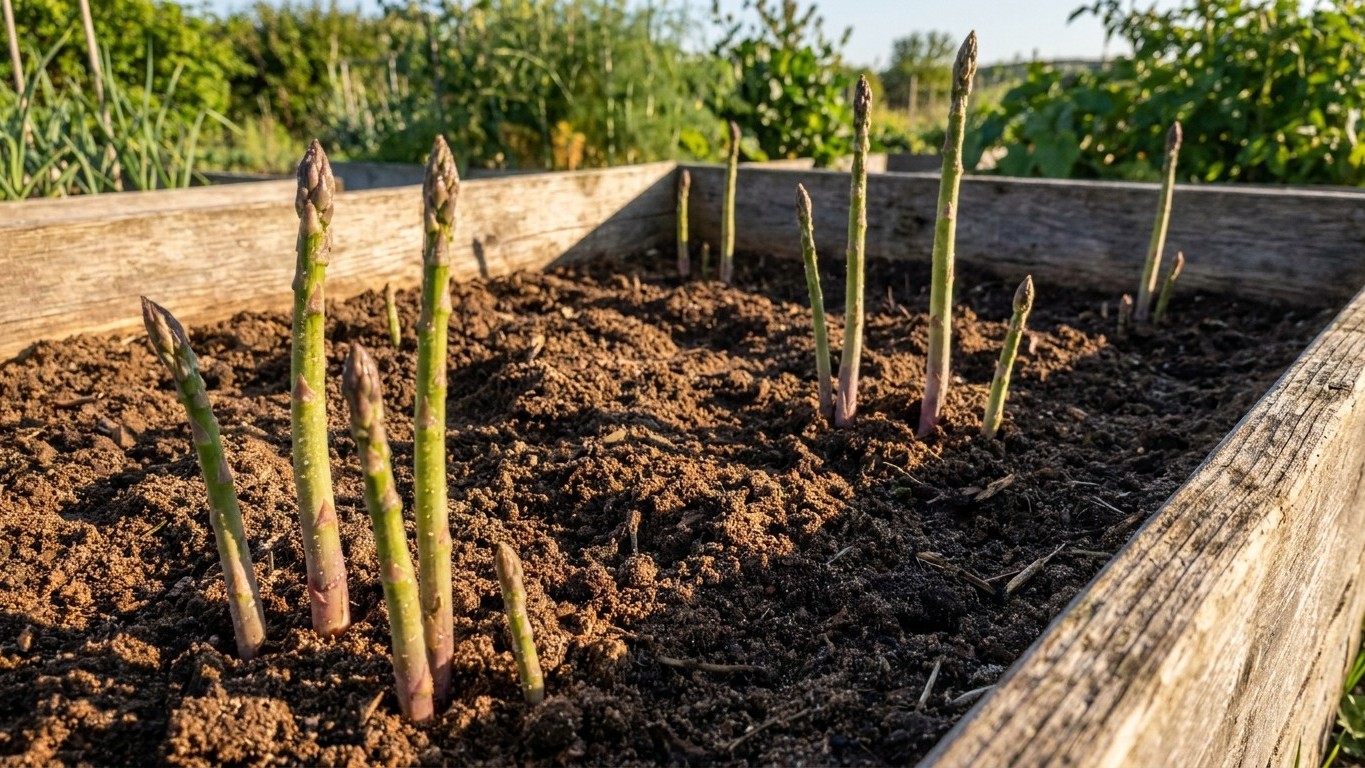

Yes, most California ground will carry an Asparagus Bed through its full run, but only because the crop is unusually forgiving about everything except one thing. The state’s own reference soil, the San Joaquin series, drains “moderately well” rather than excellently, and a bed planted this spring is still expected to be producing in fifteen seasons. That gap between “moderately” and “excellently” is where a California gardener’s real decision sits.
The short answer
Asparagus is one of the few vegetables where the planting decision is closer to buying a small orchard than sowing a row of beans. A crown put in the ground this year will still be sending up spears in ten to fifteen years, according to Utah State University Extension, and the only soil condition the source insists on is drainage. Not fertility, not a specific pH, not a chilling requirement. Just water that moves through and away from the crown rather than sitting around it.
California’s designated state soil, the San Joaquin series, gives a useful baseline for what a lot of the state’s ground actually does. It’s an Alfisol, a forest-derived soil of moderate fertility, running loam to silt: about 51 percent sand, 18 percent clay and 32 percent silt in the surface layer, with organic matter around 0.8 percent and a surface pH near 6.1. USDA’s own drainage class for it is “moderately well drained,” which sits in the middle of the scale, not at the excellent end. It moves water, but not fast, and not all the way through in a heavy winter.
For most vegetables that’s a minor inconvenience, something to work around one season at a time. For asparagus it’s a structural question, because a crown that sits in saturated soil for a few winters in a row will rot at the crown before it ever reaches its tenth year, let alone its fifteenth. A soil like San Joaquin, on its own, sits close to the line: fine on a slight slope or in a bed with any grit to it, marginal in a flat, heavy-clay pocket where water has nowhere to go.
That’s exactly why the state soil is a starting point and not a verdict on any one garden. California spans hundreds of mapped soil series, and the ground under a Central Valley farmhouse, a coastal bluff, a Sierra foothill lot and a lot that a builder scraped and refilled can be four different animals entirely. A homeowner whose yard sits over heavier clay than the San Joaquin baseline has a straightforward fix: build the bed up. A raised bed or a mounded row, six to eight inches above grade, gives the crowns the drainage the flat ground won’t. Working in organic matter before planting helps open a tight clay further, though it won’t turn genuinely poor drainage into good drainage on its own. The one thing not worth doing is planting straight into a spot that stays wet after a normal winter rain and hoping fifteen years of good luck follow. A simple test, digging a foot-deep hole and timing how long standing water takes to disappear, tells a gardener more about their own plot than any state-level soil record ever will.
Will the summer here water it for you?
an Asparagus Bed has a fairly specific thirst, and California summers do almost nothing to meet it. The crop wants one to two inches of water every other week through its first two years while the root system is still building, then settles into needing that same amount roughly every three weeks once established. Measured against what actually falls from the sky across a California summer, that request is almost entirely on the gardener’s shoulders.
- Total summer rainfall is close to nothing. Across the reference station’s June, July and August, the thirty-year normal comes to about 0.1 inches combined, against 12.2 inches for the year as a whole. Nearly all of California’s moisture arrives outside the growing season.
- August is effectively dry. The month-by-month normals run 0.08 inches in June, 0.04 in July and 0.0 in August, meaning the driest stretch of summer lines up exactly with the weeks asparagus foliage is working hardest to rebuild the crown for next year’s spears.
- Years one and two need the full one to two inches every other week supplied by hand or by drip line, since the 0.1 inch of natural summer rainfall covers a rounding error of that total, not a meaningful share of it.
- From year three on, the every-three-week schedule still falls almost entirely to irrigation, because there’s no summer rain event large enough to skip a cycle on the strength of it.
- Heat pushes the real number higher than the base schedule suggests. These are normals recorded at one reference station over 1991-2020, not a forecast for any single yard, and days that push into the 90s drive evaporation fast enough that a bed on sandy, fast-draining ground can need water sooner than the three-week mark, while a heavier clay bed holds moisture longer between waterings.
- A rain gauge on the actual bed settles what the averages can’t. Local topography, a rain shadow, or a nearby slope changes the numbers enough that tracking real rainfall on the plot itself is the only way to know how far the “every three weeks” baseline can be trusted.
When to put the crowns in
Crowns go into the ground in early spring, and in California that instruction lands very differently depending on where in the state the garden sits. Along the coast and through Southern California, the climate record shows no freeze at all in an average year, with thirty years of daily data showing zero days at or below 32°F and a frost-free season effectively running the full year. For gardeners in those zones, the constraint on planting isn’t frost at all. It’s getting crowns into cool, workable soil before the season’s heat and dryness set in, since drought and water restrictions do far more damage to a young bed here than cold ever would.
Northern California, the Central Valley and the Sierra are a different story, and lumping them in with the coast is the most common mistake in state-wide gardening advice. Those regions do freeze in a normal winter, and a gardener there should plan around their own around-the-corner last frost date rather than assume the mild coastal pattern applies. Because a mean frost date is exactly that, a mean, it’s worth treating it as a guide to plant around rather than a guarantee, and holding off a week if a late cold snap is in the local forecast.
Crowns are set into furrows roughly eight inches deep, then the trench is backfilled gradually across the season, adding about two inches of soil back in every other month rather than filling it all at once. That slow backfill lets the emerging shoots keep pace with the soil line instead of getting buried too fast to break through. Whichever variety goes in, the published record only tells a gardener the plant’s sex, not its flavor or yield: Jersey Giant and Jersey Knight are all-male selections, while UC 157 F1 and Purple Passion are male-and-female types, and Utah State Extension is the source for that distinction and nothing further.
Seed is the other route in, for anyone who’d rather start from scratch than buy dormant crowns. It’s a slower path to the same result, since seed-grown plants need to develop into a crown of their own before the same three-year wait to first harvest even begins to count down, but it removes any dependence on finding crowns locally and lets a gardener control the variety from the very first seed packet.
Common questions
Can I harvest asparagus the first year it’s planted?
No. Utah State University Extension is explicit that harvest doesn’t begin until the third year after planting, regardless of how vigorous the foliage looks in years one and two. Cutting spears early weakens the crown’s ability to build the root reserves it needs for the following decade of production.
How do I know when to stop cutting spears each spring?
Stop when most of the spears coming up are thinner than a pencil. That’s the signal the crown has spent down its stored energy for the season, not a fixed number of weeks, and letting the thin spears grow on into fern lets the plant rebuild for next year.
Does California’s soil pH need adjusting before planting asparagus?
The source behind these figures doesn’t publish a pH requirement for the crop, and the state soil’s own surface pH of about 6.1 is simply a representative baseline, not a target to hit. A basic soil test on the actual bed site is the only way to know what, if anything, needs adjusting.
Is there a winter chilling requirement to worry about?
Not one that’s published in this source. Asparagus’s ten-to-fifteen-year productive run and its drainage requirement are documented; any chilling need tied to hardiness zone isn’t part of that record, so it’s better treated as unknown than guessed at.