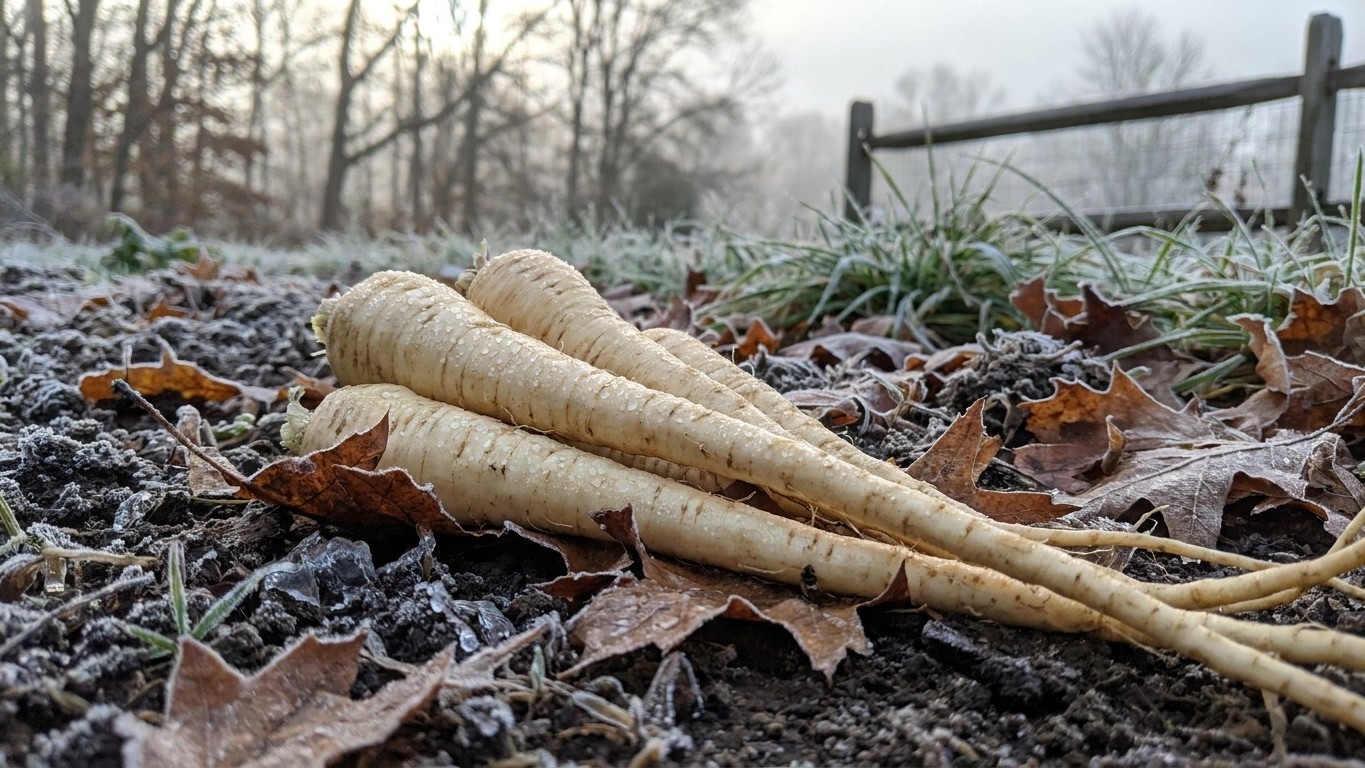

In coastal and southern California, lift parsnips when the roots reach usable size, about 100 to 120 days after seeding. Waiting on frost gains you nothing, because the Los Angeles reference station sees no freeze in an average year. Where winters do freeze (Northern California, the Central Valley, the Sierra), leave the roots in the ground through several frosty weeks first. Once lifted, a parsnip can keep four to six months, but only under conditions most kitchens never reach.
The short answer
Does your garden deliver several frosty weeks? That one question decides whether a California parsnip turns sweet or simply grows. Utah State University Extension says parsnips taste best after several weeks of cool, frosty weather, which converts stored starch to sugar. The trigger is frost exposure. A hardiness zone number can’t stand in for it, and a comfortable zone is not the same thing as a run of frosty weeks.
For Los Angeles, the NOAA reference station for this page, the mean daily minimum of the coldest month is 49.1°F. That is more than 17 degrees above freezing on the coldest nights of an average winter. The daily records show zero days at or below 32°F in 30 years, and the frost-free season is listed as 365 days. So a parsnip grown on the coast or in the southern part of the state will grow, and grow well, but it will not sweeten. You get a firm, earthy root rather than the candy-like one northern gardeners brag about.
Where the Los Angeles answer stops
Don’t stretch that station across the whole state. Northern California, the Central Valley and the Sierra do freeze, and there the question flips: you want the roots mature when the cold arrives, then you wait. This page doesn’t publish frost dates or minimum temperatures for those regions, so check your own garden’s record of freezing nights. The mechanics of that wait are covered in Will Parsnips Sweeten in California?. In a frost-free bed, lift at maturity and don’t wait for anything, since there’s no sweetness coming.
How long they keep
USDA Agricultural Handbook 66 gives parsnip roots 4 to 6 months of storage at 32 to 34°F with 98% relative humidity. That is a long keeper by any standard. It also assumes those conditions are held steady, and almost no house does that. A kitchen shelf or a garage in a California summer is nowhere close, so plan on a much shorter life.
Cold isn’t the danger. The same handbook says parsnips are not chilling sensitive. The danger is ethylene. A parsnip makes very little of its own (under 0.1 µL per kilogram per hour at 68°F), but low levels of it from outside cause bitterness, likely through a buildup of xanthotoxin. Keep them away from apples and any ripening fruit, even when the temperature is right. And top the roots after harvest, but don’t cut into the crown.
Does the season fit?
The crop needs 100 to 120 days from seeding, and the textbook advice is to sow two to three weeks before the last spring frost. Parsnips are sown in place, so the count starts the day the seed goes in the ground. Here is how that arithmetic plays out in California.
- Start the clock at seeding. There’s no transplanting. Germination takes 14 to 21 days, and those days count toward the total. A bed that looks bare for two to three weeks is normal, not failed.
- Look for the anchor date. The usual rule hangs on the last spring frost. In Los Angeles there isn’t one, since no freeze occurs in an average year and the same is true of the first fall frost. The rule has nothing to attach to, so you choose the sowing date yourself.
- Count against the frost-free season. With 365 frost-free days, a 120-day crop uses about a third of the year. Subtract it and 245 days are left over. Even at the short end, 100 days leaves 265. The season fits comfortably, with room for a late sowing or a slow one.
- Check the real limits. In coastal and southern California the constraints are heat, drought and water restrictions, not frost. Four months of steady watering is the price of the crop, so the season can’t run out on you, but your water allowance might.
- Run the sum again where it freezes. In the Central Valley, Northern California and the Sierra, take your local first freeze date and work backward. Seeding plus 100 to 120 days should land before the cold arrives, so the roots are full size when the frosty weeks begin. This page holds no freeze dates for those areas, so that figure has to come from your own records.
The verdict for a frost-free garden is that the season fits easily, and the winter is the weak link. That’s the reverse of what northern growers face. For the full picture of the crop in the state, start with Growing Parsnips in California.
What goes wrong here
Most failures come from soil, water and winter rather than from the calendar. Here are the ones to expect, with the fix for each.
- Forked roots in heavy or stony ground. Clay or rocks stop the taproot and split it. Utah State University Extension calls for deep sandy soil and says heavy soil must be double dug. Remove stones as you go. The state soil is only a starting point, so dig a spade deep in your own bed and see what’s there.
- Forked roots from overwatering. This is a separate cause and it needs a separate fix, because even well-prepared soil can produce forks if it’s kept too wet. Water the bed as it needs it, checking with a finger a couple of inches down, rather than on a fixed schedule.
- Digging up bare soil. Seed takes 14 to 21 days to germinate. Gardeners who see nothing after a week often rake the row and re-sow, which disturbs the seedlings that were about to emerge. Mark the row and wait the full three weeks.
- A season that runs out. In frost-free areas this almost never happens, but water restrictions can cut a crop short at month three. Sow only what you can water for 100 to 120 days. Where winters freeze, a late sowing may not mature before the cold, so count back from your first freeze.
- A winter too mild to sweeten. On the coast and in the south there are no frosty weeks, so the starch never converts. The remedy is realistic expectations: lift at maturity and cook it as a mild root vegetable. If you garden somewhere that does freeze, wait for the frosty weeks and then lift.
- Bitterness after storage. Parsnips stored next to apples or ripening fruit turn bitter from ethylene. Keep them separate, and top them without trimming into the crown.
Pests are a separate question with their own timing. What Eats Parsnip in California, and When covers it.
Common questions
Can I leave parsnips in the ground in Los Angeles until I need them?
The sources behind this page don’t give a figure for holding roots in the ground, so there’s no number to offer. What they do say is that sweetening comes from frost, and a frost-free bed offers none. Waiting adds no sugar, so lift at maturity and use the storage guidance below.
How long do lifted parsnips keep?
Four to six months at 32 to 34°F and 98% humidity, according to USDA Handbook 66. That is the ideal, held steady. A home setup without that control will get less, so treat the figure as a ceiling.
Does my hardiness zone tell me whether they’ll sweeten?
No. Sweetening depends on exposure to several frosty weeks, not on the zone. A zone number describes how cold the coldest nights can get over the long run, and a mild-winter garden can sit in a perfectly comfortable zone and never see a frosty week. At the Los Angeles station, the coldest month’s mean minimum is 49.1°F.
How soon will seedlings show?
Expect 14 to 21 days. Parsnips are sown in place and the 100 to 120 days run from seeding, so those weeks of bare soil are already part of the schedule. Leave the row alone.