
Winter Squash in California follows no single calendar because the state has no single climate. Along the coast and across the south, there’s no frost to schedule around at all, so the sowing window is set by heat and water rather than by a last-frost date. Head inland or uphill, and frost returns as the deciding factor. This page gives the state-level pattern; your county extension office gives the number that actually applies to your garden.
The short answer for California
At the reference climate station used for these normals (Los Angeles), there is no computable frost date at all: zero days at or below 32°F across 30 years of records, and a frost-free season listed as 365 days. That’s not an estimate rounded up for convenience. It’s what three decades of daily temperature data actually show for that location. For a gardener there, winter squash isn’t timed around frost risk because there effectively isn’t any.
That number is a probability drawn from a specific weather station, not a guarantee stamped on the whole state. It describes coastal and southern California reasonably well. It says nothing reliable about the Central Valley, the foothills, or the Sierra, where freezing nights are a normal part of winter and sometimes linger into spring. This page simply doesn’t have a computed frost date for those colder zones, and it would be a mistake to borrow the Los Angeles number and apply it to Fresno, Sacramento, or Truckee. If you garden inland or at elevation, treat frost as a real constraint until your local extension office tells you otherwise.
For the frost-free stretch of the state, the planting question shifts from “when does it stop freezing” to “when is the soil warm enough and the water available enough to support a heat-loving vine.” Winter squash germinates poorly in cold soil and sits in the ground doing nothing if conditions aren’t right, so a mild coastal or southern California garden generally gets its window open earlier than a snow-dusted Sierra valley, sometimes by a matter of months rather than weeks. The trade-off is that summer in these mild zones brings its own limits: the same reference station logs an average of only 2.4 days a year at or above 90°F, meaning the classic worry of “too hot to set fruit” isn’t the dominant local risk. Water is. Summer rainfall at that station totals about 0.1 inch across June, July, and August combined, with August landing at a flat 0.0 inches. Whatever window you pick, you’re planting into a summer that will not water itself.
What will not work here
Two failure patterns show up again and again in California winter squash beds, and both trace straight back to the numbers above rather than to bad luck.
The first is treating this as a rainfall-fed crop. A summer total of roughly 0.1 inch across three months, with the driest month delivering nothing measurable, means winter squash here survives entirely on irrigation you provide. Weekly watering, which might carry a squash plant through a wetter climate, is not enough when the sky is contributing essentially zero moisture for weeks on end. Fruit set and rind development are the stages most easily wrecked by an inconsistent supply: a plant that dries out hard between waterings, then gets flooded, tends to abort young fruit or produce squash with soft, uneven skin that won’t store. The fix isn’t more water on one big day. It’s a steadier, more frequent schedule sized to your actual soil, because sandy soil sheds that irrigation within a day while clay holds it for a week, and the reference-station rainfall figure says nothing about which one you’re standing on.
The second failure pattern is the mirror image, and it belongs to the colder end of the state’s range rather than the mild end. Where real frost risk exists, inland and at elevation, a grower who plants a slow, 100-plus-day winter squash variety without confirming the local frost-free window can lose the crop to an early fall freeze before the fruit fully cures. This page has no frost date to offer those readers, which is itself the warning: without a local number to plan against, the slower varieties are a real gamble in the parts of California that do freeze, and a shorter-season choice is the safer default until a county source confirms otherwise.
What generally isn’t the risk here, at least at the mild reference station, is extreme heat shutting down pollination. With only 2.4 days a year reaching 90°F or higher there, that specific failure mode is uncommon in the coastal and southern strip this data represents. It becomes a much bigger question inland, where the state’s heat runs considerably hotter than this coastal station, but that’s a fact this page doesn’t have numbers for, and it shouldn’t be guessed at.
What changes across California
The state’s official hardiness range runs from zone 5a to zone 11a, a six-zone spread inside one set of borders. That’s built on one variable, the average annual extreme minimum temperature, but it’s still a useful signal of just how little “California” means as a single gardening climate. A zone 5a reading belongs to a cold mountain winter. A zone 11a reading belongs to a nearly frost-free coastal or desert-adjacent spot. Nothing about this page’s numbers, drawn from one reference station, can stand in for that whole range.
Practically, that spread means a reader gardening in the north of the state, or at any real elevation, should expect a later opening to the planting window than the mild picture painted above, a shorter frost-free stretch to work inside, and a real reason to lean toward faster-maturing winter squash varieties rather than the longest-season types. It also means the heat and rainfall pattern described here, mild summer heat, near-zero summer rain, may simply not hold. Interior valleys run hotter than a coastal station across the whole season, and mountain gardens can see summer thunderstorms that a coastal rainfall total never captures.
None of that tells you which zone your own yard sits in, and this page won’t guess. The USDA Plant Hardiness Zone Map is built for exactly that lookup, at the address and by zip code, and it’s the right next step before you treat anything above as your personal planting date rather than the state’s general shape.
Where to check this for your own county
California’s land-grant extension service is the University of California Agriculture and Natural Resources program. That’s the site to use, not a county-specific URL guessed from a pattern, because coverage and page structure vary by office.
Once there, look specifically for two things. First, a local planting calendar for vegetables, ideally one built for your county or climate zone within the UC system rather than a statewide generality, since a Sacramento Valley calendar and a coastal Southern California calendar will not agree on a squash sowing date. Second, look for any variety trial results or recommended cultivar lists tied to your area. Extension offices routinely test winter squash varieties under local heat, humidity, and season-length conditions, and the ones that performed well two counties over aren’t necessarily the ones that will perform well in your soil and your summer.
A county recommendation beats a state one every time, because it’s built on the actual frost dates, heat load, and rainfall pattern of a much smaller, much more specific piece of ground. This page has given you the state-level shape: a frost-free reference climate at one end, a real freeze risk at the other, and a summer that supplies almost no rain regardless of where you sit. Your county’s extension calendar is where that shape turns into an actual date on your own calendar.
Checking this against your own garden
Every date on this page, and every date your county extension office publishes, is still an average built from past years. Your own garden this season will tell you more than any of them, and it does so through signs you don’t need a thermometer or a soil probe to read.
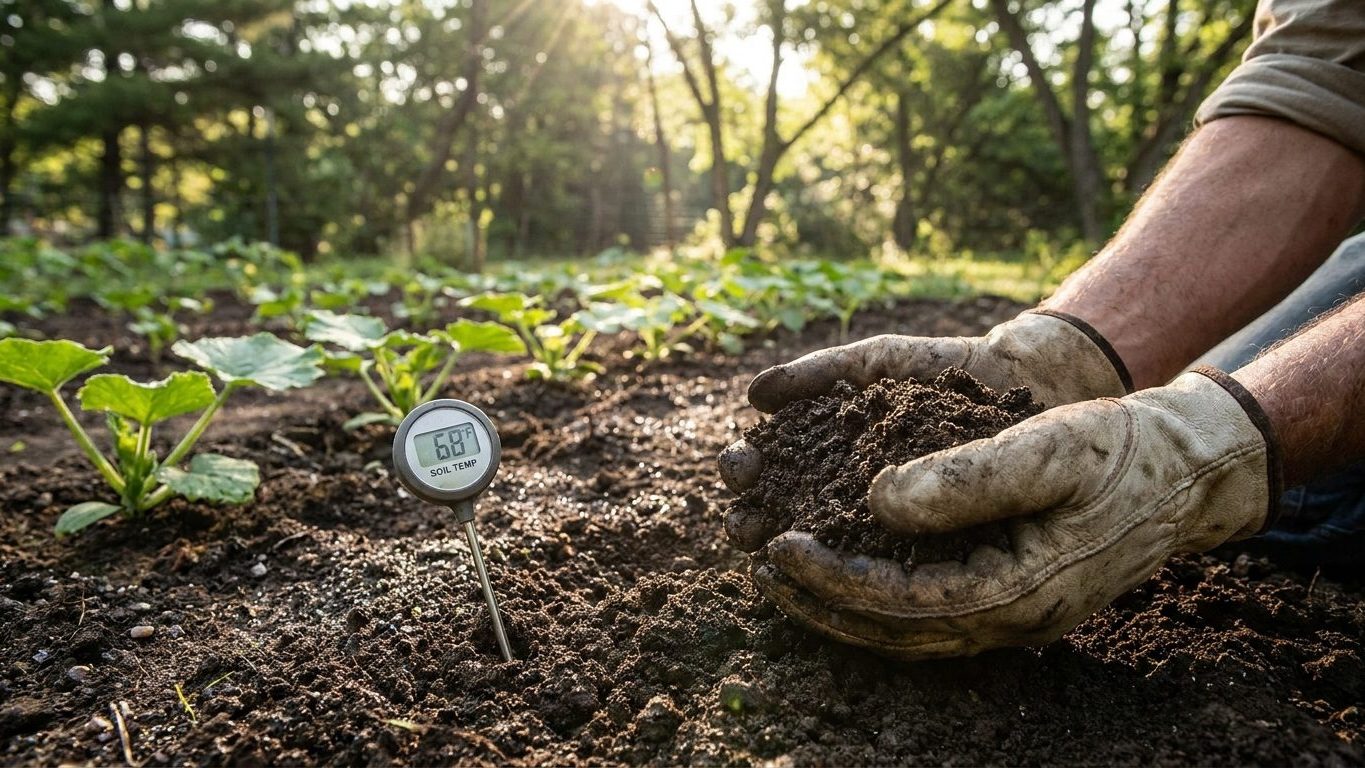
Soil warmth by feel is the first check. Press a bare hand into the planting bed in the morning before the sun has warmed the surface. Soil that still feels cold and slightly damp in a way that clings isn’t ready for squash seed no matter what the calendar says; soil that feels merely cool and crumbles loosely is usually close. Winter squash seed sitting in cold soil doesn’t just grow slowly, it often rots before it germinates at all.
The first flush of male flowers is the second signal, and it tells you your plant has shifted from vegetative growth into reproductive mode. Male flowers typically open days to a couple of weeks before the female flowers that actually set fruit, so their appearance is an early warning that pollination season, and the watering demands that come with it, is about to start in earnest.
The first true leaves, the ones that show the plant’s actual leaf shape rather than the rounder seedling leaves, mark the point where a young squash plant has established enough root system to start tolerating a slightly less babysat watering schedule. Watch for all three, in that order, and you’re reading your own microclimate rather than a station average from thirty years of someone else’s weather.