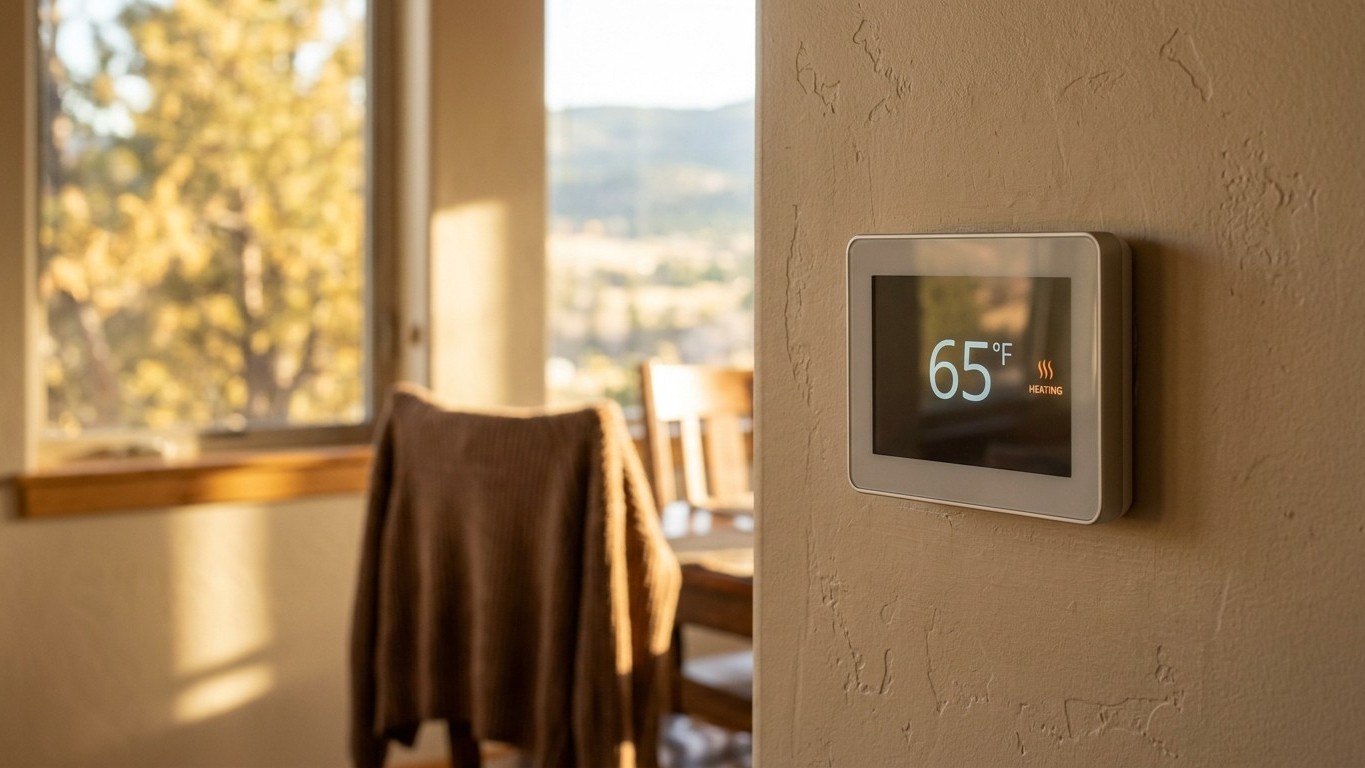

Heating demand in Colorado starts building in September, when the average mean temperature at Denver International Airport drops below 65°F for the first time since spring. The season runs roughly nine months, with December carrying the heaviest load. But “starts” here means a shift in the numbers, not a light switch, and the shape of that shift is worth knowing before the first cold morning catches you off guard.
When the heating season starts in Colorado

NOAA’s 30-year climate normals for Denver Intl AP put the average September temperature at 64.8°F, just under the 65°F threshold NOAA itself uses to count heating degree days. That’s the technical starting line: the first month where, on average, a house needs more warmth than the outdoor air provides on its own. From there, degree days build through fall, peak in December at 1,048, and taper back down until June, when the mean climbs back above 65°F and the heating season closes for the year.
A “monthly normal” is an average across three decades of Septembers, Octobers, and Decembers. It doesn’t predict the exact night your furnace kicks on this year, some autumns bring a hard frost in early September, others stay mild into October. The number tells you the pattern, not the calendar date.
| Month | Heating Degree Days |
|---|---|
| January | 1,034 |
| February | 904 |
| March | 726 |
| April | 517 |
| May | 261 |
| June | 52 |
| July | 4 |
| August | 9 |
| September | 105 |
| October | 436 |
| November | 767 |
| December | 1,048 |
Notice how the table doesn’t drop to zero even in July and August. Colorado’s high elevation and dry air mean cool nights persist year-round at a place like Denver, which is part of why the state’s heating season stretches so wide compared to lower, more humid parts of the country. September marks the turn toward winter; December marks the peak; the months in between and after tell the rest of the story, and the table above is the honest version of it, not a summary someone rounded off.
How hard the winter works here
Denver Intl AP averages about 5,862 heating degree days a year on the 65°F base. That figure is a proxy for fuel use: a house that needs twice the degree days needs, roughly, twice the fuel to stay at the same indoor temperature, all else being equal. It’s a useful yardstick for comparing one Colorado winter to another, or for sizing up how this location stacks against a similarly measured city elsewhere in the country.
What the annual number alone won’t tell you is whether a place has a long, mild slog or a short, brutal freeze. The monthly table above answers that for Denver: heating demand is spread across nine months rather than crammed into two or three, with January and December each carrying over a thousand degree days but no single month dominating the total. That’s a long-season climate, not a spike-and-recover one. A furnace here works moderately hard for most of the year rather than working flat-out for a few brutal weeks and idling the rest of the time.
The cooling side of the ledger, about 850 cooling degree days annually, is a fraction of the heating load. Denver’s HVAC systems spend far more of the year fighting cold than heat, which shapes everything from duct design to how homeowners budget for seasonal maintenance.
What most homes in Colorado actually heat with
Federal survey data on Colorado households shows a clear preference for one type of system, though not without some gaps in the reporting.
| System / Fuel | Share of Homes |
|---|---|
| Furnace | 77% |
| Steam or hot-water boiler | 9% |
| Natural gas | 76% |
| Electricity | 16% |
| Propane | 4% |
Central heat pumps and fuel oil or kerosene systems don’t appear as reliable figures in this dataset. That’s not the same as saying nobody in Colorado uses them. In survey terms, “not reported” means an estimate exists but was judged too unreliable to publish, and “none reported” means too few households turned up in the sample to generate a number at all. Neither is a zero.
Furnaces dominate for a straightforward reason: natural gas has been the cheap, accessible fuel across most of the state for decades, and builders installed furnace-and-ductwork systems to match. That doesn’t make a furnace the right call for every house today, it’s simply what the market built when these homes went up. A furnace paired with ducts does one thing well: it moves a lot of heat fast, which matters in a climate where January and December both average over a thousand degree days. What it struggles with is even distribution to far rooms and basements, especially in older homes where ductwork was an afterthought.
The one maintenance item furnace owners skip most often, and pay for later, is the air filter. A clogged filter restricts airflow, forces the blower motor to work harder, and can shorten the life of the whole system by years. It’s the cheapest fix on this list and the most commonly ignored one. For households burning wood as a supplement or primary source, the seasonal prep looks different enough that it deserves its own guide rather than a paragraph here.
Run it once before you need it
The worst night to discover a broken furnace is the first genuinely cold one, which in Colorado tends to land sometime in that September-to-October window when the monthly average first slips below 65°F. Every HVAC technician in the region gets booked solid within days of the first hard freeze. Testing the system weeks ahead, while it’s still mild out, is the difference between a quick fix and a week without heat.
- Turn the thermostat up a few degrees above room temperature and run the system for a short cycle, listening for grinding, rattling, or a delayed ignition that takes longer than a second or two.
- Expect a faint burnt-dust smell on the first firing of the season. That’s normal, it’s just dust burning off the heat exchanger, and it should clear within a few minutes. A smell that lingers or smells like something else warrants attention.
- Replace or check the air filter before you run anything else long-term. A dirty filter is the single most common cause of poor airflow and early system wear.
- Clear the area around vents, radiators, or the outdoor unit if you have a heat pump. Furniture, curtains, and stored boxes block airflow and reduce efficiency.
- Test the carbon monoxide alarm. Combustion heating systems can leak carbon monoxide if a heat exchanger cracks or venting fails, and a working alarm is the cheapest safeguard against it.
- Know when to stop. If you hear unusual noises, smell gas, or the system won’t hold a steady cycle, that’s the point to call a licensed technician rather than keep troubleshooting.
Even a system in perfect working order loses heat before it reaches a room. The U.S. Department of Energy notes that “in a typical house, about 20%-30% of the air that moves through the duct system is lost due to leaks, holes, and poorly connected ducts.” That’s air moving through the ducts specifically, not a measure of a house’s total heat loss, but it explains a lot about rooms that never quite warm up and bills that seem high for the temperature outside.
What turning it down is actually worth
The Department of Energy states plainly: “You can save as much as 10% a year on heating and cooling by simply turning your thermostat back 7-10°F for 8 hours a day from its normal setting.” That figure covers heating and cooling combined, over a full year, for that specific setback and duration. It is not a per-degree rule, and stretching it into one overstates what setback actually delivers.
In a place with a nine-month heating season like Denver, that setback has a lot of hours to work with. A programmed pullback overnight or during a workday isn’t a token gesture here, it’s touching a system that’s already running for the better part of three-quarters of the year. The longer the season, the more those 8-hour windows add up across the calendar.