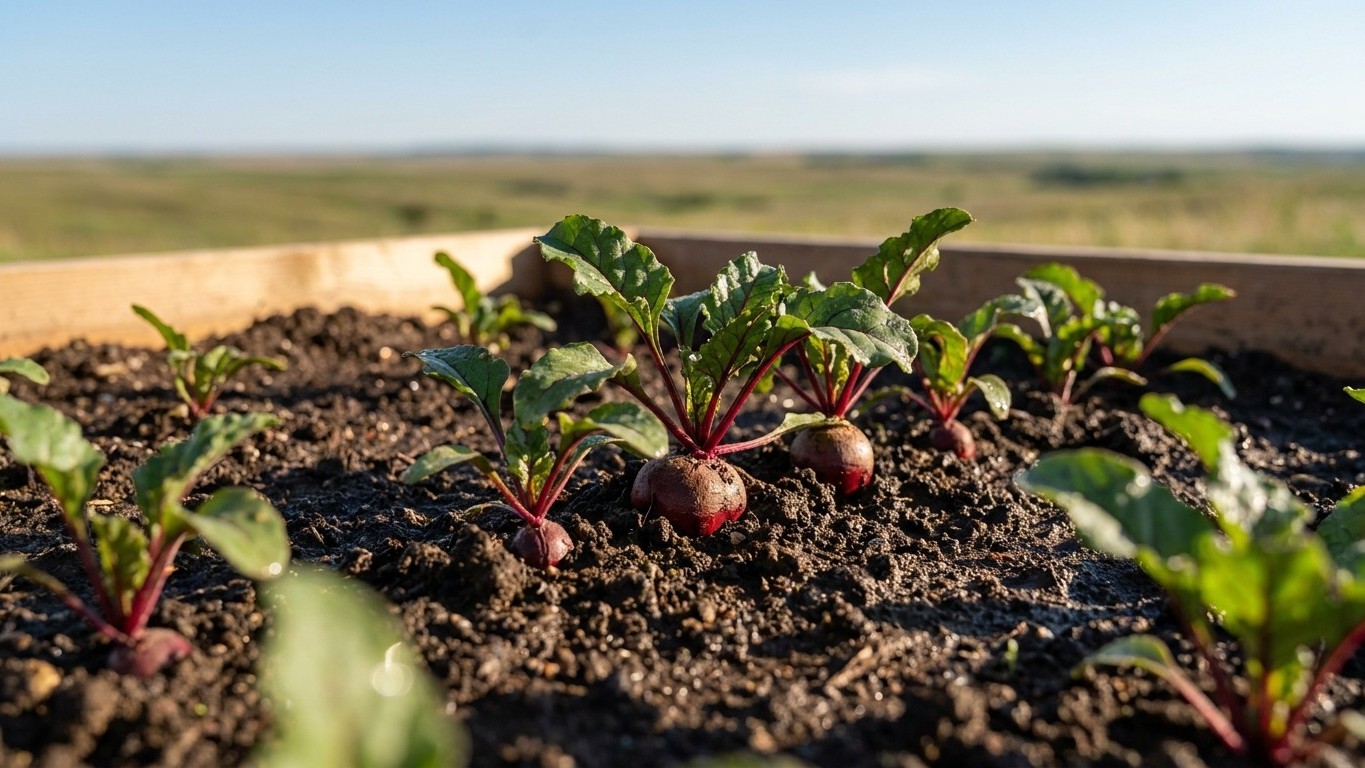

North Dakota’s prairie soil and short, intense growing season both push beets in the same direction: sow early, keep the row moist for the first six weeks, and get the roots out of the ground before late-summer heat sets in. The two failures that actually happen here, bolting and woodiness, come from two different causes, and the fix for one won’t fix the other.
The short answer
The soil USDA lists as representative of North Dakota is the Williams series, a Mollisol, the deep, dark prairie soil that built the Corn Belt’s reputation. Its surface horizon runs 38 percent sand, 22 percent clay and 40 percent silt, a silt loam texture, with a surface pH around 7.2 (essentially neutral) and organic matter averaging about 4.0 percent. It’s classified as well drained. That’s a useful starting point, not a verdict on your yard: North Dakota spans hundreds of mapped soil series, and river-bottom ground, hill-country ground, and anything a builder has scraped or filled will behave nothing like this, which is why it’s worth digging deeper into Beet Soil in North Dakota before assuming your own bed matches this profile.
For a beet, that combination is mixed news. Utah State University Extension’s guidance is that beets want deep, sandy, well-drained soil rich in organic matter. The Williams series checks the drainage and organic-matter boxes comfortably, an organic-matter reading near 4 percent is already generous, well above what most vegetable beds start with, but the texture leans heavier than “sandy,” carrying 40 percent silt and 22 percent clay. That mix can crust after a hard rain and stays cooler and slower to dry out in spring than a sandy loam would. It’s workable ground for beets, not ideal ground, and a gardener sitting on true Williams-type soil should think about loosening the seedbed rather than adding more organic matter than the Utah State recommendation calls for.
On the heat side, this page doesn’t have a published count of how many days a year any specific North Dakota city crosses 90 F, and rather than guess, it’s worth saying plainly that figure isn’t available here. What is documented is the threshold that matters for the crop: Utah State’s research ties woodiness to temperatures above 85 F arriving while the plant is also short on water. North Dakota summers do produce stretches that reach and pass that mark, which is exactly why the harvest-timing advice below matters more than any single soil number.
The six weeks that decide it here
Beets are sown directly in the ground, never transplanted, and the standard advice to sow 2 to 3 weeks before the last frost puts the crop’s first six weeks in a specific, known stretch of the North Dakota spring, a window covered in detail in When to Sow Beets in North Dakota. NOAA’s 1991-2020 climate normals, drawn from the Fargo airport station (Hector International, USW00014914), put the last spring freeze at 32 F somewhere between May 4 and May 15. Sowing two to three weeks ahead of that window means seed typically goes in the ground in mid to late April, with the critical first six weeks running from then through roughly early to mid-June.
That’s the stretch North Dakota’s spring is known for being unsettled. Cold snaps can sit behind warm days, wind dries the surface fast, and a soil that leans silty and clay-heavy, like the Williams series, can either crust over after a downpour or dry out on top while staying wet underneath. Neither extreme is good for a beet seedling, but the one that causes lasting damage is drought stress. Utah State’s research is specific on this point: water stress in the first six weeks after sowing is what triggers premature flowering, the plant bolting to seed instead of building a root. That’s a different failure from the woodiness that comes later in summer, and it happens earlier, while the plant is still small and easy to overlook.
The frost dates above come from one airport weather station, not a state-wide guarantee. Suburban and rural gardens routinely see their last spring frost later than an airport reading, often by one to two weeks, and more if the garden sits at elevation or in a low frost pocket. A gardener planning sowing dates off the Fargo normals alone risks planting into a frost that hasn’t actually passed yet in their own yard.
What goes wrong here
- Seedlings that never break the surface. A silt-and-clay soil like the Williams series can crust hard after a heavy spring rain, sealing in beet seed that’s only sown a half-inch deep. Keep the seedbed loose at sowing, avoid working the soil while it’s wet, and break any crust gently with a rake tine or a light scattering of finer material over the row before germination.
- Bolting before the root ever forms. This is the first-six-weeks failure: a dry stretch during that early window, common in a swinging North Dakota spring, sends the plant into premature flowering instead of root growth. The remedy is steady, even soil moisture from sowing through the sixth week, not a single deep watering after the row already looks dry.
- Woody, fibrous roots at harvest. This is a separate, later failure, caused by temperatures above 85 F combined with water stress once the root is already forming, typically in July and August. Mulch to hold soil moisture, water deeply during hot stretches, and don’t let the crop sit in the ground once a heat wave and a dry spell overlap.
- Too much of a good thing in the soil. Williams-series ground already carries about 4.0 percent organic matter, more than many garden beds start with. Utah State’s guidance caps composted organic matter at 1 inch per 100 square feet; piling on more, or adding a nitrogen-heavy fertilizer on top of soil that’s already fertile, tends to push leafy top growth at the root’s expense.
Checking this against your own county
Everything above starts from one representative soil series and one airport’s climate record, useful for sizing up the general pattern across North Dakota, not a substitute for what’s actually under your feet. A soil test is the only way to know whether your garden is closer to sandy loam or heavy clay, and how much organic matter it’s actually carrying before you add more.
For that testing, and for planting-date guidance built around your specific county rather than a single airport station, North Dakota State University Extension is the resource to use. Local extension offices can also flag frost-pocket tendencies and soil-series quirks that no state-wide dataset will catch.
Common questions
How many days do beets take to mature from seed in North Dakota?
Beets typically run 60 to 80 days from direct seeding to harvest, not from a transplant date, since beets are always sown in place. Counting from a mid to late April sowing puts a typical harvest window somewhere in the mid-summer stretch, timing that matters given the woodiness risk once temperatures climb.
Can I sow beets earlier than 2 to 3 weeks before the last frost?
The Williams-series soil type is well drained but silt-and-clay heavy, which means it warms more slowly in spring than a sandy soil would. Sowing into cold, still-wet ground ahead of the usual window risks poor germination rather than any frost damage to the seed itself.
Is bolting the same problem as woody roots?
No, and treating them as one issue is the most common mistake. Bolting comes from water stress in the first six weeks after sowing and ends the root’s development early. Woodiness comes later, from heat above 85 F combined with drought stress once the root has already formed. Watering to prevent one doesn’t automatically prevent the other; both call for consistent moisture, but at different points in the season.
Should I add compost to soil that already tests high in organic matter?
Not beyond the Utah State University Extension recommendation of 1 inch of composted organic matter per 100 square feet. If a soil test shows organic matter already near the Williams-series average of 4.0 percent, adding more risks pushing leaf growth over root growth.