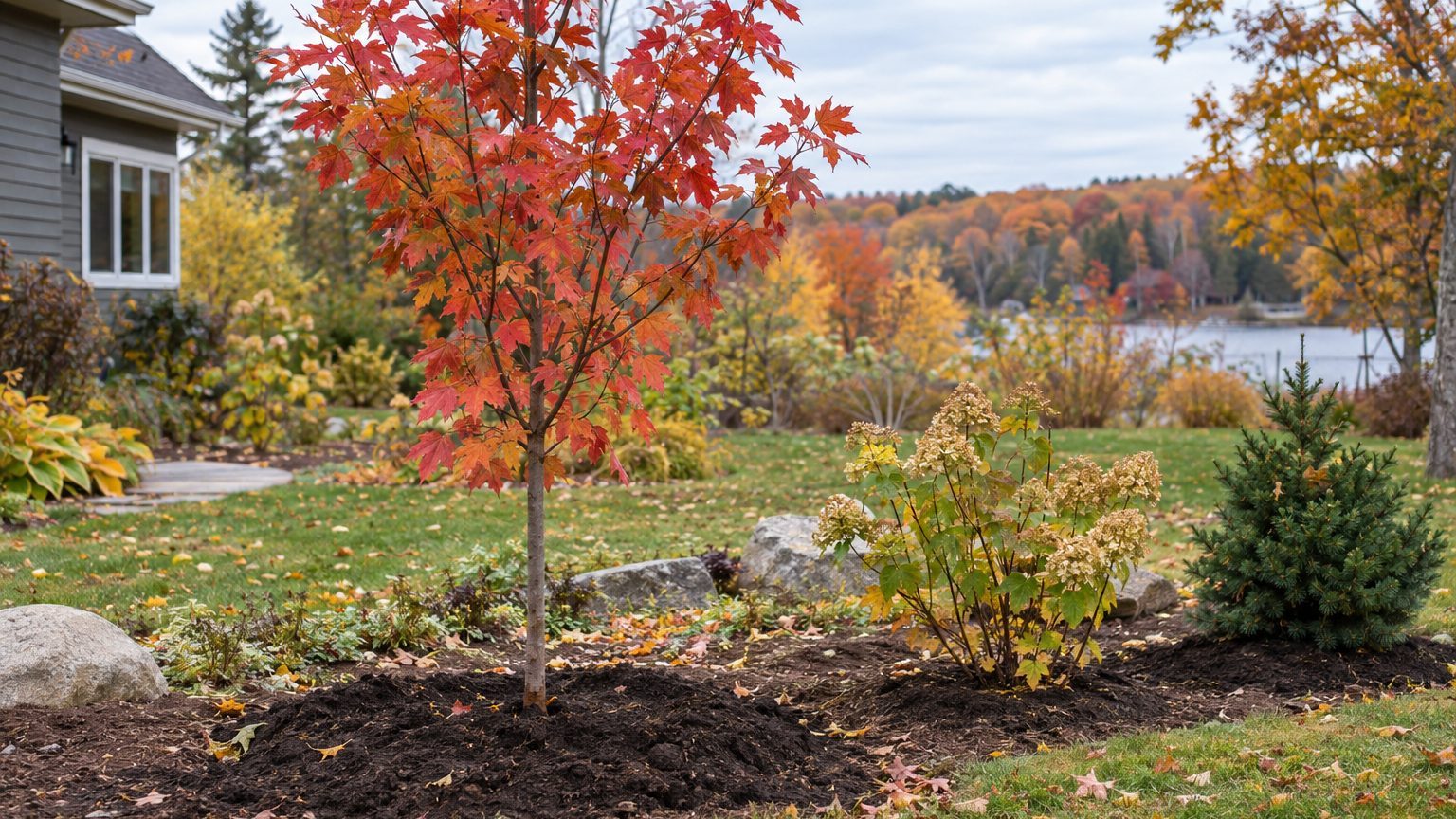

Six weeks before the first fall frost is the safe target. In Denver, where frost arrives between September 30 and October 12 (NOAA’s 1991-2020 normals), that puts the cutoff at August 19 to August 31. Miss it and the season isn’t over. Roots keep working as long as the soil stays workable and unfrozen, so hardy container and balled plants set in later still have a real shot. They just have less margin. Higher, colder ground reaches every one of these dates sooner.
The deadline in Colorado
Air and soil run on different clocks. A frosty night in early October burns tender leaves and stems, but soil is a big reservoir of stored summer heat and cools slowly, trailing well behind the thermometer. Tree and shrub roots stay active in that ground long after the tops have gone dormant. That lag is the only reason fall planting works at all.
Where the six weeks come from
Cornell Cooperative Extension states the rule this way: “Fall is an excellent time for transplanting, provided you get them to their new home at least 6 weeks before the ground freezes, allowing them time to establish roots before winter dormancy.” Notice what it counts from. Not the first frost on the lawn, but frozen ground, which arrives later. The trouble is that no climate table gives a ground-freeze date for your yard. Snow cover, exposure, soil type and the particular year all move it around.
So the practical move is to count back from the first fall frost instead. It comes earlier than the ground freeze, which makes the resulting date conservative. The NOAA NCEI 1991-2020 Climate Normals for the Denver station (USW00003017) put the first 32°F freeze in the 30 to 70 percent probability band at September 30 to October 12. Six weeks earlier lands at August 19 to August 31, the safe target to write on the calendar.
That is the safe date, not the final one. The true limit, the ground freezing, usually falls later. As of the last day of September 2026, the safe target is already behind Denver gardeners, but the window hasn’t closed. If a spade still slices into the soil without a fight, roots can still grow. What’s gone is the cushion, so the watering and mulching covered below matter more.
Why the date slides with elevation
Denver sits at 5,280 feet on the plains, and that matters for every number above. The coldest month there has a mean daily minimum of 18.4°F (NOAA NCEI Climate Normals, 1991-2020). That is well under freezing, so the ground does freeze along the Front Range and the six-week logic applies in full.
Move uphill and the calendar compresses. Mountain towns run far shorter seasons and can see frost in July, and the colder the spot, the earlier the first fall frost and the earlier the safe planting date. Their safe window can close while Denver is still in summer. The western slope follows its own pattern again. Look up your town in First and Last Frost Dates in Colorado, then count back six weeks from the start of your range, not from Denver’s.
What to plant late, and what to wait on
Hardiness does the sorting. Denver’s 18.4°F figure is a mean daily minimum for the coldest month, which is the number that decides whether a plant survives winter here at all. It is not a record low, and real cold snaps dip below it. The USDA Plant Hardiness Zone Map (2023 edition, built on the average annual extreme minimum temperature) runs from 3b to 7b across Colorado, so the state covers a lot of ground. Your plant tag has to match your own spot on that map, not the state as a whole.
Plants that are comfortably hardy for your zone and come in a container or a dug root ball handle late planting best. A container plant arrives with its root mass intact. A balled-and-burlapped tree has lost some roots at digging, but a dormant one, after leaf drop, has little foliage to keep supplied while it recovers. Bare-root stock is a spring job.
| Plant type | Late-fall outlook in Colorado | What drives the risk |
|---|---|---|
| Hardy deciduous shrubs in containers | Good, while soil is workable | Intact root mass, no leaves to feed in winter |
| Hardy deciduous trees, container or balled | Good, with steady watering | Roots still expanding in unfrozen soil |
| Conifers and broadleaf evergreens | Risky late; earlier is better | Foliage loses water all winter through dry air and wind |
| Plants borderline for your zone | Wait for spring | A small root system has no reserve against a hard cold snap |
Evergreens and borderline plants
An evergreen never stops losing water through its needles or leaves. Colorado winters are dry, sunny and often windy, and a newly planted evergreen has only a partial root system to replace what the foliage loses. Frozen soil makes it worse, because roots can’t pull water from ice. A spruce planted in late August has a decent shot. The same tree dropped in just before the ground locks up is gambling.
Borderline plants are the other gamble. A shrub rated at the edge of your zone can ride out a mild winter once it is established. A fresh transplant with few roots has far less to draw on. If a plant is borderline for your zone, hold it until spring, when it gets a full growing season to build roots before its first real winter test.
For the planting itself (hole width, root flare at soil level, loosening circling roots), Planting and Caring for Trees, Shrubs and Perennials walks through the steps. Late planting doesn’t change the technique. It only removes the room to fix mistakes.
Watering and mulch until the ground freezes
Colorado’s fall and winter are dry. Humidity is low, and snow can stay away for long stretches. A newly planted tree with no irrigation can get through a fall without a single soaking rain, and the roots that were supposed to be growing stall instead. Water is the main job from planting day onward: a slow, deep soak that reaches the full root ball and the soil just beyond it, then a pause to let the surface dry before the next one. Quick sprinkles only wet the top inch and do little.
The schedule has no fixed end date. Water through fall and into winter whenever the soil is thawed and snow isn’t covering it, and stop only once the ground is truly frozen. A mild afternoon in a dry December counts as a watering day.
The first winter is about roots
Above ground, a transplant does nothing all winter. Below ground, it is rebuilding. Digging cost it a chunk of its root system, and year one is spent growing roots back out past the original root ball. Branch growth comes later, once the plumbing can support it. Judge the plant by next spring’s buds, not by how it looks in January.
That is why fall fertilizer is a bad idea on a fresh planting. It pushes soft top growth at exactly the wrong moment. Prune only dead or broken wood and leave the rest alone.
Mulch: a ring, not a volcano
Mulch buffers the soil against swings in moisture and temperature, which is useful in a climate with sunny, freeze-and-thaw winters. NC State Extension’s Gardener Handbook (chapter 11, Woody Ornamentals) gives two sentences on depth. On weeds: “A 2-inch to 3-inch layer of mulch suppresses most annual weed seeds and makes it easy to hand-pull any that do germinate.” On trees: “Provide a 3-inch layer of mulch to reduce water loss and maintain uniform soil moisture and temperature around roots.” It is a North Carolina source, but the depth holds wherever the goal is steadier moisture and temperature, and the two purposes land on the same order of depth.
More is not better. Stack mulch higher and up against the trunk and you’ve built the classic volcano, which keeps bark damp, invites rot and gives gnawing rodents a cozy winter shelter. Spread the mulch in a flat ring around the planting and keep it clear of the trunk so the root flare stays visible. Mulching Without Killing the Plant covers how to lay out that ring and how to fix one that has already gone volcanic.
What goes wrong
Too late, then too dry
The most common failure is simply running out of time. If the ground freezes before roots have spread beyond the root ball, the plant enters winter anchored by a container-sized clump and little else. The safe target, August 19 to August 31 (Cornell’s six-week rule applied to NOAA’s Denver frost range), exists to prevent that. A planting made after it isn’t doomed, but it depends on the soil staying open and on the gardener’s watering.
A dry fall turns that dependence into a problem. Soil that stays unfrozen but dry won’t support root growth, and a tree that looks fine in November can be in trouble by March. If nature skips the moisture, the hose has to cover it.
Winter burn and heaving
Winter burn shows up in late winter as brown needle tips on conifers or scorched, crisp edges on broadleaf evergreens. Sun and wind pull water out of the foliage while roots sit in cold or frozen soil and can’t replace it. A freshly planted evergreen, with its smaller root system, is the likeliest casualty. Planting earlier, watering through winter thaws and mulching at the depth above all help.
Heaving is the quieter problem. Repeated freezing and thawing pushes shallow root balls upward, sometimes leaving the top of the root ball sitting above the soil line and roots exposed to drying air. A plant with few roots has little to hold it down. Press any heaved root ball back down and re-cover the roots as soon as the soil thaws, then refresh the mulch ring.
Gardeners who came from the East should leave their old calendar at the door. The answer in How Late Can You Plant Trees and Shrubs in Fall in Pennsylvania? plays out in a different climate, with more rain in fall and less risk of a parched root zone than a Colorado autumn brings.
Common questions
Is it too late to plant trees in Colorado at the end of September?
In Denver, the safe target (August 19 to August 31) has passed, but the ground isn’t frozen yet, so hardy container or balled trees can still go in with careful watering and mulch. Evergreens and borderline plants are better held for spring. At higher elevations, where frost and frozen ground come sooner, the window may already be closed.
Can I plant after the first frost?
Yes, as long as the soil is workable. A frost is an air temperature, and it kills tender foliage, not roots in unfrozen ground. NOAA’s Denver normals put the first 32°F freeze between September 30 and October 12, and plenty of hardy plants go in after that. What changes is the margin for error, which shrinks with every week of delay.
Does the six-week rule work in the mountains?
The logic holds, but the dates move earlier. Mountain towns run far shorter seasons and can frost in July, so count six weeks back from your own first fall frost, not Denver’s. The western slope has its own pattern as well. The Colorado guides cover timing by region, and where the season is very short, spring planting is often the safer choice.
How deep should I mulch new trees and shrubs?
NC State Extension’s Gardener Handbook recommends “a 2-inch to 3-inch layer of mulch” for weed suppression and “a 3-inch layer of mulch” around trees to hold moisture and even out soil temperature. Stay within that range, keep the mulch off the trunk, and skip anything that looks like a cone. A fresh ring needs checking after the first hard freeze-and-thaw cycle, since mulch can shift as the soil heaves.