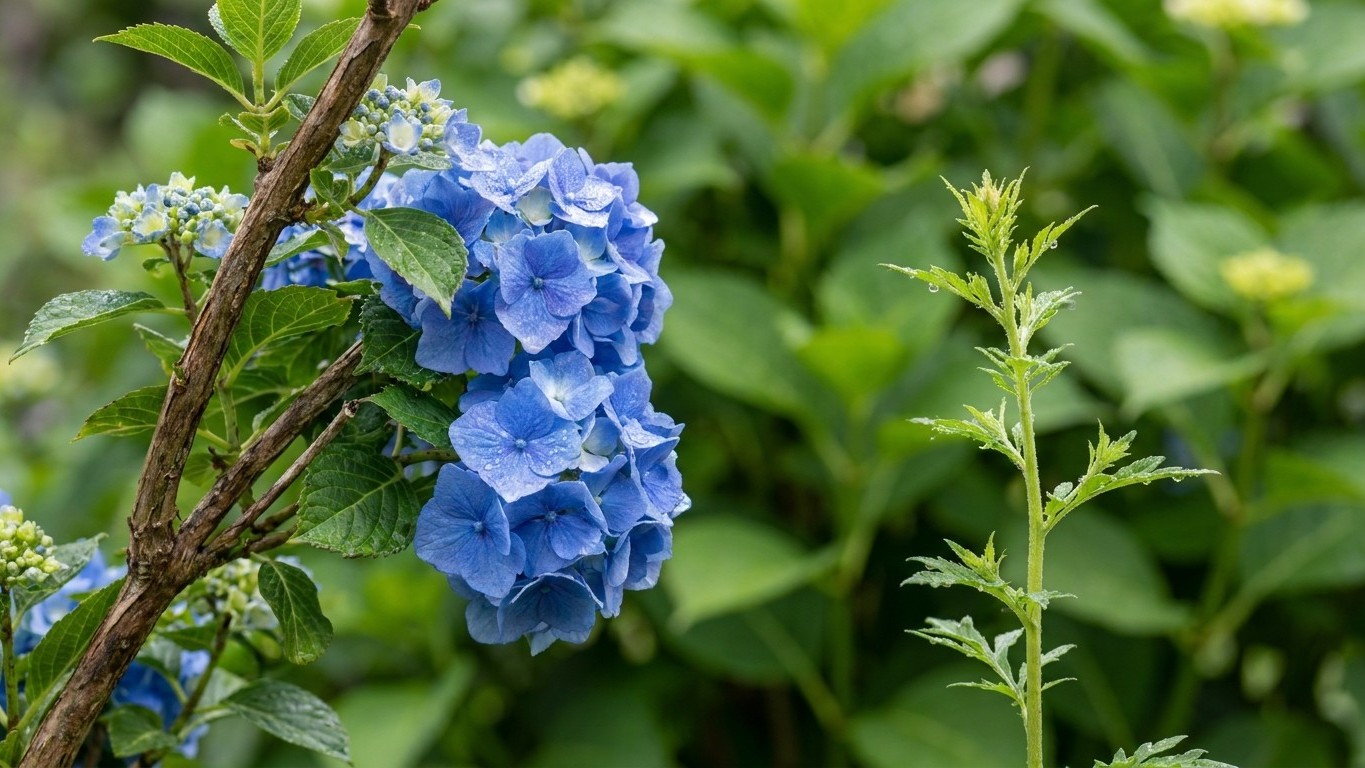

Colorado soil is alkaline, and alkaline soil keeps aluminum locked away from hydrangea roots. Without aluminum moving into the plant, bigleaf hydrangeas open pink. Blue takes two things: a lower soil pH and aluminum the plant can absorb, both held steady through the growing season. That is doable in containers and small beds, but the shift is gradual. Expect one to two seasons, not one weekend. White types never change at all.
What this comes down to in Colorado

In Denver, the last spring frost falls between May 1 and May 11 and the first fall frost between September 30 and October 12 (NOAA NCEI 1991-2020 Climate Normals, 32F freeze probabilities in the 30-70% band). Every blue-flower project has to fit inside that stretch, and it is shorter than it sounds.
Count it out. From the later end of the spring window to the earlier end of the fall window is about 20 weeks. From the earlier spring date to the later fall date, about 23. That is the entire span in which a bigleaf hydrangea leafs out, takes up whatever the soil offers, and sets the buds that will flower later.
Why the soil pushes toward pink
Hydrangea flower color is chemistry. Aluminum in the plant produces blue sepals, and its absence produces pink. The plant can only absorb aluminum when the soil is acidic. Blue generally needs a pH somewhere around 5.5 or lower, while pink shows up as pH climbs toward neutral and beyond. Much of Colorado, the Front Range plains especially, sits well above neutral. Irrigation water in many towns is hard and alkaline too, so every watering nudges the pH back up.
The soil usually has plenty of aluminum. The pH just keeps it unavailable. So the usual fix is acidifying the root zone, not feeding the plant more metal. Aluminum sulfate does both at once, which is why it is the common choice, though it works fast and can burn roots if overapplied.
Where the frost window comes in
Frost affects color indirectly but decisively. Bigleaf hydrangeas flower on buds formed the year before, so a late freeze that kills those buds means no flowers to color at all. Treatments also have a calendar: they start when growth starts, after the spring window closes, and they need to finish well ahead of the fall one. The two sibling topics in this guide, Protecting Hydrangeas Through a Colorado Winter and When to Prune Hydrangeas in Colorado, cover bud survival. Color only matters once the buds make it.
Working it out for your own garden
A recipe that says “apply in spring” breaks the moment you move or a cold year delays everything. A method holds up better. It has three steps: find out where your soil stands, build a schedule backward from your frost window, then check the result against the flowers.
Step one: test before you treat
Pink flowers do not tell you the pH, only that the plant is not getting much aluminum. A soil test does. Your county extension office can point you to a testing lab, and a basic pH reading is cheap. Test the spot where the hydrangea actually grows, not the vegetable bed across the yard. If the reading is far above neutral, which is common in Colorado, expect to work for it. If it is already mildly acidic and the flowers are still pink, the issue is probably high phosphorus in your fertilizer, which binds aluminum. Switching to a low-phosphorus feed can help.
Step two: build the schedule backward
Start from the fall frost window, September 30 to October 12 in Denver. Subtract a cushion of about six weeks so the last treatment lands well before cold slows the plant down. That puts your final application between roughly August 19 and August 31. The six weeks is a reasonable planning margin.
Now work forward. Say new leaves are open by mid-May, a bit after the last spring frost window closes, and you apply every four weeks following the product label. Applications fall in mid-May, mid-June, mid-July and mid-August. That is four treatments, the last of them comfortably ahead of the cutoff. Delay the start to mid-June and the same four-week rhythm runs into mid-September, past your cushion, so you would drop the last round. A range minus a number of weeks gives another range, so treat these dates as a window, not a single day.
Step three: read the flowers
Color tends to shift in stages. Expect purple or a blotchy blend before true blue, often on a first-year treatment. Blooms that opened before you started will stay pink, because color is set as buds develop. Judge the results on the next flush of flowers, and retest the soil each spring. Colorado soil and water will pull the pH upward again if you stop.
What changes across the state
A single Denver number is a starting point. Colorado’s USDA hardiness zones run from 3b to 7b (USDA Plant Hardiness Zone Map, built only on average annual extreme minimum temperature), and that spread tells you how different the state’s gardens are. Denver sits at 5,280 feet on the plains. Mountain towns run far shorter seasons and can frost in July, so a bigleaf hydrangea there may never get the 20-plus weeks that Denver offers. In those places a container you can move to shelter makes more sense than a bed.
The western slope differs again. Lower valleys there tend to be warmer, which can lengthen the season, but many of those soils are also strongly alkaline and often irrigated with high-pH water. Color management there looks more like the Front Range than like the high country, and the season is simply different.
Elevation and the north-south tilt of the state move frost dates earlier or later. Soil is also not uniform. Some mountain and forested soils run less alkaline than the plains, and a few yards come close to neutral. Testing beats assuming. A neighbor two valleys over can get blue hydrangeas with no effort while you fight for every shade of lavender, and neither of you is doing it wrong.
The mistakes this state punishes

Planting too early is the first. A warm April afternoon tempts people into setting out hydrangeas before the May 1 to May 11 window has passed, and one 32F night can strip new growth or take next year’s buds with it. Wait for the window to close, or keep the plant in a pot that can come inside.
Second, dumping aluminum sulfate on dry soil. Water the plant thoroughly first, mix the product exactly as the label directs, and never use extra to speed things up. Too strong a dose burns roots, and in a short season a damaged plant costs you far more than a slow color change would.
Third, treating the wrong plant. White types such as ‘Annabelle’ and most panicle hydrangeas do not respond to pH, so no amount of aluminum will turn them blue. Check that you actually own a bigleaf before spending money.
Fourth, finishing late. Treatments that run into the fall frost window mostly stress the plant without coloring anything, since bud color has already been set. Stop on your backward-counted schedule.
Last, fixing color while ignoring cold. A bigleaf in an exposed Colorado spot can lose its flower buds every winter, and blue is irrelevant if there are no blooms. Pair any color plan with the basics in the main guide on growing hydrangeas in Colorado, and consider a container or a sheltered site.
Checking this against your county
The Denver frost window and the soil advice here are a starting point, not an instruction for your yard. Elevation, exposure and local water chemistry can change both. Call your county office of Colorado State University Extension, ask about soil testing and what typical pH looks like in your area, and compare the local frost dates they use with the Denver ones above. Then return to the state hydrangea guide for planting, pruning and winter care.
Common questions
Can I turn pink hydrangeas blue in a single season in Colorado?
Sometimes partly. Buds that are already formed keep their color, so the first season often gives purple or mixed blooms. A more complete blue usually shows in the second year, once the soil has stayed acidic through a full bud-setting period.
Will white hydrangeas turn blue if I acidify the soil?
No. White cultivars have no pigment that responds to aluminum. Only bigleaf and mountain hydrangeas shift between pink and blue, so check what you planted before changing anything.
Do coffee grounds or rusty nails work?
Not reliably. Coffee grounds add little acidity once they break down, and nails supply iron, not aluminum. In alkaline Colorado soil, a measured pH-lowering amendment and a soil test are far more dependable.
Will I have to keep treating the plant every year?
Most likely yes. Colorado’s alkaline soil and hard water raise the pH again over time, so retest each spring and repeat the schedule as needed. Growing in a container with acidic potting mix makes this easier to control.