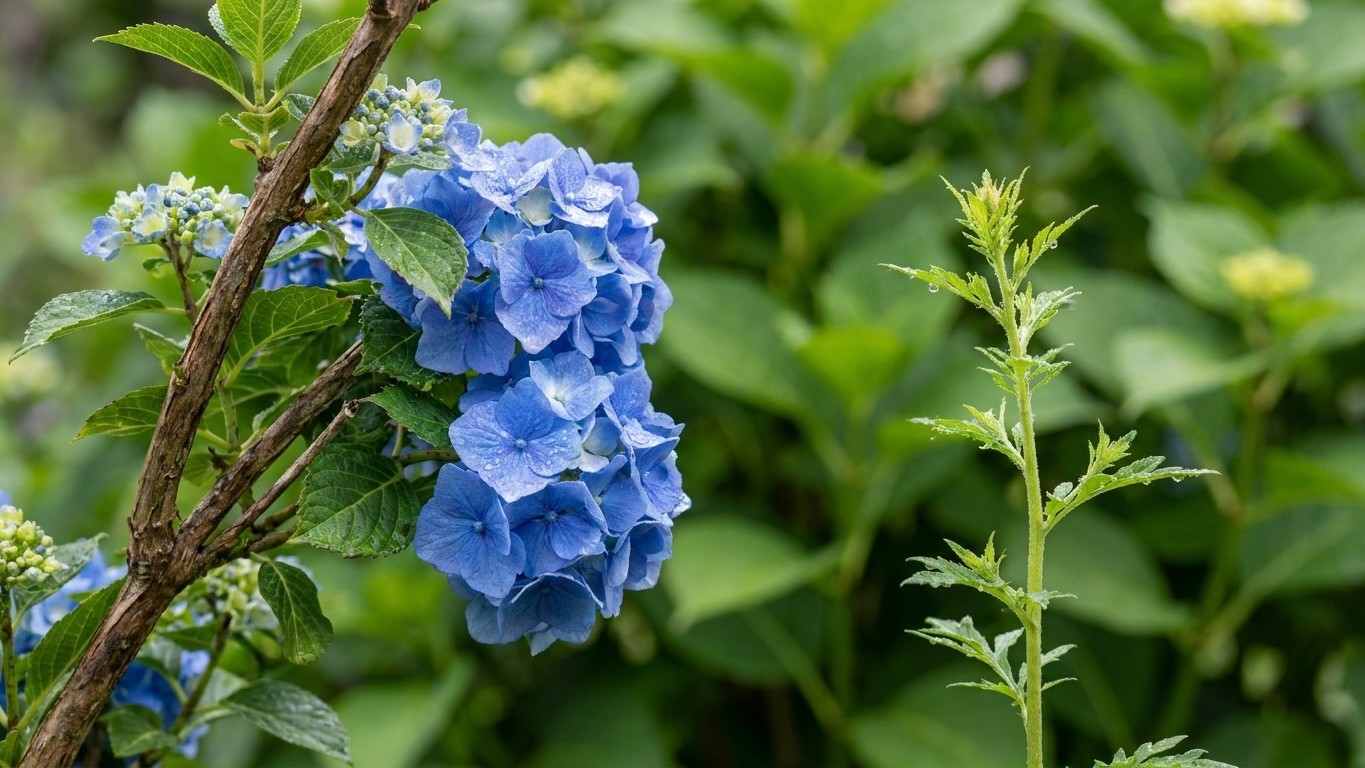

Most Colorado hydrangeas get through winter when three jobs are done: a deep drink before the ground freezes, a thick mulch over the crown, and some cover for the buds of types that bloom on old wood. The materials are cheap. Timing is the hard part, along with knowing which of your plants is actually at risk.
What this comes down to in Colorado
In Denver, the first fall frost lands between September 30 and October 12 and the last spring frost between May 1 and May 11, so a hydrangea there needs watching for roughly seven months of the year. Both ranges come from NOAA NCEI Climate Normals for the Denver station (station USW00003017) and mark the 30 to 70 percent probability band of a 32 F freeze, so any given year can fall on either side of them.
Seven months sounds grim, but cold alone rarely kills a hydrangea along the Front Range. Three other things do the damage, and each one calls for a different fix.
Flower buds on old wood
Bigleaf hydrangeas set next summer’s flower buds on stems that grew this year. Lose those stems to cold and the plant comes back green but flowerless, which is how many Colorado gardeners end up with a handsome shrub that never blooms. Panicle and smooth hydrangeas flower on the current season’s growth, so a winter that kills their tops costs them far less. Which group you grow decides how much effort protection deserves, and Which Hydrangeas Survive a Colorado Winter sorts the types.
Dry air and wind
Colorado winters are often sunny, windy and short on snow. Bare stems keep losing moisture to that dry air while roots sit in frozen, parched soil and can’t replace it. A hydrangea that goes into December thirsty can die back without ever seeing a truly brutal night. Snow cover, when it comes, insulates the crown. Bare ground does not.
Warm spells followed by a hard freeze
Front Range weather swings fast. A mild February afternoon can wake buds that a cold snap then burns, and the same pattern shows up in the weeks around the spring frost window. Damage from a cold night in April or early May is usually bigger than anything January delivered.
Working it out for your own garden
A date printed in an article is only as good as the city it was measured in. What lasts across moves and odd years is the method: anchor your calendar to your local frost window, then count outward from it.
Build the calendar from the frost window
Start with the fall side. Take the first-frost range for your nearest reference point (for Denver, September 30 to October 12) and subtract two weeks, which gives September 16 to September 28. That is when your supplies should be in the garage: mulch, burlap or frost cloth, stakes, wire for cages. Everything after that waits on the plant. Cover once leaves have dropped and a hard freeze has put the shrub to sleep, because wrapping a plant that is still growing invites rot.
Spring runs on the same arithmetic. Take the last-frost range, May 1 to May 11, and add a week of margin: May 8 to May 18. Keep frost cloth within reach until then. Peel off heavy mulch and wraps in stages as new growth shows, but leave the light cover ready for any night the forecast drops to 32 F.
Putting it together for one plant
Say you have a bigleaf hydrangea on the east side of a Denver house. Supplies are bought by mid-September. After the first freeze and leaf drop, you mound mulch over the crown and surround the stems with a wire cylinder stuffed with leaves or straw. Through winter, you water on any dry stretch when the soil is not frozen. Around the last-frost window, you pull the stuffing out in stages and keep cloth handy through mid-May. A panicle hydrangea next to it needs only the mulch and winter water, since its flowers form on new growth.
The same plan can fail in a different spot. In a mountain town where frost can show up in July, the window around your reference point means little, and the old-wood bigleaf may not be worth the effort at all. Colorado is a place where the right answer is sometimes to switch types.
Telling what kind of damage you have
Come spring, resist the urge to cut early. Hydrangeas leaf out late, and stems that look dead in April often produce shoots in May or even June. Scratch a bit of bark with a thumbnail. Green underneath means living wood. Brown and dry means that section is gone. Swelling buds on a stem that is green inside promise flowers on old-wood types. If the plant leafs out only from the base, the upper stems died and you will probably see few blooms this season.
What changes across the state
The Denver numbers above describe the plains at 5,280 feet. They are one reference point, and Colorado is not one climate. The USDA Plant Hardiness Zone Map, which rates zones on a single variable (the average annual extreme minimum temperature), puts the state anywhere from zone 3b to 7b. That spread is wider than you will find in most states.
Elevation and the mountain towns
Elevation moves the calendar more than anything else. Mountain towns run far shorter growing seasons than Denver, and frost can arrive in July. Fall protection there starts earlier and spring protection ends much later, to the point where the plains calendar is useless. Snow depth matters too. A reliable snowpack insulates plants through the coldest weeks, but it does nothing for stems standing above it.
The plains, foothills and western slope
Out on the eastern plains, the winter problem is more often wind and dryness than raw cold. Foothill gardens catch downslope winds and abrupt temperature swings. The western slope differs again, with its own pattern of milder lowlands and colder high valleys, so a Grand Junction gardener and a Gunnison gardener should not share a calendar. Aspect adds another layer within any single yard: a south wall bakes in winter sun and can wake plants too early, while a north-facing bed holds snow and stays dormant longer.
Without published local frost figures, the best proxy is observation. Note when your own first frost arrives and when your neighbors’ tender plants get burned in spring, then shift the Denver calendar accordingly.
The mistakes this state punishes
Mistakes made in fall
Letting the soil dry out is the most common one. Gardeners stop watering when leaves drop, but a Colorado fall can be dry for weeks. Give the root zone a deep soaking before the ground freezes, and again during any long snowless stretch when it thaws. Mulching too early is the opposite error: pile it on during a warm October and you create a cozy home for rodents and a damp crown. Wait for the freeze. Pruning old-wood bloomers in fall is a third trap, because cutting those stems removes next year’s flowers.
Mistakes made in spring
Uncovering during a warm spell is the classic one. A string of 60 F days in March or April makes protection feel pointless, then a cold night hits the exposed, swelling buds. Remove the heavy layers gradually and keep cloth ready until the frost window has closed. Cutting back too soon is the other mistake. Gardeners see bare brown stems and clear them in April, then discover in June that half of them were alive. And late fertilizing, which pushes soft growth right before the first frost, sets plants up for the same kind of dieback that careful mulching was meant to prevent.
Checking this against your county
A state-wide figure is a starting point, not an instruction. Denver’s frost window will be wrong for a canyon neighborhood, a high mountain town or a western slope orchard valley. Colorado State University Extension has county offices that know local frost patterns, soil and wind, and can often tell you what has worked in your neighborhood. For plant selection and everything beyond winter, the state guide to growing hydrangeas in Colorado covers the rest. If you are also fighting pink flowers where you wanted blue, Why Hydrangeas Are Pink in Colorado, and How to Turn Them Blue explains the soil side.
Common questions
When should I cover my hydrangeas in Colorado?
Wait until the first hard freeze has arrived and the leaves have dropped. In Denver, the first fall frost lands between September 30 and October 12, so covering usually happens in the weeks after that range. Have supplies ready in the weeks before it.
Do I need to protect panicle hydrangeas?
Much less than bigleaf types. Panicle hydrangeas flower on new growth, so mulch around the base and winter watering are generally enough. Save the wire cages and stuffing for old-wood bloomers.
When can I take the winter protection off?
Remove it in stages as growth appears, and keep light frost cloth available until the last-frost window closes. For Denver that window runs from May 1 to May 11, so mid-May is a safe margin. Gardeners at higher elevations should wait much longer.
My hydrangea looks dead in April. Should I dig it up?
No. Scratch a stem with your thumbnail and look for green, and wait until late spring before pruning. Hydrangeas are slow to leaf out, and stems that look dead often produce shoots later. If nothing has appeared by early summer, then cut back to the lowest green wood.