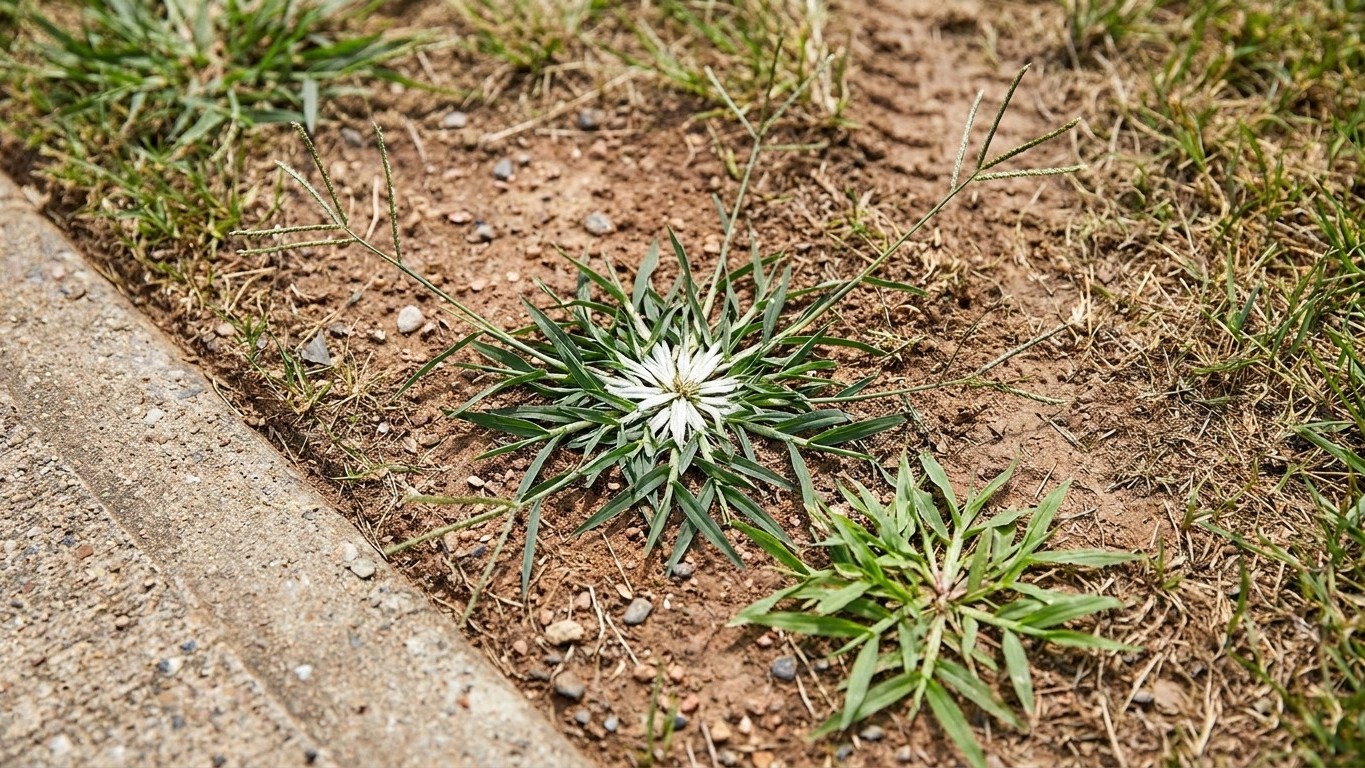

Mow tall fescue at 3 to 3.5 inches, Kentucky bluegrass at 2 to 3, perennial ryegrass at 1.5 to 2.5, and zoysiagrass or bermudagrass at 1 to 2. Colorado lawns are a mix of cool-season and warm-season grasses, so the right number depends on which one you actually have. Cut a fescue lawn at bermudagrass height and you scalp it. Do the reverse and you get a shaggy, matted mess. Identify the grass first, then adjust for heat, rain and frost.
The mowing height for Colorado lawns
For turf purposes, Colorado sits in the transition zone, and that shapes everything about the grass choice. Neither family wins. A cool-season lawn looks good in May and October but suffers in July. A warm-season lawn handles the heat well but is brown from October to April. Nobody can name one best grass for the state, so this page gives the height for each species you are likely to be mowing.
Cool-season grasses
Tall fescue wants the tallest cut at 3 to 3.5 inches. Kentucky bluegrass sits at 2 to 3 inches. Perennial ryegrass takes the shortest cut of the three, at 1.5 to 2.5 inches. If your lawn is a blend of these, as many seed mixes are, the mower setting needs to land where the ranges overlap, which is roughly 2.5 to 3 inches for the bluegrass and fescue share.
Warm-season grasses
Zoysiagrass and bermudagrass are the opposite temperament. Both are mowed at 1 to 2 inches, which looks almost scalped next to a fescue lawn. They spread by runners and form a dense, low mat, so a taller cut just lets them get stemmy and thatchy.
| Grass | Season type | Mowing height |
|---|---|---|
| Tall Fescue | Cool-season | 3 to 3.5 inches |
| Kentucky Bluegrass | Cool-season | 2 to 3 inches |
| Perennial Ryegrass | Cool-season | 1.5 to 2.5 inches |
| Zoysiagrass | Warm-season | 1 to 2 inches |
| Bermudagrass | Warm-season | 1 to 2 inches |
These ranges come from land-grant extension publications, including Clemson Cooperative Extension, K-State Research and Extension and University of Missouri Extension, and each figure sits inside the range those sources give. The gap between the families is wide, more than an inch at the closest point. That is why checking your species before touching the deck lever matters more than any fine-tuning afterward.
Raising the deck when the heat comes
Why July is the month to go tall
Cool-season grasses are under the most stress in July, so that is when the top of the range earns its keep. Set tall fescue at 3.5 inches, bluegrass at 3, ryegrass at 2.5. Longer blades shade the soil, which slows evaporation, and a lawn that is not scalped keeps more leaf to feed its roots. Warm-season lawns do not need the same rescue. Bermudagrass and zoysiagrass are growing hardest in summer, so they stay within their 1 to 2 inch range and simply get mowed on schedule.
What the rainfall numbers say, and what they hide
NOAA NCEI Monthly Climate Normals for 1991-2020, taken at the Denver reference station, show about 5.7 inches of rain across June, July and August, out of 14.5 inches for the year. Month by month it is 1.94 in June, 2.14 in July and 1.58 in August, which makes August the driest summer month. That is not much water for a lawn, and it is what the region can usually expect, not a forecast for any particular summer.
The number never works alone, though. Soil changes what an inch of rain does. On sand, rain drains through within the day. Clay holds it for about a week. A sandy yard can need watering far more often than the rainfall total suggests. Heat matters just as much: days at or above 90°F pull moisture out of the ground quickly, and when summer rain comes as one thunderstorm, much of it runs off instead of soaking in.
These are normals for a single station, not for the whole state. A foothills slope, a rain shadow or a hot city block can differ a lot from them. A cheap rain gauge in your own yard settles the question better than any regional average, and a screwdriver pushed into the soil tells you how far the water went.
The one-third rule, and why it is not arbitrary
What happens when you cut too much
The rule says never remove more than one third of the blade height in a single mowing. Grass blades are the plant’s solar panels. Take off too much and the plant has to burn stored energy to regrow leaf, and root growth stalls while it does. In summer, with roots already working against heat, that setback shows up as thin, pale turf.
Doing the arithmetic
The math turns the rule into a mowing schedule. A tall fescue lawn kept at 3.5 inches should be cut when it reaches about 5 inches, which means removing roughly 1.2 inches. Bluegrass kept at 3 inches gets cut at 4.5. Bermudagrass kept at 2 inches gets cut at 3. The lower you mow, the more often you have to mow, because the buffer is smaller.
A missed week or a rainy stretch is where people get into trouble. If the grass has outgrown the one-third limit, do not cut it straight back to the usual height. Lower the deck in stages, with a couple of days between passes. The basics of keeping a regular routine are covered in Mowing a Lawn, and lawns elsewhere follow the same arithmetic with different species, as in How High to Mow a Lawn in Pennsylvania and How High to Mow a Lawn in North Dakota.
The first and last cut of the year
Starting in spring
Start mowing when the grass is actually growing, not on a calendar date. At the Denver reference station, NOAA NCEI 1991-2020 normals put the last spring frost between May 1 and May 11 (that is the 30-70% probability band for a 32°F freeze). Cool-season grass tends to start moving before the frost risk is gone, so the first cut may come earlier. Keep it high, near the top of your species range, and resist the urge to scalp off winter-dead growth. Warm-season lawns green up later. Do not mow zoysiagrass or bermudagrass until they have begun growing again.
Finishing in fall
The same station’s normals put the first fall frost between September 30 and October 12. Keep mowing as long as the grass keeps growing. For the final cut, drop toward the lower end of your species range, but stay inside it. Leaving cool-season grass too long going into winter invites matting, and cutting below the range just stresses it. Warm-season lawns will already be browning by then, and with no growth, there is nothing to mow until spring.
Those dates describe one plains station at 5,280 feet, not the whole state. Mountain towns run much shorter growing seasons and can see frost in July, and the western slope is different again. For your own area, Colorado State University Extension is the place to check local conditions.
Common questions
Can I mow tall fescue shorter to cut down on mowing?
Shorter cuts mean more frequent mowing, not less, because the one-third rule leaves a smaller buffer. Tall fescue is happiest at 3 to 3.5 inches, so staying there is the easier path.
What height works for a mixed lawn?
Mow for the grass that dominates, and stay where the ranges overlap. For a bluegrass and fescue mix, that is around 2.5 to 3 inches. Avoid dropping to warm-season height unless the lawn is mostly bermudagrass or zoysiagrass.
Do I need to raise the mower in July for every grass type?
No. Cool-season grasses benefit from the top of their range in summer. Bermudagrass and zoysiagrass grow hardest in the heat, so they stay at 1 to 2 inches.
Do these heights change with elevation?
The heights here are set by species, and nothing in these figures shifts them with altitude. What changes in the mountains is the calendar, with a shorter season between frosts.