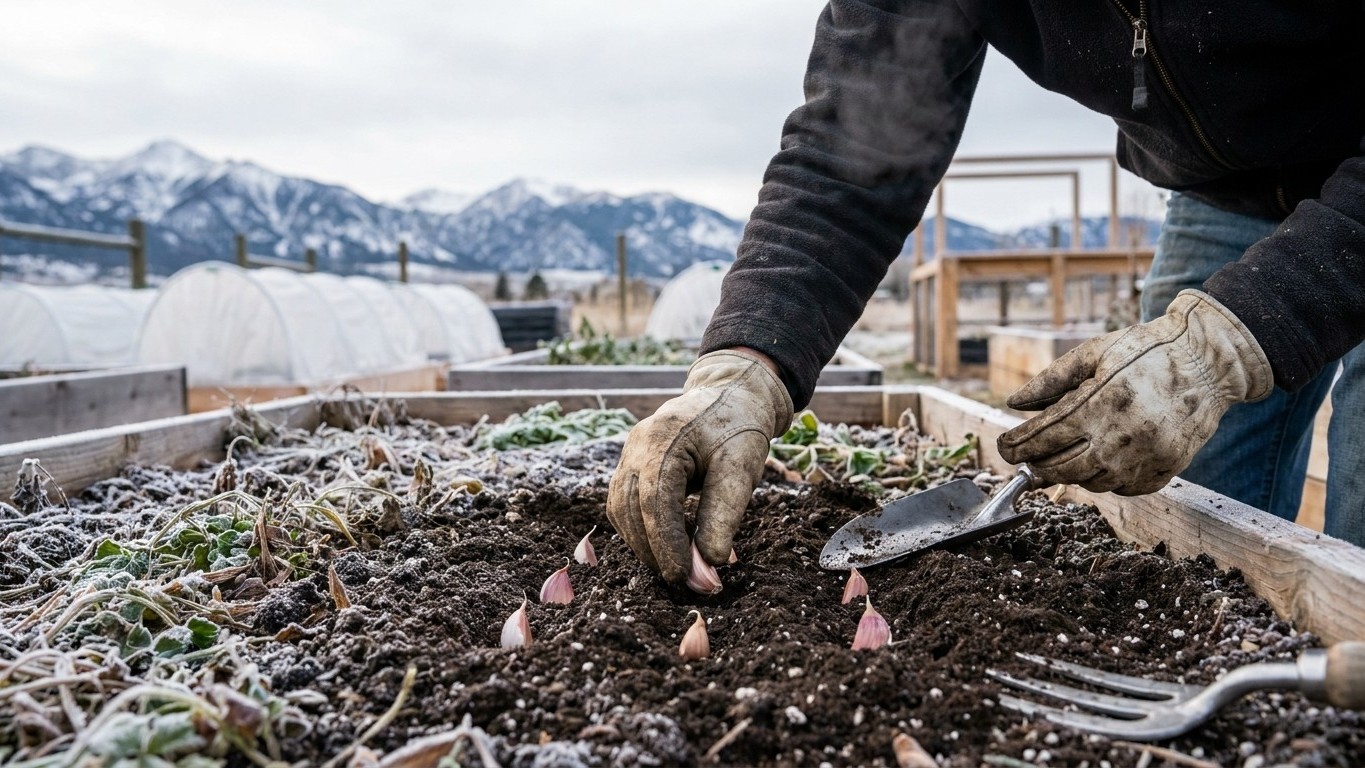

Across most of Colorado, the growing season closed weeks before November arrives. At the Denver reference station, the first fall freeze lands somewhere between September 30 and October 12, so by November the direct-sow window is shut for anything tender. What still goes in: garlic and shallots where soil remains workable, hardy greens under cold frames or low tunnels, bare-root and dormant plants, and forced rhubarb or chicory indoors.
What goes in the ground in November

The calendar says November, but the soil doesn’t care what the calendar says. What matters is whether the ground has already frozen solid, and across the Colorado plains it usually has. NOAA’s 1991-2020 Climate Normals put the first fall freeze at the Denver-area reference station somewhere between September 30 and October 12, which means the open-ground season has typically closed a full three to five weeks before November even begins. Higher up, in the mountain towns, that window shuts earlier still, and some of those valleys have already seen a hard frost by mid-summer in a cold year. The western slope runs on its own clock again, shaped by elevation and by the Colorado River corridor rather than by anything happening on the plains.
So the honest answer for most of the state is that nothing new goes into open, unprotected ground this month. That’s not a gap in the guide, it’s the reality of a 3b-7b hardiness range where the coldest pockets see extreme minimum temperatures that few vegetables are built to survive.
What still works: garlic and shallot cloves can go into beds that haven’t frozen hard yet, since both need a cold period to form properly and root in before the ground locks up. Cold frames and low tunnels extend the season for cold-hardy greens like spinach, mache, and claytonia, essentially creating a warmer microclimate over a small patch of ground. Bare-root fruit trees, roses, and berry canes can be planted while dormant, provided the site drains well and the hole can still be dug. And two old kitchen-garden tricks pay off indoors right now: forcing chicory roots in a dark box for tight, blanched heads, and forcing rhubarb crowns in a warm, dark spot for an early stalk harvest weeks ahead of anything outdoors.
What to start under cover
Counting backward from the frost window is the only arithmetic that matters here, and in November that arithmetic works against most seed starting. Take tomatoes or peppers, both usually started indoors six to ten weeks before the last spring frost. With the last frost at the Denver reference station falling between May 1 and May 11, that puts the sensible sowing window in mid to late winter, not now. Start those long-season crops in November and you’ll end up with rootbound, leggy transplants sitting under lights for months before the ground is anywhere near warm enough to receive them.
That doesn’t mean the grow lights sit idle. Under-cover sowing this month makes sense for crops meant to live their whole cycle indoors or under protection: microgreens and sprouts, which are ready in one to three weeks regardless of the season outside, and quick-cycling greens like lettuce or mustard sown for a cold frame rather than the open bed. These can be timed on a short loop, sow, harvest, resow, without any need to reference the spring frost date at all.
The other failure mode worth naming is starting too late. Onions and leeks, which need ten to twelve weeks of indoor growth before they’re sturdy enough to transplant, have to be started well before spring if they’re going to size up properly by the time the ground opens. November is early for that clock too, but it’s the month to line up seed, trays, and a light source so that late-winter start doesn’t get missed. Getting the timing right means working backward from May 1 to May 11, not forward from today’s date.
What is ready to pick
Outdoors, the harvest has mostly wound down by November across the state, since the first fall freeze has already passed for the plains and passed even earlier at elevation. That’s not a failure of the garden, it’s just where the season sits. What still feeds a household comes from three places: what’s been tucked under cover, what’s stored, and what’s grown indoors on purpose.
Kale, leeks, and Brussels sprouts often hold in the garden under a blanket of snow, and cold actually improves their flavor by converting starches to sugars. A cold frame with spinach, mache, or arugula planted earlier in the fall can keep producing small pickings right through the cold months, as long as the cover keeps wind and hard freezes off the leaves. Indoors, sprouts and microgreens fill the gap on a one to three week cycle, giving fresh greens with no dependence on outdoor weather at all.
Stored crops need checking now, not later. Winter squash should feel firm with no soft spots near the stem, since a soft patch there usually means rot is already working inward. Potatoes stored in a dark, cool spot should be checked for any that have started sprouting or gone soft, and pulled before they spread trouble to the rest of the bin. Onions are the crop to watch closest, since one going soft in storage can take neighboring onions with it if it isn’t caught and removed.
The jobs that matter this month
A dormant garden isn’t an idle one. The work that happens now sets up everything that comes after, and skipping it doesn’t cost this week, it costs the whole next season.
Structural work while things are bare
Dormant pruning of fruit trees and berry canes is easiest to do now, while there are no leaves hiding the branch structure and the plant isn’t actively pushing sap. Cutting back canes, removing crossing branches, and shaping young trees now heals cleaner than pruning during active growth. It’s also the month to repair raised beds, mend fencing that’s been sagging all season, and fix anything that a summer of use knocked loose, before frozen ground or snow makes that work miserable.
Planning work that has a deadline
Seed ordering has a real clock attached to it. Popular varieties, especially heirloom tomatoes and specialty peppers, sell out of seed companies’ stock well before spring, and ordering now beats scrambling in February for a variety that’s already gone. This is also the natural point to sketch out next season’s crop rotation, since the beds are empty and it’s easier to remember what grew where without a plant blocking the view.
Soil work that needs time to act
A soil test now gives results back before spring planting decisions have to be made, and any amendments recommended, lime, sulfur, compost, have the whole winter to work into the soil rather than being rushed in at the last minute. Turning the compost pile, even in cold weather, keeps the pile from going anaerobic and speeds up what’s ready to use by spring. And cleaning and sharpening tools now, rather than reaching for a rusty, dull hoe in March, is the kind of five-minute job that always gets skipped until it’s needed.
What not to do in November
The classic mistake this month is trusting a warm afternoon over the calendar and the soil thermometer. A stretch of 60-degree days on the Front Range can feel like an invitation to plant, but the first fall freeze has typically already happened by the time November starts, and one more cold snap is normal, not a fluke. Anything tender put into the ground now is a gamble against odds that don’t favor it.
The same mistake shows up in reverse with row covers and cold frames: a mild week convinces a gardener to pull the cover off hardy greens to “let them breathe,” and then a freeze comes through and undoes weeks of protected growth. Covers exist for exactly the swings this month brings, and pulling them at the first sign of sun defeats the purpose of having put them on.
Fertilizing is the third trap. Nitrogen applied now, whether to lawns, perennial beds, or dormant fruit trees, can push a flush of tender new growth right before a hard freeze, and that new growth is the part most likely to die back and weaken the plant going into winter. If soil test results call for lime or sulfur, apply those now since they need time to shift pH slowly. Save the nitrogen feeding for when the plant is actually growing again, not when it’s shutting down for the season.
Checking this against your own county
Every date and range here comes from one reference station on the plains near Denver, sitting at 5,280 feet. A garden in a mountain valley, on the western slope, or tucked into a river bottom can run weeks ahead or behind that station’s frost windows, and Colorado’s 3b-7b hardiness range makes clear just how much the state varies from one elevation to the next. Treat this page as a starting point, then check it against local conditions.
The Colorado State University Extension service is the best next stop, since county-level offices track local frost patterns and can point to a planting calendar tuned to a specific area rather than a single statewide station.
Common questions
Can I still plant garlic in November in Colorado?
Yes, as long as the soil hasn’t frozen solid. Garlic cloves need a cold period to form bulbs properly and benefit from a few weeks of root growth before the ground locks up, which makes them one of the few crops that still make sense going into the ground this month.
Is it too late to start seeds indoors for spring in November?
For long-season crops like tomatoes and peppers, yes, it’s too early rather than too late. Counting back six to ten weeks from a last frost of May 1 to May 11 points to mid-to-late winter starts, not November. What does make sense now is sowing quick-cycling greens, microgreens, or sprouts meant to be harvested indoors or under a cold frame.
Why did my cold frame greens die after a warm week?
Pulling covers off during a mild spell is one of the month’s most common mistakes. Colorado’s frost pattern this time of year includes real swings, and a cold frame or low tunnel left uncovered during a warm stretch leaves plants exposed the moment temperatures drop again.
Should I fertilize my lawn or beds in November?
Hold off on nitrogen. It can trigger new growth right before a freeze, and that new growth is usually what dies back first and weakens the plant. If a soil test calls for lime or sulfur, those can go down now since they work slowly and benefit from a full winter to take effect.