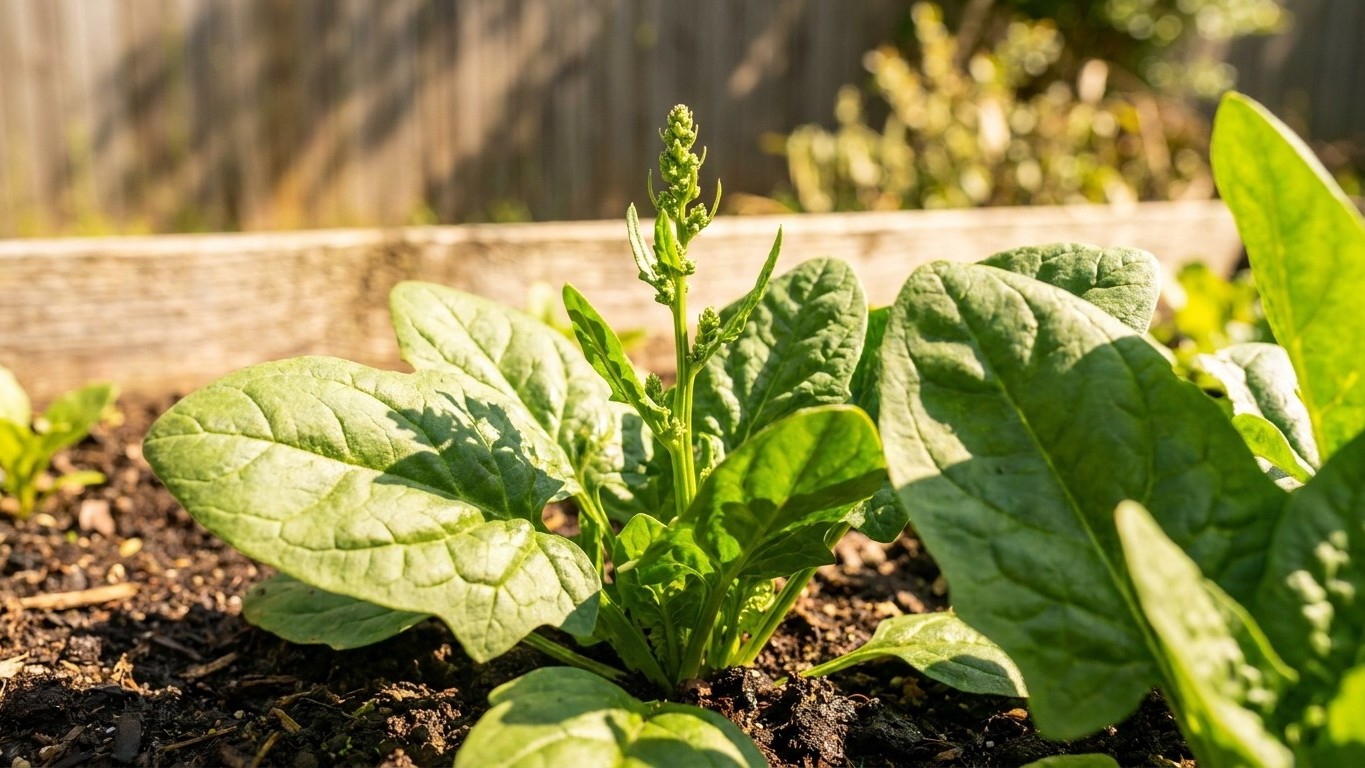

Cut spinach once the outer leaves are big enough to eat, and cut before the plant sends up a flower stalk. Across most of California that puts the harvest in the cool months. The exact weeks depend on how fast your soil cools in fall and how soon spring days lengthen. After the cut, the clock runs fast. Spinach holds for up to two weeks only at 32°F with very high humidity, and a home fridge delivers a shorter, messier version of that.
When spinach is ready in California
The plant gives the signal: leaves about as long as your hand, with the center still a tight rosette of small, upright leaves. Utah State University Extension advises planting a fall crop 50 to 75 days before the date you want to harvest, so count backward from the dinner you have in mind. Spinach is sown directly in the ground, so packet days count from sowing, not from any transplant date.
Frost dates matter less here than in most states. Along the coast and in Southern California, no freeze occurs in an average year. At the Los Angeles reference station, NOAA’s daily records show zero days at or below 32°F across 30 years, and the frost-free season runs the full 365 days. Northern California, the Central Valley and the Sierra do freeze, and there the fall and spring windows are bracketed by cold. Your county extension office can tell you the average frost dates for your town.
Warm soil, not cold, is what holds back an autumn sowing. Utah State reports that seed germination drops once soil climbs above 80°F, so in a hot region the window opens when the soil cools. The same source says spinach grows best where temperatures stay at or below 75°F. That number is both the growth ceiling and the point where leaves turn bitter. At the reference station, only 2.4 days a year reach 90°F or more (NOAA 1991-2020 Climate Normals). Inland valleys run hotter than that, and the heat shortens the season there.
Day length adds a second limit. The longest day at the reference station brings 14 h 16 of daylight. Long days trigger flowering in spinach along with warmth, so a mild coastal spring does not buy extra weeks once the days stretch out. If you want to see how that plays out, read Will Spinach Bolt Early in California?
| Area | Freeze | What limits spinach | Where cutting sits |
|---|---|---|---|
| Coast and Southern California | None in an average year | Warm soil at sowing, then lengthening days and spells above 75°F | The cool months, from when soil drops below 80°F until days lengthen |
| Central Valley | Yes | Summer heat, plus winter cold snaps | After fall soil cools, ending as spring warms |
| Sierra and high ground | Yes | Cold at both ends of the season | The cool stretch between hard freezes; ask your county extension office |
Keeping it, and for how long
UC Davis Postharvest Technology Center, in its spinach fact sheet, puts the optimum at 32°F with a relative humidity of 95-98%. It also says spinach is highly perishable and will not maintain good quality for more than 2 weeks. That is a ceiling for ideal conditions, and it is a poor basis for a plan. A garden harvest that sits in a normal kitchen should be eaten much sooner.
What happens after 10 to 14 days?
The same UC Davis sheet says problems become likely to increase after about 10 to 14 days, even at the optimum. Three things show up:
- Wilting, as the leaves lose water faster than they can hold it.
- Yellowing, which starts at the edges and works inward.
- Decay, usually first in the crushed or wet spots at the bottom of the pile.
UC Davis adds that these happen faster at common distribution conditions of 41 to 50°F. That temperature range matters at home, because it is roughly where many kitchen fridges run, especially in the door and on upper shelves.
Why does humidity matter as much as temperature?
Spinach leaves are thin and have a lot of surface for their weight. In dry air they give up water quickly, which is why the target of 95-98% is so high. Air that damp is rare in a kitchen. You create it with a bag or a damp wrap around the leaves, since the fridge itself will not supply it.
The cut also starts a clock. A leaf sitting in the sun on a warm afternoon is already losing water before it reaches the kitchen. Cut in the morning while leaves are cool and full, and get them into the fridge soon after. Check the leaves as you go. Chewed edges or holes mean something else harvested first, and What Eats Spinach in California, and When covers who it usually is.
For planning, treat the two-week figure as the outer edge. Spinach cut on a Saturday is at its best for the first several days, and meals built around it should come early in the week. If the fridge runs closer to 41°F than 32°F, expect yellowing sooner. A sensible habit is to cut only what you will eat in a few days, and to cut again when you need more, since a healthy plant stays in the ground until it bolts.
Where in the house that actually is
A home fridge runs warmer than 32°F, and the door runs warmer than the shelves because it takes the warm air every time it opens. A cold fridge usually keeps food a few degrees above freezing, so no shelf reaches the optimum. The closest is the back of the bottom shelf, away from the door, and that is where spinach should go. Keep it away from the very back wall if your fridge has a cold spot that freezes lettuce.
The crisper drawer works if it has a humidity slider. Set it to the high-humidity side and the drawer holds moisture around the leaves. A drawer with no control is still better than the door, but add a bag.
For humidity, the practical options are simple:
- Loosely bag the leaves in a perforated or slightly open plastic bag.
- Wrap them in a damp (not dripping) towel or cloth before bagging.
- For whole plants cut at the base, stand the cut ends in an inch of water and drape a bag loosely over the tops.
Each method does the same job, which is to keep the air around the leaves close to saturated. Water standing on the leaf surface is a different matter. Soaking wet leaves packed tightly in a closed container will decay at the crushed spots, so shake off extra water before storing. Wash just before eating, or wash earlier and dry well.
Check the bag every other day. Pull out any yellowing or slimy leaves right away, because decay spreads through a pile. A paper towel tucked inside absorbs excess moisture and can be swapped when it gets soggy. If you skip the cold shelf and the damp wrap and leave the bunch in the door, expect yellowing in days.
Common questions
Can you cut spinach more than once?
Yes, until it bolts. Take the outer leaves and leave the center growing, and the plant keeps producing in cool weather. Once a flower stalk rises, the leaves turn bitter and the plant has given what it will.
How many days from sowing to the first cut?
The seed packet for your variety is the best guide, and the count starts at sowing. For a fall crop, Utah State University Extension says to plant 50 to 75 days before the date you want to harvest. Local conditions shift this, so watch the leaves and cut when the outer ones are about hand-long.
Which spinach varieties can you grow?
Utah State University Extension names several suitable varieties. Check each packet for its days from sowing and any note about bolting. Variety matters most in warm weather, so check the packet before you buy.
Is spinach bitter when it gets warm?
Often, yes. Spinach grows best where temperatures do not exceed 75°F, and that is also the point where bitterness shows up. Long days and warmth together trigger flowering, and leaves cut after bolting usually taste sharp. If a leaf tastes bitter, cut the whole row and eat it soon.
The 32°F optimum is a cold-storage figure from a postharvest lab, and few kitchens match it. Most home fridges land in the range where UC Davis says spinach declines faster, which is the reason to eat what you cut within days.